
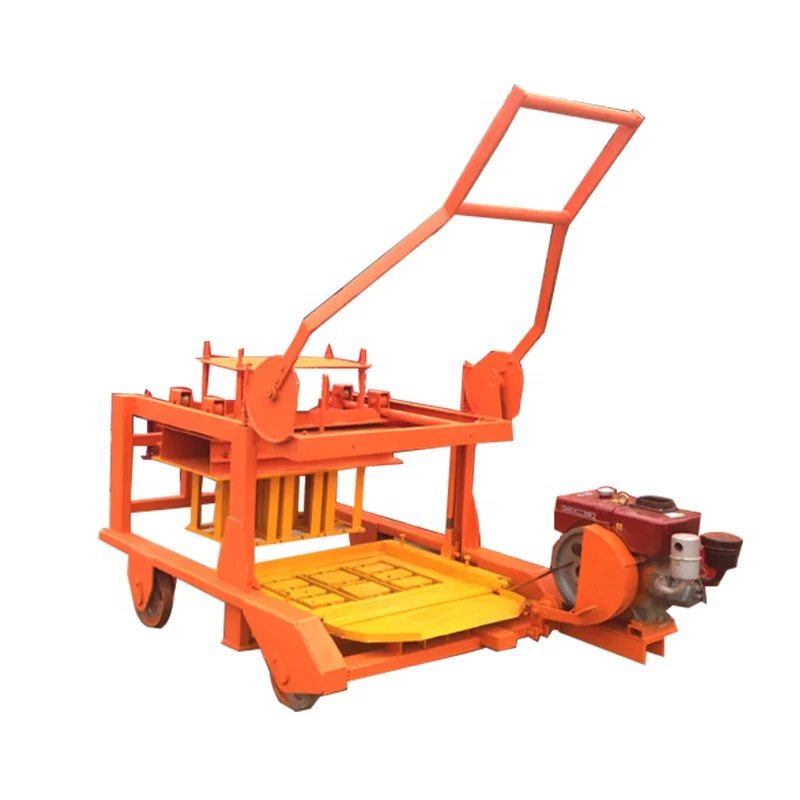
Matched line configuration — the QMR4-45 mobile block machine production line is quoted as a connected system with mixer and trolley, not just a standalone press.
Technical Specifications
| Parameter | Value |
|---|---|
| Model | QMR4-45 |
| Product Type | Mobile Concrete Block Making Machine |
| Overall Dimensions (L×W×H) | 1100 x 950 x 2100 mm |
| Net Weight | 810 kgs |
| Molding Cycle | 30–45 s |
| Power Source | Diesel / Petrol Engine / Electric |
| Output Capacity | 2560 pcs/day (basis not stated in source — confirm block format / material / thickness) |
| Automation Level | Manual pallet handling, mobile egg-laying type |
| Pallet Requirement | No pallet required |
| Mould Format | Paver brick, hollow block, concrete block, solid brick, fly ash brick |
| Warranty | 1 Year |
| Supporting Equipment | JZC350 Diesel Concrete Mixer or JQ350 Diesel Concrete Mixer (Electric Generating Unit); Trolley |
Application Suitability
| Application | Material or Output |
|---|---|
| On-site housing project block production | Hollow blocks and solid bricks from local crushed stone and cement |
| Remote infrastructure site manufacturing | Paver bricks and kerbstones produced directly on compacted ground |
| First-time block plant setup | Fly ash bricks and concrete blocks with minimal fixed investment |
| Mobile contractor operations | Solid blocks and hollow blocks relocated between project sites |
Why the Supporting Equipment Question Must Come Before the Press Price
A mobile block machine production line without a matched mixer and trolley is a press that spends half its shift waiting for material.
When I first started quoting these lines from the shop floor in Shandong, I would send out the press specification and assume the buyer already had a mixer on site. That assumption cost one West African contractor three weeks of idle time while he sourced a JZC350 locally at twice the price. A mobile block machine production line only earns its name when the mixer output, trolley transport, and press cycle are timed so the QMR4-45 is never left standing empty [NEED_CITE: equipment matching principles for small-scale block plants]. The egg-laying design already eliminates pallets and curing racks, so the material supply chain is the one variable that can still stall the entire operation.
How the Mixer, Trolley and Press Connect on Site
The JZC350 diesel mixer or JQ350 electric mixer sits at one end of the work area, batching concrete in small volumes that match the QMR4-45 molding cycle of 30 to 45 seconds. A trolley carries each batch to the press so the operator never walks away from the machine. This mobile block machine production line configuration means the entire setup fits within a small cleared area on a construction site, and the whole line can be relocated when the project moves to the next plot.
What Egg-Laying Design Removes from Your Site Layout
Because the QMR4-45 lays blocks directly on the ground, there is no pallet cost, no curing rack footprint, and no forklift traffic in the production zone. The operator simply advances the machine forward after each stroke, leaving a row of blocks to cure in place. For contractors working on housing developments where space is shared with other trades, this eliminates the dedicated curing yard that a static plant would demand [NEED_CITE: curing space requirements for static versus mobile block production].
Reading the QMR4-45 Specifications Against Real Site Conditions
The 1100 x 950 x 2100 mm overall dimensions mean the press passes through standard site gate widths and can be loaded onto a flatbed without special transport permits. The 810 kg net weight is light enough for two workers to reposition on uneven ground, yet heavy enough to provide the vibration resistance needed during the molding stroke. The diesel, petrol, and electric power source options let the line run on whatever fuel is available at the project location, which matters when grid power has not yet reached a new development site. The molding cycle of 30 to 45 seconds per stroke varies with block format — a thin paver brick completes faster than a deep hollow block, so the 2560 pcs/day figure must be confirmed against your specific block dimensions and mix consistency before it can be treated as a planning number.
What Happens When Line Timing Is Ignored
A mixer that batches too slowly forces the press operator to stop and wait, and those idle minutes compound across a shift into a daily output that falls well below expectation. I have seen contractors blame the press when the real bottleneck was an undersized mixer they bought locally to save on the initial quotation [NEED_CITE: common causes of output shortfall in mobile block operations]. The trolley capacity must also match the batch size so that each delivery fills the hopper completely — partial fills mean the next stroke produces an underweight block.
Why Source the Full Line from One Block Machinery Supplier
Block machinery is our single focus, so the QMR4-45, its moulds, the mixer, and the trolley are specified as one matched system rather than assembled from separate vendors. The configuration is set against your actual mix design and local aggregate, not a catalogue default. Mould drawings are provided for every block format your market sells, including custom drawings if your project requires a non-standard size. Voltage, frequency, and engine type are confirmed before production so the line runs on arrival, not after weeks of electrical rework.
Documentation & Verification
- Machine specification sheet listing QMR4-45 dimensions, weight, and power source options
- Line layout showing mixer placement, trolley route, and press advance pattern
- Mould drawing and format list for each block type in your production plan
- Voltage and engine specification confirmation signed against your site conditions
- Factory test record on your chosen block format before dispatch
- Packing photographs documenting the press, mixer, and trolley before container loading
Installation, Commissioning & Support
- Site ground preparation requiring a level compacted area sized to the 1100 x 950 mm machine footprint
- Power connection matched to your confirmed diesel, petrol, or electric supply specification
- Assembly of press frame, hopper, and mould at your site with bolt-tightening sequence provided
- First-run molding cycle adjustment to match your local aggregate and mix consistency
- Operator training covering mould change, daily greasing points, and trolley loading rhythm
- Wear parts list identifying the hydraulic seals and vibration springs to stock for the first year
What We Need from You to Size This Line Correctly
To build an accurate quotation, share the block formats your market demands, the daily output you are targeting, and the local aggregate and cement available at your project location. Confirm whether your site has grid power or whether a diesel engine is required for both the mixer and the press. Let us know the curing area dimensions so we can plan the egg-laying advance pattern.
Frequently Asked Questions
Q: How is the 2560 pcs/day capacity calculated, and which block format does it assume?
A: That figure is listed in the source documentation without a stated block format, material mix, or shift length. Before treating it as a planning number, we confirm your target block dimensions, wall thickness, and aggregate type, then recalculate based on the 30 to 45 second molding cycle applied to your specific format across your actual working hours.
Q: What mixer-to-press timing is needed so the QMR4-45 is never waiting for material?
A: The mixer must complete one batch within the time the press takes to process the previous batch, accounting for trolley transport. We match the JZC350 or JQ350 batch volume to the QMR4-45 hopper capacity so each delivery fills it completely, eliminating partial-fill strokes that produce underweight blocks.
Q: Which supporting equipment is included in the line quotation and which must be sourced locally?
A: The quotation covers the QMR4-45 press, your choice of JZC350 diesel or JQ350 electric mixer, and the trolley. Water supply, curing area ground preparation, and any block transport equipment for moving cured product to the stockyard are the buyer’s responsibility on site.
Q: Can the line be configured for diesel or electric depending on site power availability?
A: Yes. The QMR4-45 is available with a diesel engine, petrol engine, or electric motor, and the mixer has a corresponding diesel or electric option. We confirm your site voltage, frequency, and fuel availability before production so every component runs on arrival.
Q: What is the on-site curing and stacking arrangement when no pallets are used?
A: The egg-laying design leaves blocks on the ground where they are formed. The operator advances the press forward after each stroke, building rows of curing blocks. We provide a site layout showing the advance pattern so rows remain accessible for water curing and eventual collection by hand or wheelbarrow.


