
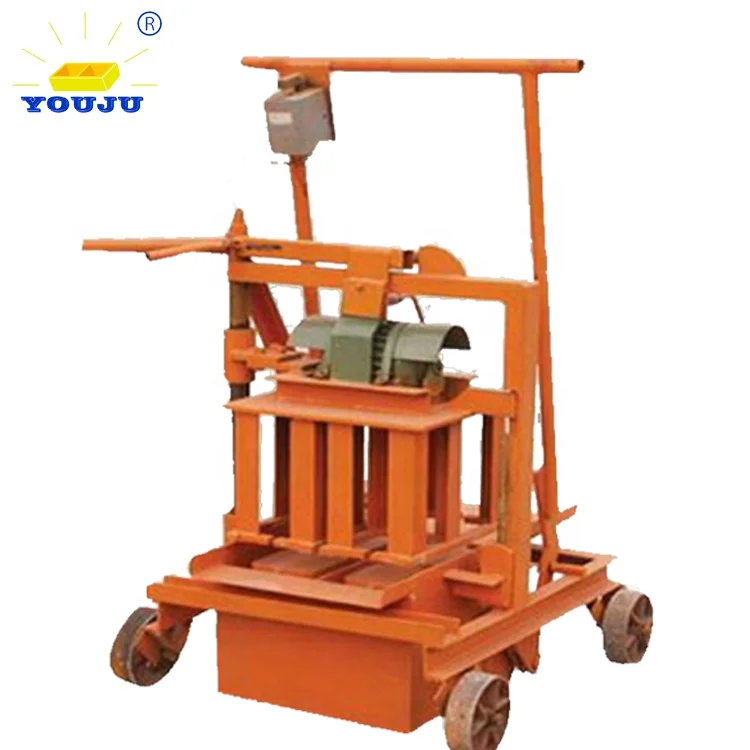
Single-focus block machinery supply — machine, mixer and curing area specified as one matched line so the press cycle is never starved of material.
Technical Specifications
| Parameter | Value |
|---|---|
| Product Type | Mobile Concrete Block Making Machine |
| Machine Model | QMJ2-45 |
| Machine Operation | Manual mobile, hand-pushed |
| Supported Block Formats | 400×200×200mm / 400×150×200mm / 400×100×200mm hollow brick |
| Molding Cycle | 25-30s |
| Output per Mould | 2 pcs (400×200×200mm) / 3 pcs (400×150×200mm) / 4 pcs (400×100×200mm) |
| Hourly Output | 160 pcs/h based on 400×200×200mm hollow brick |
| Daily Output | 1280 pcs/8hr based on 400×200×200mm hollow brick |
| Pallet Requirement | None (pallet-free operation) |
| Power Source | No diesel or external power required |
| Labor Requirement | 1 to 3 workers |
| Mould Change | Manual |
| Key Features | Pallet-free, hand-pushed mobility, no fixed plant installation required |
Application Suitability
| Application | Material or Output |
|---|---|
| On-site hollow block production | Crushed stone, cement, sand and water mixed for hollow brick formats |
| Small-scale block production in confined spaces | Hollow bricks produced directly on compacted ground without pallets |
| Low-investment block production | Multiple hollow brick sizes from a single press with manual mould change |
| Mobile production for construction sites | Hollow blocks produced and cured in place where grid power is unavailable |
Why Mixer Throughput Matters More Than Press Speed
A block press that waits for the next batch of wet concrete is a block press that is not producing.
I once watched a QMJ2-45 mobile block making machine production line sit idle for nearly a third of each shift because the pan mixer upstream could not discharge fast enough. The press itself cycled at 25-30 seconds per mould, but the crew spent most of that time waiting for the next barrow of mix. [NEED_CITE: material feed rate matching in manual block production] Quoted hourly output figures only hold when the entire feeding, mixing and delivery chain keeps pace with the press rhythm. That gap between a quoted capacity and real daily output is where most first-time block plant operators lose money.
Mapping the Complete Line Around the Press
The QMJ2-45 eliminates pallet handling entirely, which simplifies the downstream side of a mobile block making machine production line considerably. There is no pallet feeding station, no pallet return conveyor and no pallet curing rack to design into the layout. What remains is the raw material feed, the mixer, manual transport to the press and a ground-level curing area sized for the daily output volume.
Where Cycle Time Dictates Line Rhythm
Each block format changes the press throughput and therefore the demand on every upstream station. At 25-30 seconds per mould producing two pieces of 400×200×200mm hollow brick, the press consumes a specific volume of wet mix per hour that the mixer must match continuously. Switch to a four-piece 400×100×200mm mould and the material demand per cycle rises accordingly. [NEED_CITE: concrete mix consumption rates by hollow block format] The line layout must account for the highest-demand format the buyer intends to run, not the lowest.
Reading the Specifications for Line Design
The absence of external power dependency means the QMJ2-45 can operate where grid electricity or diesel generators are not available, but it also means every material movement around the press is manual. The mixer capacity, the distance between mixer and press, and the number of workers assigned to transport all become variables in the line equation. The supported block sizes — 400×200×200mm, 400×150×200mm and 400×100×200mm — determine mould inventory requirements and the time the crew spends on manual mould changes between production runs. The stated labour requirement of one to three workers covers the press itself; additional workers are needed for mixing and material transport depending on the site layout. Pallet-free operation removes a significant cost and logistics burden, but it also means every freshly pressed block must cure undisturbed on the ground where it was formed, so the curing area must expand with daily output targets.
The Cost of Overlooking Line Balance
A buyer who focuses only on the press quotation and treats the mixer, raw material feed and curing area as afterthoughts typically discovers the bottleneck during the first week of production. [NEED_CITE: common causes of downtime in mobile block production] The press idles while workers shuttle mix in insufficient batches, blocks cure in a space too small to hold a full day’s output, or a single mould format runs out of demand while the crew struggles through a manual mould change that takes longer than expected. These are not machine faults — they are line design gaps that surface only when production begins.
What We Build Into Every Line Proposal
Block machinery is our single focus, which means the QMJ2-45 is never quoted as a standalone item without the mixer and material handling that surround it. We configure the line against the buyer’s actual mix design and local aggregate rather than a catalogue default, so the mixer capacity and feed method match the press cycle from the start. Mould design covers the hollow brick formats the buyer’s market actually sells, with custom drawings available for sizes outside the standard range. The automation level is selectable — a buyer can begin with the manual QMJ2-45 and plan an upgrade path as production volume grows. Installation support includes line layout confirmation so that the curing area, mixer position and press operating zone are mapped before the equipment arrives on site.
Documentation & Verification
- Line layout drawing showing mixer, material feed and curing area positions relative to the QMJ2-45
- Capacity calculation stated per hollow brick format with mould change time included
- Mould drawing and format list confirming which block sizes ship with the machine
- Factory test record on the buyer’s specified block format before dispatch
- Operation manual covering manual mould change procedure and maintenance intervals
Installation, Commissioning & Support
- Ground preparation guidance for the curing area sized to daily output of 1280 pcs based on 400×200×200mm blocks
- Mixer placement recommendations to minimize manual transport distance to the QMJ2-45 press position
- First-day production run with operator guidance on the 25-30s moulding cycle rhythm
- Mould change training covering all supplied hollow brick formats and manual swap procedure
- Wear parts list with reorder intervals for mould liners and vibration components
- Daily maintenance checklist aligned with the manual operation and hand-pushed mobility design
Before You Send an Inquiry
To size a complete mobile block making machine production line around the QMJ2-45, share the hollow brick formats your market requires and the daily volume you plan to produce. Tell us about your local aggregate and cement supply, the available ground space for production and curing, and whether grid power is accessible for the mixer even though the press itself needs none. If you already own a mixer or material handling equipment, provide its capacity so we can confirm whether it matches the press cycle.
Frequently Asked Questions
Q: How do I verify real daily output for each block format?
A: Request a capacity calculation that states hourly and daily output separately for every hollow brick size you plan to produce, based on the 25-30s cycle and the number of pieces per mould. A single headline capacity figure without format breakdown does not account for mould change time or the different output rates across 400×200×200mm, 400×150×200mm and 400×100×200mm formats.
Q: What supporting equipment completes the line around the QMJ2-45?
A: The press requires a mixer sized to match its material consumption rate, a raw material feed method to keep the mixer charged, and a ground-level curing area large enough for a full shift’s output. Because the QMJ2-45 is pallet-free, no pallet feeding or return system is needed, which simplifies the line layout considerably.
Q: How does pallet-free design change the production layout?
A: Without pallets, blocks cure directly on the ground where they are pressed, eliminating pallet storage, pallet feeding stations and pallet return conveyors. The trade-off is that the curing area must be flat, level and large enough to hold blocks undisturbed until they gain sufficient strength for stacking.
Q: How do I match mixer output to the press cycle?
A: The QMJ2-45 completes a mould every 25-30 seconds, so the mixer and material transport crew must deliver enough wet concrete to fill each mould at that interval without gaps. Undersizing the mixer or placing it too far from the press creates idle time that reduces daily output below the quoted capacity.
Q: What documentation should the quotation include?
A: Before ordering, confirm that the quotation includes a line layout drawing, a capacity calculation per block format, a mould drawing and format list, and a factory test record. These documents ensure the supplier has matched the press, moulds and supporting equipment to your specific production requirements rather than offering a standard catalogue package.


