
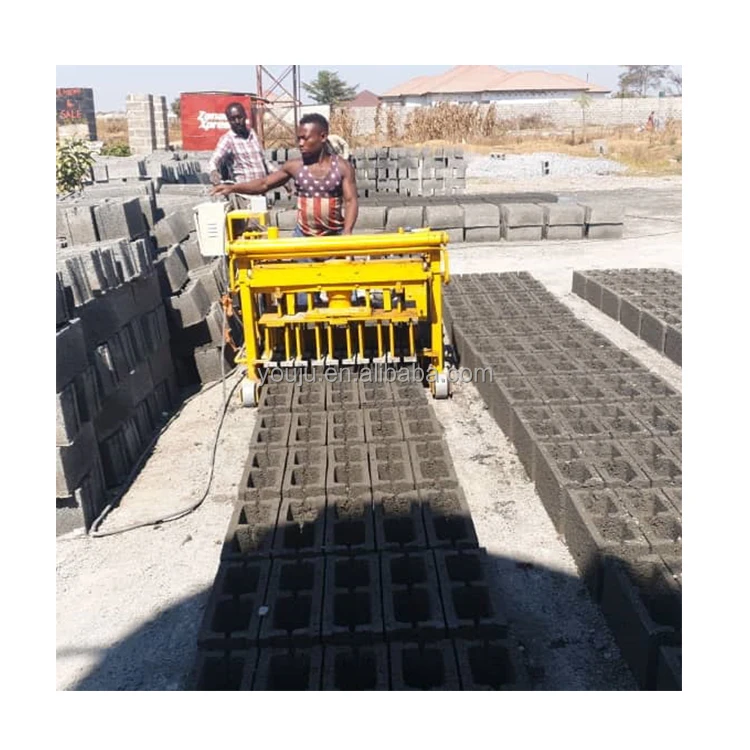
Matched Line Configuration — every output figure for the QMY4-30 states the exact block format assumed, so upstream mixing and curing logistics are sized against real throughput rather than catalogue peaks.
Technical Specifications
| Parameter | Value |
|---|---|
| Model | QMY4-30 |
| Product Type | Mobile Egg-laying Block Machine |
| Rated Power | 5 kW |
| Overall Dimensions (L×W×H) | 1200×1200×1100 mm |
| Net Weight | 950 kg |
| Moulding Cycle Time | 30 seconds |
| Output Capacity | 480 pcs/h based on 400×200×200 mm hollow block, 4 pcs/mould |
| Output Capacity | 600 pcs/h based on 400×150×200 mm hollow block, 5 pcs/mould |
| Output Capacity | 840 pcs/h based on 400×100×200 mm hollow block, 7 pcs/mould |
| Daily Output | 3,840 pcs/8h based on 400×200×200 mm hollow block |
| Daily Output | 4,800 pcs/8h based on 400×150×200 mm hollow block |
| Daily Output | 6,720 pcs/8h based on 400×100×200 mm hollow block |
| Mould Format | Hollow block and solid brick, standard sizes |
| Mould Change | Changeable moulds for different block formats |
| Automation Level | Semi-automatic / manual pallet handling |
| Raw Materials | Cement, sand, crushed stones, slag |
| Hydraulic Pressure | (basis to be confirmed) |
| Vibration Force | (basis to be confirmed) |
| Pallet Size | (basis to be confirmed) |
| Voltage & Frequency | (basis to be confirmed) |
| Control System | (basis to be confirmed) |
Application Suitability
| Application | Material or Output |
|---|---|
| On-site hollow block production for housing projects | Cement, sand, crushed stones — 3,840 to 6,720 pcs/8h depending on format |
| Construction contractor self-supply without a fixed plant | Local aggregate mixed with cement, laid directly on a prepared concrete floor |
| Start-up block yard with minimal infrastructure | Solid brick and hollow block formats, changeable moulds |
| Remote development sites with limited grid access | 5 kW rated power draw, mobile egg-laying operation |
Why the Mixer Sizing Question Comes Before the Machine Price
A 30-second moulding cycle means the upstream mixer must deliver a fresh batch every half minute, or the mobile block machine production line sits idle.
I once watched a contractor in Peru lose a full third of his shift output because the pan mixer feeding his egg-laying press could not discharge fast enough. The press cycled fine — it was the material supply that bottlenecked the entire operation. When you evaluate a mobile block machine production line, the press capacity is only one station. The mixer batch size, discharge rate, and raw material feed conveyor must all be calculated against the same 30-second cycle the QMY4-30 runs on. Skip that matching step and the daily output figures in any brochure become theoretical [NEED_CITE: line synchronization principles for concrete block production].
How Supporting Equipment Defines Real Throughput
The QMY4-30 presses a mould every 30 seconds, which translates to roughly 120 cycles per hour in continuous operation. That pace demands a mixer capable of delivering a consistent batch within that same window. On a mobile block machine production line, the raw material feed — whether a belt conveyor, a screw feeder, or manual wheelbarrow supply — must also keep the mixer hopper charged. If any upstream station falls behind, the press waits, and the per-format daily output drops proportionally.
Curing Logistics That Match the Press Output
An egg-laying machine deposits blocks directly on the ground or on a prepared slab, so the curing area must accommodate the daily volume the QMY4-30 produces. At 6,720 blocks per 8-hour shift on the 400×100×200 mm format, you need enough flat, shaded floor space to lay out that quantity without stacking wet units on top of each other. Water supply for curing, access paths for manual or forklift movement, and ambient temperature all shape how quickly blocks reach handling strength. Planning the curing footprint before the press arrives prevents a backlog that forces the operator to slow down [NEED_CITE: concrete block curing area sizing guidelines].
Reading the Specs That Actually Matter
The rated power of 5 kW tells you what electrical supply the site needs — confirm voltage and frequency against local grid standards before ordering, because a mismatch delays commissioning by weeks. The 1200×1200 mm footprint means the QMY4-30 operates in tight spaces, but that compact size also limits the hopper volume, so manual or semi-continuous feeding becomes part of the operator’s rhythm. Mould changeability between hollow block and solid brick formats gives scheduling flexibility, though each format swap requires a pause in production and a fresh mix adjustment if the aggregate ratio differs.
The Hidden Cost of Skipping Line Integration
When a mobile block machine production line is quoted as the press alone, buyers often discover after delivery that the mixer, material feed, and curing setup were never part of the conversation. The result is a machine that runs below its rated cycle time because the supporting stations cannot keep pace. Operators end up hand-stacking output, manually batching materials, or idling while waiting for the next mix — all of which erode the daily throughput the buyer based their project timeline on [NEED_CITE: common causes of block machine downtime on construction sites].
Why Procurement Here Covers the Full Line
Block machinery is the single focus of this operation, so the QMY4-30 is never specified in isolation. Configuration starts from the buyer’s actual mix design and local aggregate, not a catalogue default, which means the mixer and feed system are sized to match the 30-second cycle. Mould design covers the formats the buyer’s market actually sells, including custom drawings when standard sizes do not fit. Automation level is selectable — a buyer can begin with semi-automatic manual pallet handling and add feeding or stacking stations later as volume grows. Installation support includes on-site commissioning and operator training so the line runs correctly from the first shift.
Documentation & Verification
- Line layout drawing showing QMY4-30 placement relative to mixer and curing area
- Capacity calculation sheet stating block format assumed for each output figure
- Mould drawing and format list matching the buyer’s target product range
- Voltage and control language confirmation signed before production begins
- Factory test record captured on the buyer’s specified block format
Installation, Commissioning & Support
- 5 kW rated power requires a dedicated circuit matching confirmed voltage and frequency
- 1200×1200×1100 mm footprint needs a level concrete slab with drainage for wet curing
- Mould change procedure trained on-site so format switches fit within a shift schedule
- Semi-automatic operation means manual pallet or egg-laying workflow is demonstrated during commissioning
- Wear parts list provided with first-order consumables sized to the buyer’s daily output volume
What to Prepare Before Requesting a Quote
To size a mobile block machine production line around the QMY4-30, share the block formats your market demands, the daily volume your project requires, and the raw materials available on site. Confirm the local voltage and frequency, the language needed on the control interface, and whether existing mixers or conveyors will feed the press. If the site has space constraints or a specific curing area layout, include those dimensions so the line proposal accounts for every station.
Frequently Asked Questions
Q: How is capacity verified per block format, and what does the 30-second cycle assume?
A: Each output figure for the QMY4-30 is tied to a specific block dimension and mould cavity count. The 30-second cycle assumes a continuous material supply from an upstream mixer sized to match. If the mixer batch interval exceeds 30 seconds, actual throughput will fall below the stated capacity for that format.
Q: What supporting equipment must be matched so the press is not left idle?
A: Beyond the QMY4-30 itself, the mobile block machine production line needs a mixer with a discharge rate aligned to the 30-second cycle, a raw material feed method to keep the mixer charged, and a curing area large enough to receive the daily output volume without bottlenecks.
Q: How should voltage and frequency be confirmed for the target market?
A: Before the QMY4-30 enters production, the buyer must confirm local grid voltage and frequency. A mismatch discovered after arrival can delay commissioning significantly. This confirmation is documented as part of the order process and verified during the factory test.
Q: What pallet or curing arrangement works with this mobile machine?
A: As an egg-laying machine, the QMY4-30 deposits blocks directly on a prepared floor surface rather than on pallets. The curing area must be sized for the daily output of the chosen format, with adequate water access and shade to bring blocks to handling strength on schedule.
Q: Can the automation level be upgraded later?
A: The QMY4-30 starts as a semi-automatic unit with manual material handling. As production volume grows, upstream feeding conveyors, larger mixers, or additional line stations can be added without replacing the press itself, allowing the mobile block machine production line to scale with the buyer’s operation.


