
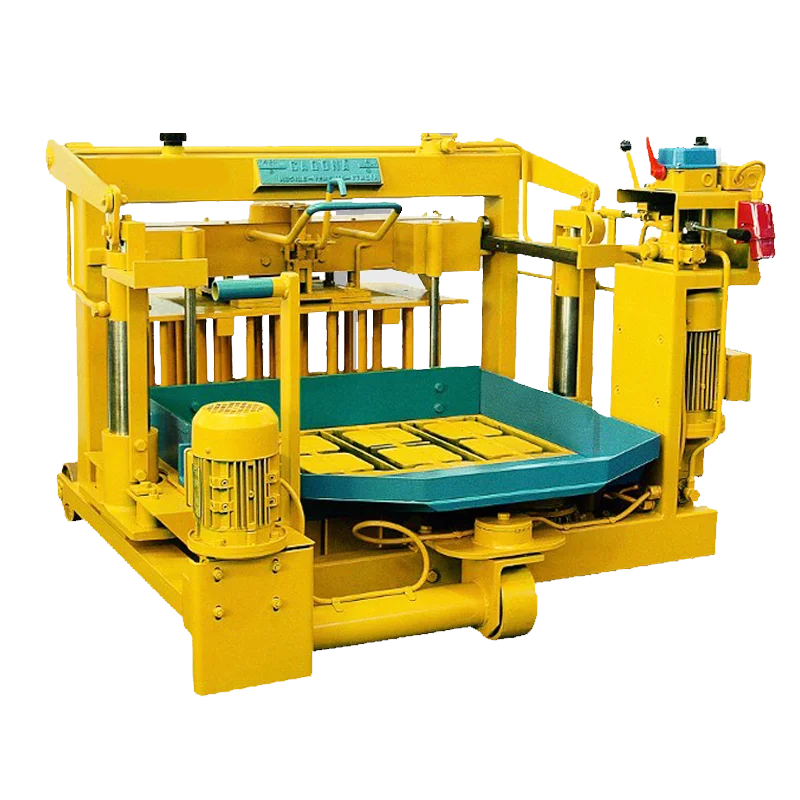
Matched System — the press, moulds, pallets and material feed are specified together so cycle times stay consistent across the whole mobile block making machine production line.
Technical Specifications
| Parameter | Value |
|---|---|
| Model | QMY4-30 |
| Product Type | Mobile Block Making Machine |
| Rated Power | 5 kW |
| Overall Dimensions (L×W×H) | 1200 × 1200 × 1100 mm |
| Net Weight | 950 kg |
| Cycle Time | 30 seconds |
| Raw Materials | Cement, sand, crushed stones, slag |
| Mould Format | Hollow block and solid brick (changeable) |
| Pallet Size | Basis not stated in source (confirm format and thickness) |
| Output Capacity | 480 pcs/h based on 400×200×200 mm hollow block, 4 pcs/mould |
| Output Capacity | 600 pcs/h based on 400×150×200 mm hollow block, 5 pcs/mould |
| Output Capacity | 840 pcs/h based on 400×100×200 mm hollow block, 7 pcs/mould |
| 8-Hour Output | 3,840 pcs based on 400×200×200 mm hollow block |
| 8-Hour Output | 4,800 pcs based on 400×150×200 mm hollow block |
| 8-Hour Output | 6,720 pcs based on 400×100×200 mm hollow block |
| Voltage & Frequency | Basis not stated in source (confirm destination market) |
| Control System | Basis not stated in source (confirm interface language) |
| Hydraulic Pressure | Basis not stated in source (confirm mix design match) |
| Vibration Force | Basis not stated in source (confirm aggregate match) |
| Automation Level | Manual egg-laying mobile operation |
| Warranty | One year |
| Assembly State | Complete machine, plywood packing |
Application Suitability
| Application | Material or Output |
|---|---|
| On-site housing project production | Hollow blocks from cement, sand, and crushed stone |
| Remote construction site supply | Solid bricks using locally sourced slag or aggregate |
| First-plant entrepreneur startup | Mixed hollow and solid output with mould changes |
| Contractor self-supply for masonry walls | 400×200×200 mm hollow blocks at 3,840 pcs per shift |
| Small-scale paving and partition work | Solid brick formats via interchangeable moulds |
Why "Pieces per Hour" Means Nothing Without the Block Size
Every output figure must name the format it assumes, or it is not an output figure at all.
I have watched buyers sign contracts based on a single hourly number, then discover on commissioning day that the machine produces a different format at a different rate. A mobile block making machine production line quoting 840 pieces per hour sounds strong — until you learn that number applies only to 400×100×200 mm hollow blocks at seven per mould. Switch to 400×200×200 mm blocks at four per mould and the same machine delivers 480 pieces per hour. [NEED_CITE: common misrepresentation of block machine capacity in export quotations] The gap between expectation and reality is not a machine fault; it is a quotation fault. This page ties every capacity number to a specific block dimension and pieces-per-mould count so your daily planning starts from honest ground.
How the Stations Connect Around the Press
The QMY4-30 sits at the centre of a mobile block making machine production line that extends beyond the press itself. Raw material arrives at a mixer, moves to the hopper, and drops into the mould cavity during each 30-second cycle. If the mixer cannot keep pace with the press, the operator stands idle waiting for the next batch. If the curing area is too small or too far from the laying path, freshly formed blocks must wait on the ground, risking deformation before initial set. Matching the mixer output, press cycle, and curing footprint keeps material flowing without bottlenecks.
Where Mobile Production Changes the Line Layout
A fixed plant can rely on conveyors and rack systems to move blocks from press to curing zone. On a job site, the QMY4-30 lays blocks directly onto the ground surface and moves forward after each cycle. This egg-laying method eliminates pallet return conveyors but introduces a different constraint: the ground must be level, firm, and large enough to hold a full shift’s output before blocks are moved. [NEED_CITE: site preparation requirements for mobile egg-laying block machines] Planning the curing area length and the machine travel path before the first pour prevents the crew from running out of space halfway through the day.
Reading the Numbers That Actually Matter
The 5 kW rated power reflects a compact drive system suited to sites with limited generator capacity. At 950 kg net weight, the machine can be relocated between zones of a large project using a standard forklift or small crane, which matters when a housing development shifts from foundation walls to partition work. The 1200 × 1200 mm footprint allows operation in confined areas where a stationary press would not fit. Mould changeability between hollow block and solid brick formats lets a single machine serve multiple phases of a build without requiring a second press on site.
What Happens When Vibration and Mix Do Not Match
Last year I sent a QMY4-30 to a project in East Africa. Our factory test ran on river sand, and the blocks came out clean. The buyer’s site used volcanic scoria aggregate — lighter, more porous, completely different damping characteristics. The vibration frequency that compacted river sand left the scoria mix under-densified and crumbling at the edges. We spent two weeks adjusting vibration duration and pressure settings over video calls before the blocks passed their local strength test. [NEED_CITE: effect of aggregate type on vibration compaction in concrete block production] The lesson is permanent: before any machine ships, I ask what material the buyer can actually get within hauling distance of the site.
Why the Rest of the Line Cannot Be an Afterthought
A mobile press without a matched mixer forces the crew to hand-mix in small batches, introducing inconsistency in water-to-cement ratio from one batch to the next. Without a dedicated curing zone marked out before production starts, blocks laid in direct sun cure unevenly compared to those in shade, creating strength variation across the same day’s output. These are not machine problems — they are line design problems. Specifying the mixer capacity, water metering method, and curing layout alongside the QMY4-30 ensures the mobile block making machine production line delivers consistent blocks from the first cycle to the last.
What You Receive Beyond the Press
Block machinery is the only product category here, so the machine, moulds, and handling tools are specified as one system rather than assembled from separate suppliers. Mould design covers the hollow block and solid brick formats your market actually sells, and custom drawings are available if your project requires a non-standard size. The automation level starts at manual egg-laying operation, which suits contractors who do not want fixed infrastructure. Installation support includes operator training so your crew understands cycle timing, mould change procedure, and daily maintenance from the first day of production.
Documentation & Verification
- Capacity calculation sheet naming block format and pieces per mould for each output tier
- Mould drawing with dimensional tolerances for hollow block and solid brick formats
- Voltage and control language confirmation recorded before production begins
- Factory test record using your specified raw material mix design
- Wear parts list with part numbers for first replacement order planning
- Packing photographs showing crate condition before container loading
Installation, Commissioning & Support
- Confirm 5 kW power supply with dedicated circuit breaker rated above motor inrush current
- Level and compact the ground surface across the full machine travel and curing path
- Machine arrives fully assembled; position on firm ground and connect power before first run
- Adjust vibration duration and cycle timing to match your local aggregate during commissioning
- Train operators on mould change procedure and daily bolt-torque checks on the vibration motor
- Stock vibration motor bearings and mould liner plates as first-order wear parts
What to Prepare Before Requesting a Quote
To size a mobile block making machine production line properly, the useful details are the block formats your project or market requires, the raw materials available within economic hauling distance, and the daily output target tied to a specific block size. Include your site voltage and frequency, the language your operators read, and whether you already have a mixer or need one quoted alongside the press. With that information, a configuration proposal can address the full line rather than the press alone.
Frequently Asked Questions
Q: How is output capacity calculated for each block format on the QMY4-30?
A: Each capacity figure is tied to a specific block dimension and the number of cavities in the mould. For example, 480 pieces per hour applies to 400×200×200 mm hollow blocks at four per mould with a 30-second cycle. Switching to a smaller format with more cavities raises the hourly count, which is why every number on this page names the format it assumes.
Q: What raw materials work with this mobile machine?
A: The QMY4-30 processes cement mixed with sand, crushed stone, or slag. The vibration and compaction settings must match the density and grading of your specific aggregate. Before shipment, confirm what material is available at your site so the machine can be tested against a representative mix rather than a generic formula.
Q: How does the curing area layout affect daily production planning?
A: The egg-laying method deposits blocks directly on the ground as the machine advances. Your curing area must be level, firm, and long enough to hold an entire shift’s output before blocks are moved. Running out of ground space mid-shift stops the press, so measure the travel path against your target daily output before production begins.
Q: What supporting equipment is needed alongside the mobile press?
A: A mixer matched to the press cycle time, a water metering system for consistent batch moisture, and basic hand tools for mould changes form the minimum supporting setup. If your curing zone is far from the laying path, a flatbed cart or small loader helps move cured blocks without damaging green units.
Q: How are voltage and control interface confirmed before shipment?
A: Provide your site voltage, frequency, and the language your operators read during the quotation stage. These details are recorded in the build specification so the electrical panel and any labels arrive configured for your market, avoiding delays during on-site commissioning.


