
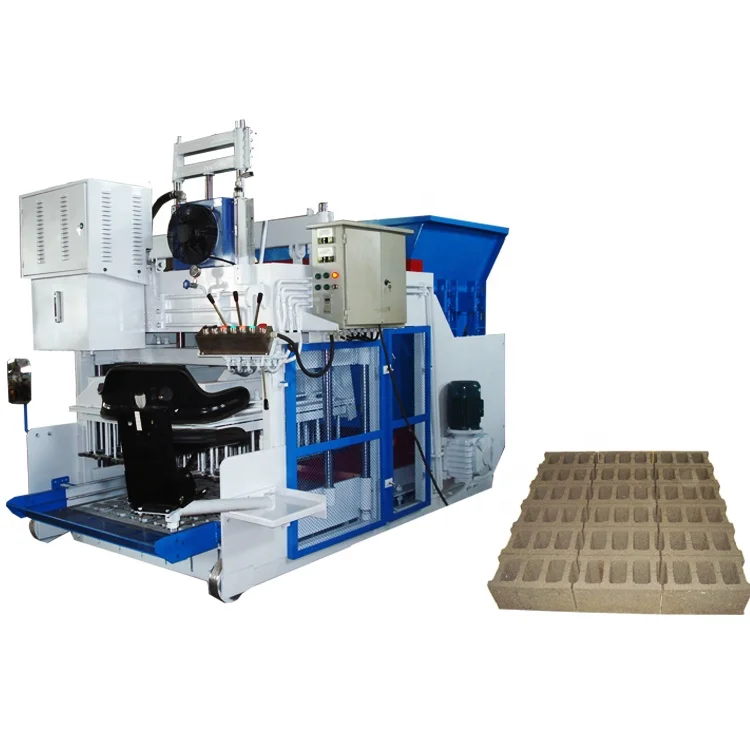
Integrated Line Planning — every mixer, travel path, and curing yard is sized to the QMY18-15 cycle before dispatch, so the press never waits for a batch or a cleared floor.
Technical Specifications
| Parameter | Value |
|---|---|
| Model | QMY18-15 |
| Product Type | Mobile Cement Block Making Machine |
| Rated Power | 24 kW |
| Voltage & Frequency | Configurable to local industrial supply (rating to be confirmed per site) |
| Control System | PLC with language options to be confirmed |
| Output Capacity | approx. 34,000 pcs per shift based on 400×200×200 mm hollow block (smaller formats yield higher count) |
| Working Method | Hydraulic pressure station |
| Block Formats | Customizable moulds: hollow, solid, and other cement-based formats per buyer drawing |
| Pallet Requirement | None — blocks laid directly on ground (egg-laying / mobile type) |
| Automation Level | Semi-automatic with PLC assist |
| Stacking & Curing | Manual handling; blocks cured in place on the ground |
| Certification | CE / ISO status not stated in source — confirm with supplier before order |
Application Suitability
| Application | Material or Output |
|---|---|
| On-site production for housing and infrastructure contractors | Hollow and solid cement blocks using locally sourced crushed stone, sand, and cement |
| Startup block plants with limited yard space and capital | Standard 400×200×200 mm hollow blocks and smaller solid formats on a prepared ground slab |
| Multi-phase development projects requiring machine relocation | Cement-based blocks produced sequentially across different zones of a construction site |
| Regional building material supply from a small curing yard | Interlocking and solid block formats switched by mould change as market demand shifts |
What "34,000 Blocks per Shift" Actually Requires on the Ground
A mobile egg-laying block machine is only as fast as the mixer feeding it and the curing yard absorbing its output.
When a line is quoted on cycle count alone, buyers often discover that the mixer batch cycle runs longer than the press cycle, leaving the QMY18-15 idle between batches. The curing yard must also be sized for a full shift’s ground-laid output with enough clearance for the machine to travel and turn. If the yard fills before the shift ends, production stops regardless of what the spec sheet says. [NEED_CITE: mobile block machine line balancing principles for egg-laying equipment]
Removing the Pallet Loop from the Line
The defining feature of this mobile block machine production line is the absence of pallets. In a stationary press setup, the line must include a pallet feeder, a pallet return conveyor, and a curing rack handling system — each adding cost, maintenance, and floor space. The QMY18-15 lays blocks directly on a prepared concrete floor, which eliminates those three stations entirely. The supporting equipment around the press is reduced to the raw material batching and mixing station, a water supply arrangement, and the curing yard itself.
Sizing the Mixer to the Press Cycle
The QMY18-15 is rated at 24 kW total, and its hydraulic pressure station drives compaction on every cycle. To keep the press running without interruption, the mixer must deliver a fresh batch in equal or shorter time than the press consumes one. A pan mixer or twin-shaft mixer sized to the hopper volume of the mobile unit is typically the correct pairing. Undersizing the mixer is the most common cause of mobile egg-laying block machine supporting equipment bottlenecks on small sites. [NEED_CITE: mixer-to-press batch timing in mobile block production]
How Hydraulic Pressure and Vibration Shape Block Density
The hydraulic pressure station on the QMY18-15 applies compaction force while vibration consolidates the mix around the mould cavity. These two forces must be balanced to the buyer’s specific aggregate and cement ratio. High-clay or high-silt aggregates absorb vibration differently than clean crushed stone, and a pressure setting that works for one mix may produce weak or cracked blocks with another. Before the machine leaves the factory, the pressure and vibration parameters should be tuned against a sample of the buyer’s actual raw material — not a default sand blend. Mould format changes also affect the required force profile, meaning each block type may need its own stored parameter set in the PLC.
When Line Stations Are Specified in Isolation
A buyer who sources the mixer from one supplier, the mobile press from another, and plans the curing yard independently often finds that batch timing, hopper height, and travel clearance do not align. The mixer discharge may sit too high or too low for the QMY18-15 hopper, requiring a custom chute. The curing yard may be laid out without accounting for the machine’s turning radius, forcing operators to reverse manually in tight spaces. These mismatches do not appear on any single supplier’s quotation but surface immediately on the first production day. [NEED_CITE: integration failures in multi-vendor block production lines]
Why the Line Is Planned as One System Here
The QMY18-15 is specified alongside its mixer, water dosing, and curing yard dimensions as a matched set, not as a standalone press dropped into an undefined site. The capacity calculation states the block format assumed, so the daily output figure corresponds to what the buyer actually intends to produce. Voltage, frequency, and PLC display language are confirmed before the machine enters production, preventing commissioning delays at the destination. Moulds are designed to the buyer’s market formats and supplied with drawings, so there is no guesswork when the first format change is needed on site.
Documentation & Verification
- Line layout showing QMY18-15 travel path, mixer position, and curing yard dimensions matched to shift output
- Capacity calculation sheet stating the exact block format and cycle basis used for the 34,000-piece figure
- Mould drawing and format list confirming each block type the buyer’s market requires
- Hydraulic and electrical schematic with voltage and frequency rated for the destination site
- Factory test record run on the buyer’s submitted aggregate sample before crating
- Operation and maintenance manual in the confirmed PLC display language
Installation, Commissioning & Support
- Ground slab must be level and cured before the QMY18-15 arrives, sized to the yard dimensions on the line layout
- Dedicated 24 kW circuit at the confirmed voltage and frequency, with breaker rating per the electrical schematic
- Machine shipped assembled; on-site setup limited to mould mounting, hydraulic fluid fill, and PLC power-up
- First-run commissioning includes pressure and vibration tuning against the buyer’s local mix design
- Operator training covers mould change procedure, PLC parameter recall per block format, and daily greasing points
- Wear parts list and mould inventory supplied at dispatch to cover the first replacement cycle
What to Include in Your Inquiry
Send the target block formats with dimensions, the daily output you need to sustain, and a sample or lab analysis of your local aggregate including clay and silt content. Confirm the site voltage, frequency, and the language you need on the PLC display. If you already have a mixer or a prepared curing slab, share those dimensions so the line layout can be built around what is already on the ground.
Frequently Asked Questions
Q: What supporting equipment forms a complete mobile block machine production line around the QMY18-15?
A: The line requires a mixer matched to the press batch cycle, a water dosing system, and a level concrete curing yard sized for one full shift of ground-laid blocks. No pallet feeder, return conveyor, or curing rack is needed because the egg-laying design eliminates the pallet loop entirely.
Q: How is daily output calculated, and what curing yard size does that require?
A: Output is approximately 34,000 pieces per shift based on 400×200×200 mm hollow blocks. Smaller solid formats yield a higher count. The curing yard must hold an entire shift’s production on the ground with enough travel clearance for the machine to move and turn between rows.
Q: Can the mixer batch cycle be matched to the QMY18-15 press cycle?
A: Yes. The mixer is selected so its batch delivery time equals or beats the press consumption rate. A twin-shaft or pan mixer sized to the QMY18-15 hopper volume is typically specified to prevent the press from standing idle between batches.
Q: What voltage and PLC language options are confirmed before shipment?
A: Voltage and frequency are set to the buyer’s local industrial supply and confirmed before production begins. The PLC display language is agreed at the same stage so operators can read alarms and parameter screens on the first day of commissioning.
Q: How does ground-cured block handling compare to pallet-based stacking?
A: Ground curing removes the pallet purchase cost, pallet return conveyor, and curing rack system from the line. Labour shifts from pallet handling to yard management and block collection after curing. The trade-off is a larger flat yard area instead of vertical rack storage.


