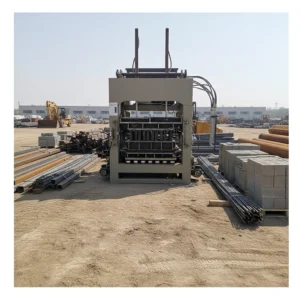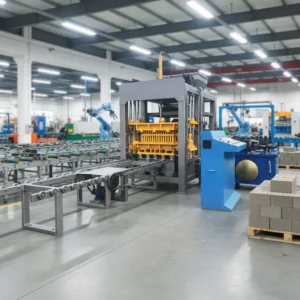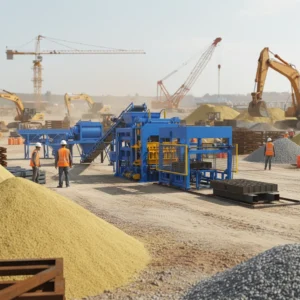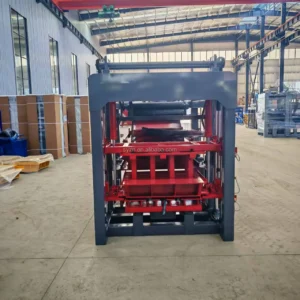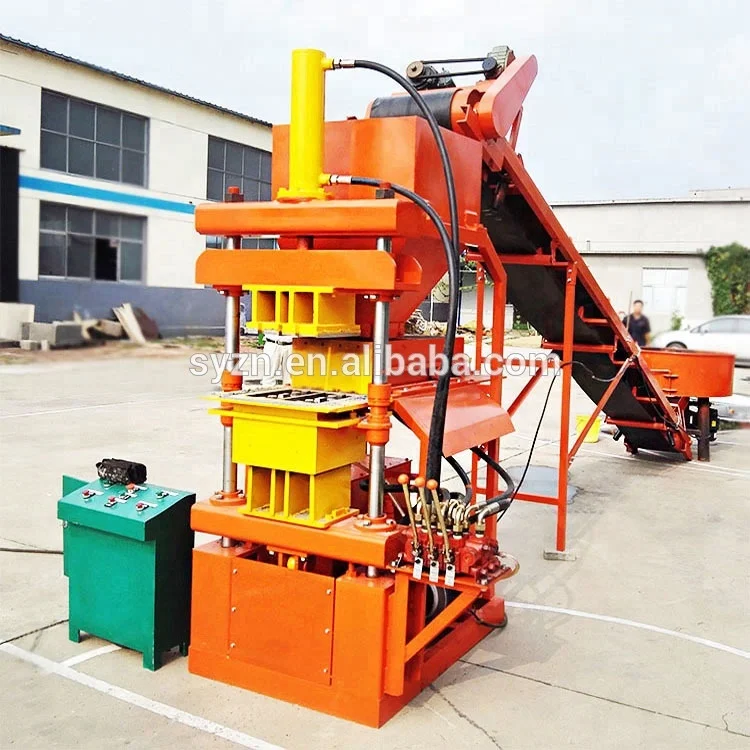
Line-Matched Throughput — every upstream feeder, mixer, and downstream stacker is timed against the LY2-10 press cycle so the machine never idles between mould strikes.
Technical Specifications
| Parameter | Value |
|---|---|
| Model | LY2-10 |
| Product Type | Clay Interlocking Brick Making Machine |
| Machine Type | Semi-automatic clay and cement interlocking brick making machine |
| Rated Power | 7.5 kW |
| Molding Cycle | 10 s |
| Output Capacity | 6000 pcs/8hours (basis not stated in source — confirm block format / material / thickness) |
| Raw Materials | Clay, soil, earth, mud, concrete, cement, fly ash |
| Overall Dimensions (L×W×H) | 1300 × 1800 × 2400 mm |
| Mould Formats Listed | 300×150×100 mm, 250×125×75 mm, 230×220×115 mm (1 pc/mould each) |
| Automation Level | Semi-automatic |
Application Suitability
| Application | Material or Output |
|---|---|
| Interlocking clay brick production for low-rise building construction | Clay, soil, earth, mud |
| Cement-stabilized interlocking brick for structural walls | Concrete, cement, fly ash blends |
| On-site or small plant brick production using locally sourced aggregates | Site-specific soil and cement mixes |
| Low-investment brick plant for entrepreneurs and local contractors | Mixed clay and cement formats across three mould sizes |
Why "6000 Bricks per Shift" Is Only Half the Story
A press rating means nothing if the mixer feeds slower than the mould cycles.
The clay interlocking brick making machine production line centered on the LY2-10 lists an output of 6000 pieces per shift, but that figure assumes every upstream and downstream station keeps pace with a 10-second molding cycle. I have walked onto sites where a perfectly capable press sat idle for minutes at a time because the pan mixer could not discharge fast enough or the pallet return conveyor jammed on warped boards. [NEED_CITE: line synchronization standards for block production plants] Daily output in those cases dropped well below what the buyer signed for, and the blame shifted between the press supplier and the auxiliary equipment vendor. The only way to prevent this is to spec the entire feed-to-stacking chain as one timed system before the order is placed.
Timing Every Station Against the 10-Second Mould Cycle
The LY2-10 completes one press cycle every ten seconds, which means the raw material feed hopper, the mixer discharge, and the pallet feeder must each deliver within that same window. If the mixer batches every fifteen seconds instead, the press loses a third of its available cycles before the shift even ends. Planning the clay interlocking brick making machine production line starts with mapping each station’s cycle and identifying where a buffer hopper or a faster mixer is required to protect the press rhythm.
Pallet Flow and Curing Rack Alignment
Semi-automatic operation means an operator moves bricks from the press table to the curing rack, but the pallets themselves must return to the feed station without bottlenecking. The three listed mould formats produce bricks of different footprints, so pallet size selection directly governs how many bricks travel per pallet and how the curing racks must be spaced. Mismatched pallets force the operator to make extra trips, slowing the entire downstream chain and creating uneven curing conditions across the rack. [NEED_CITE: pallet sizing and curing rack configuration for interlocking brick plants]
Reading the Specs That Actually Govern Output
The 7.5 kW rated power tells you the motor capacity available for both vibration and hydraulic clamping; if local clay is heavy and stiff, the mixer upstream may need a separate motor circuit to avoid tripping the main breaker. The overall dimensions of 1300 × 1800 × 2400 mm define the press footprint, but the full line — mixer, belt conveyor, pallet return — requires roughly three times that length in a straight layout. Mould formats ranging from 300×150×100 mm down to 230×220×115 mm mean the vibration table and hydraulic ram must distribute force evenly across different surface areas, which affects brick density and demolding consistency. Semi-automatic operation keeps the control system simple but demands a trained operator at the pallet transfer point for every cycle.
What Happens When Line Stations Are Spec’d Separately
Buying the press from one supplier and the mixer, pallet feeder, and stacking table from three others usually means no single vendor takes responsibility when the line stalls. The mixer vendor blames the press cycle, the press vendor blames the pallet conveyor, and the buyer absorbs the lost production days. On a semi-automatic line like the LY2-10, even a minor mismatch in pallet return speed forces the operator to hand-carry boards back to the feed station, turning a one-person job into a two-person job and eroding the labour advantage the buyer expected. [NEED_CITE: single-source versus multi-vendor block line integration risks]
Why Sourcing the Full Line From One Supplier Matters
Shiyue treats the LY2-10 as one node in a connected clay interlocking brick making machine production line rather than a standalone press, so feeder, mixer, pallet conveyor, and curing rack handling are specified as a timed set. Configuration is built around your actual clay or cement mix and local aggregate, not a default catalogue recipe. Mould design covers the three standard interlocking formats and can be extended to custom drawings if your market demands a fourth size. Voltage, frequency, and control language are confirmed before production starts, so the machine arrives ready to wire and run. Factory test records document cycle timing across the full station chain, giving you a baseline to hold the installation team accountable against.
Documentation & Verification
- Line layout drawing showing every station from raw material hopper to curing rack, dimensioned to your site
- Capacity calculation sheet stating the exact brick format and mix assumed for each output figure
- Mould drawing pack covering all three interlocking formats with wear-strip replacement intervals
- Voltage, frequency, and control display language confirmation signed off before production begins
- Factory test record documenting press cycle, mixer discharge, and pallet return timing as one chain
Installation, Commissioning & Support
- Foundation plan based on the 1300 × 1800 mm press footprint and 7.5 kW motor load with anchor bolt layout
- Dedicated 3-phase circuit sized for the full line draw, not just the press motor
- Machine arrives partially assembled; press frame, vibration table, and hydraulic pack ship as one skid
- First-run commissioning includes timing every station against the 10-second cycle with your local clay mix
- Operator training covers mould change procedure across all three formats and daily vibration table inspection
- Wear parts list identifies hydraulic seals, vibration springs, and mould liners with reorder part numbers
What to Share Before Requesting a Line Quote
To build a line layout that actually holds its cycle time, we need your target brick format from the three available mould sizes, the clay or cement mix you plan to use, and the daily volume you intend to sustain. Tell us your site voltage and frequency so the motor and control panel are wound correctly before shipment. If you already have a curing yard or forklift on site, share the dimensions and lift capacity so pallet size and rack spacing can be matched to your existing equipment.
Frequently Asked Questions
Q: How is the 10-second molding cycle matched with the mixer and pallet feeder so the press never idles?
A: Every station upstream and downstream of the LY2-10 is timed against the 10-second press cycle during line design. The mixer batch size, discharge gate speed, and pallet return conveyor rate are all calculated to deliver within that window. If any station runs slower, a buffer hopper or a faster motor is specified before the order is finalized, not discovered on site.
Q: Which supporting stations are included in the line quotation and which are buyer-supplied?
A: Raw material feeding, mixing, pallet feeding, and curing rack handling can all be included as part of the clay interlocking brick making machine production line scope. Items typically buyer-supplied are the curing yard surface, water supply for mix preparation, and the forklift used to move stacked pallets. The quotation clearly separates included equipment from buyer-scope civil works and utilities.
Q: How does semi-automatic operation affect the labour needed at each line station?
A: Semi-automatic means the LY2-10 press cycles automatically but an operator transfers freshly pressed bricks from the pallet to the curing rack and returns the empty pallet. This requires one dedicated operator at the transfer point and one at the mixer feed. No automated stacker or robot is needed, keeping the line simple and maintenance costs low.
Q: What pallet size is required for the three mould formats, and how does that connect to my curing racks?
A: Each of the three mould sizes produces a single brick per cycle, so pallet dimensions must accommodate the largest format at 300×150×100 mm with clearance for operator handling. Pallet material and thickness are chosen based on your curing yard conditions and forklift tine spacing. Curing rack shelf spacing is then set to match the loaded pallet height, preventing brick damage during storage.
Q: How are voltage, frequency, and control language confirmed before the machine ships?
A: Before production begins, a written confirmation sheet captures your site voltage, phase, frequency, and preferred control display language. The motor is wound and the panel is wired to match. This step is built into the order process so the LY2-10 arrives ready to connect without on-site rewiring or waiting for translated manuals during commissioning.