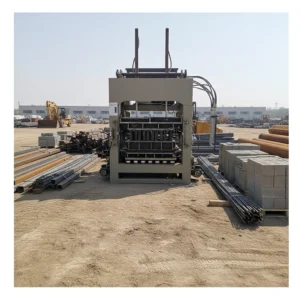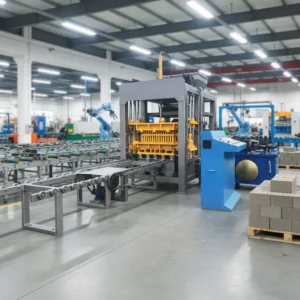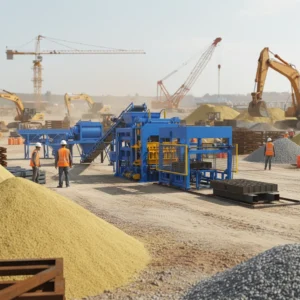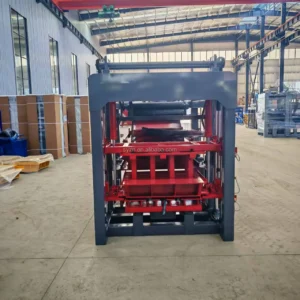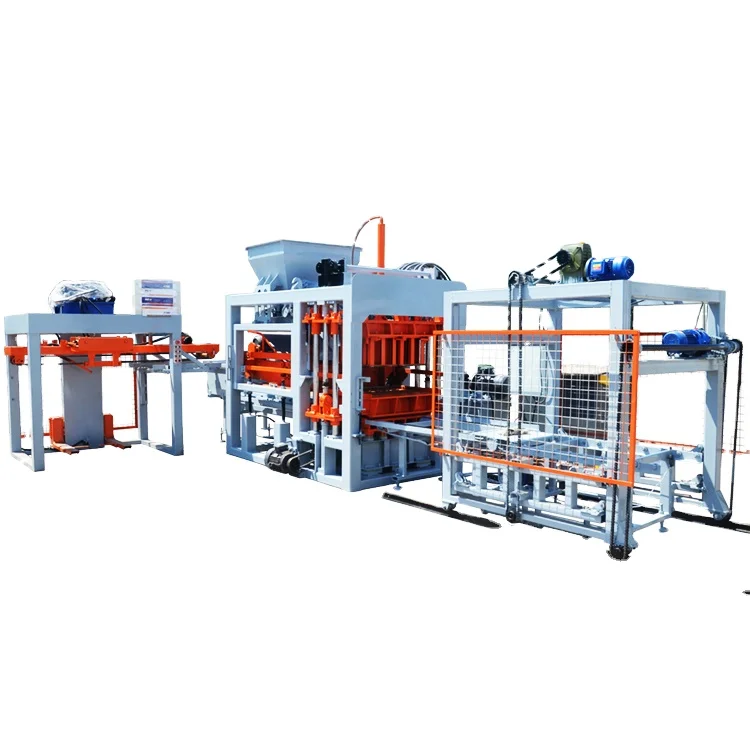
Specified around the press cycle — pallet feeder, brick conveyor, and sweeper are timed to the QT6-15 molding cycle so the line runs without the operator pulling pallets by hand.
Technical Specifications
| Parameter | Value |
|---|---|
| Model | QT6-15 |
| Product Type | Fully Automatic Hydraulic Vibration Block Making Machine |
| Overall Dimensions | 7400 × 1900 × 2660 mm |
| Molding Cycle | 15–25 s |
| Vibration Frequency | 4600 r/min |
| Exciting Force | 40–50 kN |
| Rated Power | 31.25 kW |
| Mixer Model | JQ350 |
| Pallet Size | 850 × 550 × 25 mm |
| Total Weight | 7 T |
| Control System | PLC control system |
| Hydraulic Station | Included |
| Pallet Feeder | Included |
| Brick Conveyor | Included |
| Block Sweeper | Included |
| Output Capacity (Hollow Block 400×200×200 mm) | 1200–1680 pcs/hr (basis: 15–20 s cycle) |
| Output Capacity (Hollow Block 400×150×200 mm) | 1800–2400 pcs/hr (basis: 15–20 s cycle) |
| Output Capacity (Solid Brick 240×115×53 mm) | 3240 pcs/hr (basis: 15–20 s cycle) |
| Voltage & Frequency | Configurable to buyer’s local supply |
| Mould Change Time | (basis to be confirmed) |
| Hydraulic Pressure | (basis to be confirmed) |
| Stacking Method | (basis to be confirmed) |
| Applied Products | Paver, solid block, hollow block, curbstone |
| Raw Materials | Crushed stones, sand, cement, dust, fly ash |
Application Suitability
| Application | Material or Output |
|---|---|
| Hollow block production | Crushed stone, sand, cement, fly ash mixes for 400×200×200 mm and 400×150×200 mm formats |
| Solid brick production | Standard 240×115×53 mm bricks from local aggregate and cement |
| Paver production | Interlocking and rectangular pavers from high-density concrete mixes |
| Curbstone production | Heavy-section kerbstones requiring high hydraulic pressure and vibration force |
| On-site project supply | Development and housing contractors producing blocks locally to avoid transport cost |
What the Quoted Cycle Time Leaves Out of Daily Output
A press cycling every 20 seconds produces nothing if the pallet feeder upstream cannot keep pace or the conveyor downstream is still clearing the previous batch.
Many quotations for a block production line list a peak cycle rate and stop there. In practice, pallets pile up at the press infeed, the operator starts pulling them by hand, and the shift ends with output far below the nameplate figure. The gap is not the press — it is the supporting stations that were never matched to the molding cycle [NEED_CITE: mismatched station cycle times in concrete block lines]. Specifying the turnkey block making machine as one coordinated system, where every station from the JQ350 mixer through to the block sweeper is timed to the QT6-15 press cycle, removes that gap before the line is built.
Station Synchronization Across the Block Line
The QT6-15 press cycles in 15 to 25 seconds depending on block format and mix design. The pallet feeder, brick conveyor, and block sweeper included in this line are specified so that none of those stations forces the press to wait. When the pallet feeder delivers on time and the conveyor clears the finished block before the next mold opens, the block production line holds its rated cycle across a full shift rather than degrading after the first hour.
Where Bottlenecks Actually Form
The press itself is rarely the slowest station. More often the bottleneck is the pallet return path or the time the sweeper needs to clean the pallet surface before it re-enters the feeder. On lines where these stations were sourced separately, operators report spending a significant part of the shift hand-pulling pallets or wiping them manually — work that the PLC control system on this line is designed to eliminate by coordinating every station from a single sequence [NEED_CITE: operator intervention rates in semi-coordinated block lines].
Reading the Specification Sheet Beyond the Press
A molding cycle of 15 to 20 seconds only translates into the stated output figures when the upstream mixer can deliver fresh material within that same window. The JQ350 mixer included here is sized to match the QT6-15 batch volume so that the press hopper never runs dry mid-cycle. Vibration frequency at 4600 r/min and exciting force of 40 to 50 kN compact the mix within the mold in the time the PLC allows, producing consistent block density across hollow block, solid brick, paver, and curbstone formats without extending the cycle to compensate for a weak vibration table.
Pallet Size, Curing Area, and the Forklift You Already Own
The 850 × 550 × 25 mm pallet is the interface between the machine and everything that happens after it. If the curing racks in the buyer’s yard are spaced for a different pallet dimension, every pallet must be restacked by hand before curing begins. Confirming pallet size and material against the existing curing layout and forklift fork width before production starts avoids a mismatch that no amount of press speed can correct once the line is running.
The Cost of Treating Supporting Equipment as Optional
Leaving pallet handling, stacking, or conveying out of the initial quotation shifts that work onto the operator. A turnkey block making machine that arrives without a matched pallet feeder or brick conveyor forces the buyer to source those stations locally, often with different PLC protocols and cycle timings that the original control system cannot coordinate. The result is a line that technically runs but never reaches the throughput the press alone was rated to deliver [NEED_CITE: throughput loss from aftermarket station integration].
Why Sourcing the Line as One System Matters
Specifying the QT6-15 with its hydraulic station, pallet feeder, brick conveyor, and block sweeper from a single source means the PLC sequence is written for the actual station layout, not a generic program adapted on site. The hydraulic pressure and vibration force are matched to the buyer’s local aggregate and target block format rather than a catalogue default. Mould design covers the formats the buyer’s market actually sells, including custom drawings where standard moulds do not fit. Factory testing runs the complete line — not just the press — before shipment, so cycle coordination is verified under load rather than discovered during commissioning. Documentation includes the line layout, capacity calculation per block format, hydraulic and electrical schematics, and a factory test record that covers every station [NEED_CITE: factory test scope for coordinated block lines].
Documentation & Verification
- Line layout with capacity calculation stated per block format and assumed cycle time
- Hydraulic and electrical schematic matching the as-built station configuration
- Factory test record covering press, pallet feeder, conveyor, and sweeper together
- Voltage, frequency, and PLC display language confirmation signed before production
- Mould drawing and format list including any custom moulds to buyer drawings
Installation, Commissioning & Support
- Foundation plan sized to the 7400 × 1900 mm machine footprint and 7 T operating weight
- Dedicated power circuit rated for the 31.25 kW total draw with confirmed voltage and frequency
- Dismantling and container loading plan with reassembly sequence for on-site rebuild
- PLC parameter setting and cycle coordination tuning across all stations during first run
- Operator training covering mould change procedure, daily lubrication points, and pallet inspection
- Wear parts list and hydraulic seal schedule aligned to the buyer’s planned production volume
Before You Request a Quote
To configure this block production line around your actual conditions, the information that matters most is the block format your market buys, the daily volume you need to hit, and the raw materials available locally — specifically the aggregate grading and whether fly ash or stone dust will be part of the mix. Equally important are your site voltage and frequency, the PLC display language your operators will need, and the pallet dimensions your existing curing area and forklift are set up for. Providing these details up front allows the line layout and capacity calculation to reflect your real output, not a catalogue default.
Frequently Asked Questions
Q: How is daily output calculated per block format, and what cycle time does each figure assume?
A: Output figures are calculated from the molding cycle specific to each format. For the 400×200×200 mm hollow block, the stated 1200 to 1680 pieces per hour assumes a 15 to 20 second cycle. The 400×150×200 mm hollow block reaches 1800 to 2400 pieces per hour on the same cycle basis, while the 240×115×53 mm solid brick is rated at 3240 pieces per hour under those same conditions.
Q: Which supporting equipment stations are included, and where must their cycle times match?
A: The line includes the hydraulic station, pallet feeder, brick conveyor, and block sweeper alongside the QT6-15 press. The pallet feeder must deliver a clean pallet before the mold opens, and the conveyor must clear the finished block before the next cycle begins. Any delay at these stations forces the press to idle and reduces actual shift output below the rated cycle rate.
Q: How are pallet size and material selected to fit the curing area and handling equipment?
A: The standard pallet is 850 × 550 × 25 mm, but the size and material must be confirmed against the buyer’s existing curing rack spacing and forklift fork width. A pallet that does not match the curing layout forces manual restacking after every cycle, negating the automation built into the feeder and conveyor stations.
Q: What voltage, frequency, and PLC language options are available for the target market?
A: Voltage and frequency are configured to the buyer’s local supply before production begins, and the PLC display language is set to the operator’s working language. These three items are confirmed in writing during the quotation stage so that the control system arrives ready for commissioning without electrical modification or software reload on site.
Q: What is the mould change procedure and how does it affect format flexibility?
A: The QT6-15 accepts moulds for hollow block, solid brick, paver, and curbstone formats on a single press. The change procedure and typical swap time depend on the mould locking system fitted, which should be confirmed during specification. A change that takes most of a shift cancels out the format flexibility the line was purchased to provide.