
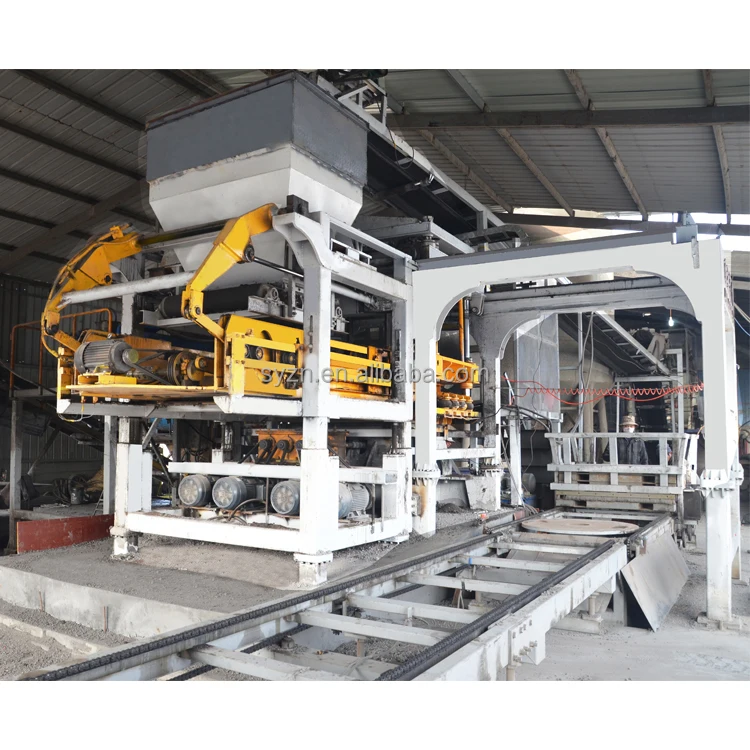
Integrated Line Matching — every station from mixer to stacker is timed against the QT18-15 press cycle so the line never bottlenecks at one machine.
Technical Specifications
| Parameter | Value |
|---|---|
| Model | QT18-15 |
| Product Type | Fully Automatic Pallet-free Block Making Machine |
| Brick Height Range | 50–300 mm |
| Stacking Height | 0–1200 mm |
| Main Vibration Form | Platform Vibration |
| Vibration Frequency | 2800–4500 r/min |
| Pallet Size | 1350×1350×120 mm (source value — verify, product is pallet-free) |
| Moulding Cycle | 15–25 s |
| Vibration Power | 60 kW |
| Hydraulic System Power | 59 kW |
| Driving Method | Hydraulic |
| Demolding Method | Vibration and Hydraulic |
| General Water Consumption | 8 T/Day |
| Factory Area | 2000 m² |
| Control System | PLC with person-machine conversation interface |
| Automation Level | Fully automatic, pallet-free stacking |
Application Suitability
| Application | Material or Output |
|---|---|
| Hollow block production | Crushed stone, sand, cement, fly ash |
| Solid block production | Gravel, slag, sand, cement |
| Paver and colored paver production | Fine aggregate, cement, pigment |
| Interlocking block production | Crushed stone, sand, cement |
| Curbstone production | Coarse aggregate, cement |
Why the Upstream Feeder Matters More Than the Press Itself
A block line is only as fast as its slowest station, and that is rarely the press.
When I plan a fully automatic block making machine production line, the first question I ask is not about the press cycle time but about how quickly the mixer can deliver a fresh batch to the hopper. I have stood on plant floors where a high-speed press sat idle for seconds between cycles simply because the belt feeder could not keep up. The quoted output looked excellent on paper, yet the daily tally told a different story. Sizing every upstream and downstream station to the same beat is what separates a turnkey block production line from a collection of mismatched machines [NEED_CITE: industrial line balancing principles for concrete product plants].
Feeding, Mixing and the Rhythm of the Press
The QT18-15 completes a moulding cycle in 15–25 seconds depending on block format, which means the mixer must discharge a homogeneous batch within that same window. If the mixer is undersized, the press waits; if it is oversized, the mix begins to hydrate before it reaches the mould. On a fully automatic block making machine production line, the feeding conveyor, mixer discharge gate and press hopper level sensor must all talk to the same PLC so that material arrives exactly when the press calls for it.
Pallet-free Stacking and What It Removes from the Floor
Traditional block lines require pallets to carry wet blocks from the press to the curing area, which means ongoing pallet investment, pallet return conveyors and forklift traffic. The QT18-15 eliminates that loop by stacking blocks directly after demolding up to 1200 mm high. This changes the downstream layout entirely: no pallet return belt, no pallet cleaning station, and a smaller curing footprint because stacked columns occupy less floor area than single-layer pallet racks [NEED_CITE: pallet-free block curing layout requirements].
Reading the Vibration and Hydraulic Numbers Together
Platform vibration at 2800–4500 r/min works alongside 59 kW of hydraulic system power to compact the mix from both directions. Vibration frequency determines how thoroughly fine particles settle into voids, while hydraulic pressure controls the overall density of the block. If either value is mismatched to the buyer’s aggregate gradation, the resulting block may show inconsistent strength from one batch to the next. Specifying both values together against a known mix design is the only way to guarantee repeatable compaction.
The Cost of Overlooking the Curing Area Match
A turnkey block production line that stacks blocks to 1200 mm still needs a curing zone sized for that column height and weight. If the buyer’s existing yard has low headroom or soft ground, the full stacking potential goes unused and blocks must be stacked lower, slowing throughput. Confirming floor loading capacity and overhead clearance before the line ships prevents a costly reschedule of the curing area after commissioning [NEED_CITE: concrete block curing yard load-bearing standards].
Why Procurement Starts at the Line Level
We specify the QT18-15 as part of a matched system rather than selling the press alone. Raw material feeding, mixing, pressing and stacking are calculated against the buyer’s target block format so that no station becomes a hidden bottleneck. The pallet-free design is confirmed against the buyer’s curing area dimensions before the quotation is finalized. Moulds are selected for the exact formats the buyer’s market demands, and custom mould drawings are available when a standard format does not fit. The PLC language, voltage and frequency are confirmed in writing before production begins so that commissioning is not delayed by a wrong control setting.
Documentation & Verification
- Line layout drawing showing each station and its cycle time relative to the press
- Capacity calculation sheet stating the block format assumed for the 15–25 s cycle
- Pallet-free stacking arrangement drawing matched to buyer’s curing area dimensions
- Voltage, frequency and PLC display language confirmation record
- Factory test record with photos before container loading
Installation, Commissioning & Support
- 2000 m² factory area requirement confirmed against buyer’s available plot
- 60 kW vibration and 59 kW hydraulic power circuits sized with dedicated breakers
- PLC language set to buyer’s operator preference before the QT18-15 leaves the factory
- Platform vibration calibration on buyer’s local aggregate during on-site commissioning
- Mould change procedure training covering all supplied block formats
- Wear parts list with hydraulic seal and vibration motor bearing replacement intervals
What to Include in Your First Enquiry
To size a fully automatic block making machine production line correctly, share your target block formats, the daily output you need per format, and the local aggregate you plan to use. Include your available floor area and overhead clearance for both the press hall and the curing yard. State your site voltage, frequency and preferred PLC display language so we can lock these details before production starts.
Frequently Asked Questions
Q: How is daily output calculated per block format on this line?
A: The 15–25 second moulding cycle varies by block height and complexity. We calculate daily output separately for each format the buyer intends to produce, stating the exact block dimensions assumed. This prevents the common gap between quoted capacity and real-world tally that occurs when only one reference format is used.
Q: How do upstream and downstream stations stay cycle-matched to the press?
A: Each station — feeder, mixer, press and stacker — is assigned a target cycle time in the line layout. The PLC coordinates start and stop signals so that the press hopper never runs empty and stacked blocks are cleared before the next demolding. Any mismatch is flagged on the person-machine conversation interface.
Q: Does the quotation include pallet-free stacking and full-line automation?
A: Yes. The QT18-15 quotation covers the press, PLC-controlled feeding, mixing, and pallet-free stacking to 1200 mm. We do not leave stacking as a manual afterthought. If the buyer later wants to add cubing or wrapping, the automation level can be extended without replacing the press.
Q: What site utilities does the full line require?
A: The line needs approximately 2000 m² of floor area, 8 T/day of water supply, and dedicated power circuits for the 60 kW vibration system and 59 kW hydraulic unit. Voltage and frequency are confirmed before production so that transformers or switchgear can be arranged in advance [NEED_CITE: industrial power supply standards for concrete plants].
Q: How are voltage and PLC language confirmed before shipment?
A: We issue a written confirmation sheet listing voltage, frequency, phase and PLC display language. The buyer signs off before the QT18-15 enters production. This step eliminates the commissioning delays that occur when a machine arrives with a control language the operators cannot read.


