
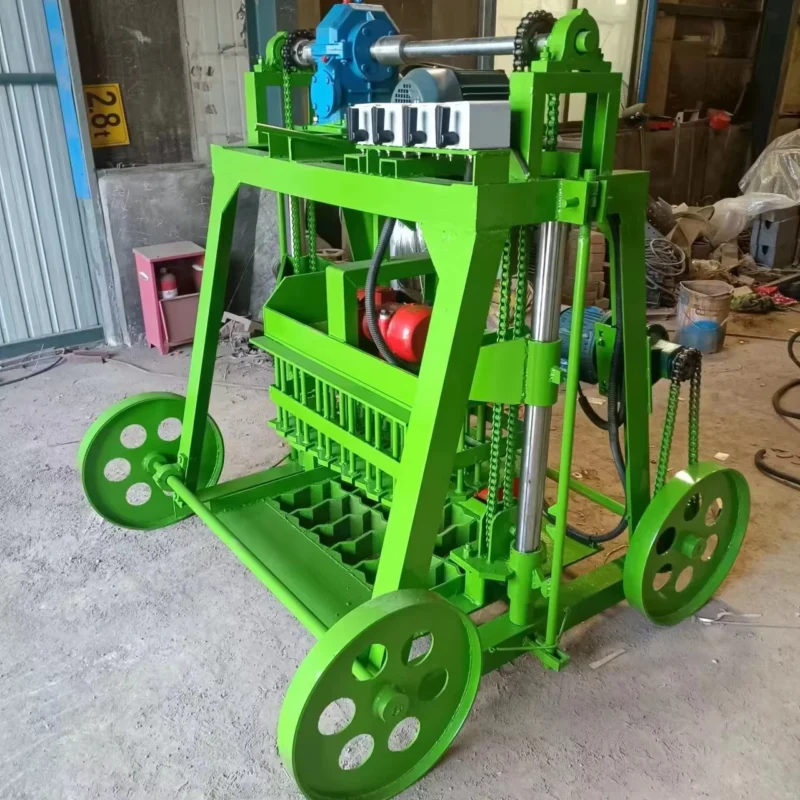
Matched System Design — machine, mould and power source specified together against your local aggregate and site conditions, not pulled from a catalogue default.
Technical Specifications
| Parameter | Value |
|---|---|
| Model | QMJ4-45 |
| Product Type | Mobile Egg-Laying Block Making Machine |
| Molding Capacity | 4pcs/mold (varies by block format) |
| Vibration Frequency | 2400 r/m |
| Molding Cycle | 45 seconds |
| Vibration System | Twice-vibrations of molding core |
| Hydraulic Method | Mold vibration |
| Demold Method | Manual |
| Turning Method | Manual |
| Total Power | 6 kW |
| Power Resource | Diesel/Petrol engine |
| Pallet Requirement | Not required (egg-laying type) |
| Hollow Block Output (400×200×200mm) | 4pcs/mould, 45s cycle, 3000pcs/day (8 hours) |
| Hollow Block Output (400×150×200mm) | 5pcs/mould, 45s cycle, 3500pcs/day (8 hours) |
| Hollow Block Output (400×120×200mm) | 6pcs/mould, 45s cycle, 4500pcs/day (8 hours) |
Application Suitability
| Application | Material or Output |
|---|---|
| On-site hollow block production | Crushed stone, river sand, cement, volcanic ash aggregate |
| Remote housing project block supply | Local aggregate with cement binder, no fixed plant needed |
| Small contractor block manufacturing | Standard concrete mix with locally sourced sand and gravel |
| Startup block production operation | Cement and aggregate blends, low-investment manual operation |
What "3000 Pieces per Day" Actually Means on Your Job Site
Daily output figures only hold when block format, mix design, and operator rhythm stay constant across the shift.
A mobile block making machine production line quoting 3000 pieces per day assumes 400×200×200mm hollow blocks, an eight-hour shift, and a 45-second cycle that includes manual demolding and repositioning. Switch to a different format mid-shift and the daily total shifts accordingly. I once saw a contractor in Sulawesi plan a housing timeline around a single output number, only to discover halfway through the project that the smaller partition blocks they actually needed cut the daily count well below the quoted figure. [NEED_CITE: block format impact on daily production calculations] The machine itself does not change — what changes is how many mould cycles fit into your shift and how the local aggregate behaves in your specific mix.
How Raw Material Feeding Connects to the Press Cycle
The QMJ4-45 operates without pallets, laying blocks directly on the ground, which removes an entire material handling loop from the mobile block making machine production line. What it does not remove is the need for consistent raw material supply to the mould area. A manual mix fed by shovel must arrive at the machine at a pace that matches the 45-second mould cycle. If the mixer batch is not ready when the operator finishes demolding, the press sits idle and the shift output drops. Planning the mixer capacity and raw material staging area around the press cycle prevents the most common bottleneck on small mobile setups.
Supporting Equipment That Completes the Line
Around the press itself, the mobile block making machine production line needs a mixer, a water supply, a curing area, and space for the machine to travel as it lays blocks in rows. The diesel engine removes the electrical grid from the equation, which is significant for remote sites in Southeast Asia where three-phase power may not reach the project boundary. [NEED_CITE: power infrastructure limitations at remote construction sites in Southeast Asia] The curing area must be level and large enough to hold a full shift’s output without disturbing blocks laid earlier in the day, since egg-laying machines leave product in place until it reaches initial set.
Twice-Vibration Core and Block Density
The twice-vibration molding core system applies vibration in two phases during the 45-second cycle, which compacts the concrete mix more evenly through the block cross-section compared to single-pass vibration. For hollow blocks, this matters most at the web walls — the thin concrete sections between the hollow cores. Inconsistent density there shows up as breakage during handling and transport. The 2400 r/m vibration frequency is set to work with standard concrete mixes; when local aggregate is lighter or more porous, such as volcanic ash commonly used in parts of Indonesia, the compaction behavior changes and the mix ratio needs adjustment before the first production run. A 6 kW total power draw from a diesel or petrol engine keeps the machine self-contained, though fuel consumption across a full shift should be factored into operating cost calculations. The manual demold and manual turning design means the operator controls the pace, which adds flexibility but also means output depends on operator skill and endurance across the shift.
When the Supporting Equipment Does Not Match the Press
Sizing a mixer too small for the press cycle is the most frequent mismatch I encounter on mobile block sites. The QMJ4-45 cycles every 45 seconds, so the mixer must deliver a fresh batch within that window or the operator stands waiting. On projects where a single pan mixer serves the machine, batch size must cover at least one mould fill with margin for loading time. Another common gap is the curing area — if the ground is not level or is too soft, freshly laid blocks settle unevenly and wall thickness varies across the batch. [NEED_CITE: ground preparation requirements for egg-laying block machines] These are not machine faults; they are line design gaps that surface only after the first week of production.
Why Sourcing the Line Together Matters
Block machinery as a single focus means the QMJ4-45, its mould, and the diesel power source are specified as a matched set rather than assembled from separate suppliers. Configuration starts with your actual mix design and local aggregate, not a catalogue default — this prevents the situation where a machine arrives configured for a sand-cement ratio your local quarry cannot supply. Mould design covers the hollow block formats your market actually sells, and custom mould drawings are available if standard sizes do not match local building codes. The automation level on this model is manual by design, keeping initial investment low while leaving room to move to a semi-automatic line later as production volume grows. Installation support includes operator training on the specific mix and format you will run, so the first production day is not spent learning cycle timing by trial and error.
Documentation & Verification
- Machine specification sheet confirming diesel engine rating and vibration frequency
- Mould drawing with hollow block dimensions and web wall thickness for your format
- Capacity calculation stating the block format and shift length assumed
- Voltage and control confirmation sheet (diesel model — fuel and engine spec confirmed instead)
- Factory test record on your specified block format before dispatch
- Operation and maintenance manual with engine servicing schedule included
Installation, Commissioning & Support
- Level ground preparation across the full curing area before the QMJ4-45 arrives on site
- Diesel or petrol engine fueled and tested for continuous 8-hour operation at 6 kW load
- Mixer positioned within manual feed distance of the mould hopper to maintain 45-second cycle
- First-day production run with operator training on demold timing and machine travel pace
- Mould and hydraulic wear parts list provided for local sourcing or direct reorder
- Daily maintenance checklist covering vibration core inspection and engine oil levels
What to Include in Your Inquiry
Send your target block format and dimensions, the aggregate type available near your project site, and your planned daily shift length. If the site has no grid power, confirm whether diesel or petrol is easier to source locally. Include the curing area dimensions you have available so the line layout accounts for block spacing and travel path.
Frequently Asked Questions
Q: How do I compare daily output across different hollow block formats on this machine?
A: The QMJ4-45 produces 4 pieces per mould at 400×200×200mm, 5 pieces at 400×150×200mm, and 6 pieces at 400×120×200mm, each on a 45-second cycle over an eight-hour shift. Daily totals shift with the format you actually run, so plan your production schedule around the specific block dimension your project requires rather than a single headline number.
Q: What supporting equipment do I need besides the mobile block machine itself?
A: You need a mixer sized to deliver one mould batch within the 45-second cycle, a water supply, a level curing area large enough for a full shift’s output, and raw material staging space. The diesel engine removes the need for grid power, but fuel storage and engine maintenance become part of your daily routine on site.
Q: How does twice-vibration affect block strength compared to single-vibration machines?
A: The twice-vibration core compacts the mix in two phases during each mould cycle, improving density consistency through the block cross-section. This is most noticeable at the web walls of hollow blocks. Actual strength depends on your mix design and local aggregate, so a test batch with your material is the reliable way to confirm performance.
Q: Can the machine use my local aggregate, or does it require specific materials?
A: The QMJ4-45 works with standard concrete mixes using local crushed stone, river sand, or volcanic ash aggregate. The mix ratio and water content must match the vibration frequency and compaction behavior of the machine. Providing your aggregate test report before ordering allows the configuration to be adjusted to your material rather than a generic default.
Q: What is included in the delivery scope versus what I need to source separately?
A: The machine, diesel or petrol engine, and standard mould for your chosen block format are included. You must source the mixer, raw materials, curing area preparation, and fuel supply locally. Operator training and a wear parts list are provided so you can plan maintenance and reordering from your first production week.


