
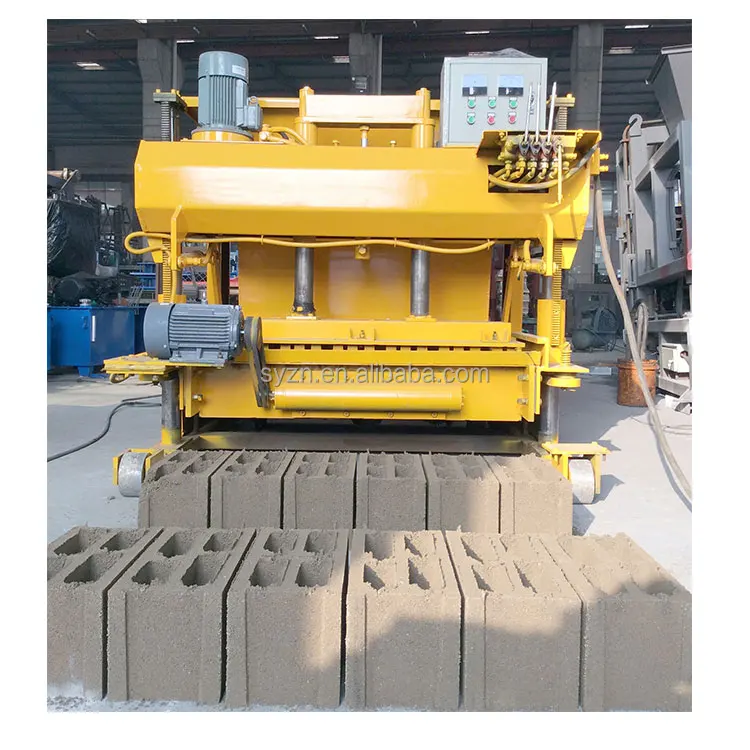
Pallet-free line layout — The QMY6-25 egg-laying design removes pallet feeding, rack handling, and stacking stations from your block production workflow, leaving only the mixer and material feed to synchronize with the press cycle.
Technical Specifications
| Parameter | Value |
|---|---|
| Product Type | Mobile Concrete Block Making Machine |
| Main Vibration Form | Three-dimensional excitation |
| Overall Power | 9.6 kW |
| Moving Method | Automatic movement with hydraulic steering |
| Overall Dimension | 2000 × 2100 × 1650 mm |
| Moulding Cycle | 25–30 s |
| Vibration Frequency | 3200 Hz |
| Pallet Requirement | No pallet required (egg-laying type) |
| Output — Hollow Block 400×200×200 mm | 1080 pcs/h, 8600 pcs/shift (8 h) (basis: 6 pcs/mould) |
| Output — Hollow Block 400×150×200 mm | 1260 pcs/h, 10000 pcs/shift (8 h) (basis: 7 pcs/mould) |
| Output — Solid Block 400×120×200 mm | 1620 pcs/h, 12960 pcs/shift (8 h) (basis: 9 pcs/mould) |
| Output — Solid Block 400×100×200 mm | 1800 pcs/h, 14400 pcs/shift (8 h) (basis: 12 pcs/mould) |
| Hydraulic Pressure | (basis not stated in source — confirm block format / material / thickness) |
| Vibration Force (kN) | (basis not stated in source — confirm block format / material / thickness) |
| Control System | (basis not stated in source — confirm PLC / MCC / manual) |
| Voltage & Frequency | (basis not stated in source — confirm target market standard) |
| Automation Level | Semi-automatic (single operator) |
| Warranty | 1 year (excluding spare parts) |
Application Suitability
| Application | Material or Output |
|---|---|
| On-site hollow block production | Crushed stone, sand, cement, and water mix laid directly on ground |
| Solid block and large-format block production | Dense aggregate mix for load-bearing wall construction |
| Low-investment starter block yard | Basic concrete mix without pallets or curing-rack infrastructure |
| Multi-site construction project work | Machine relocated across job sites via hydraulic steering |
Why "Pieces per Hour" Means Nothing Without the Block Format
A capacity number is only real when tied to a specific mould and block dimension.
I have watched contractors arrive at a block yard expecting the press to run flat-out all day, only to discover the quoted throughput assumed a small solid block while their market demands 8-inch hollow blocks. The difference between 1800 and 1080 pieces per shift on this QMY6-25 mobile block machine production line comes entirely from the mould cavity count, not from the operator working faster. When a supplier quotes a single headline figure without naming the format, the daily output you plan against will not match what actually leaves the yard. [NEED_CITE: mould cavity count and cycle time relationship in block production]
How the Egg-laying Design Reshapes the Line Layout
A stationary block plant needs a pallet return conveyor, a stacking robot or manual cubing station, and curing racks that occupy a building-sized footprint. The QMY6-25 mobile block machine eliminates every one of those stations. Blocks drop onto a prepared concrete floor and cure in place while the machine walks forward to the next position. Your line shrinks to three nodes: mixer, material feed, and the press itself. That simplification is exactly what keeps capital outlay low for first-time operators and remote project sites.
What the Supporting Equipment Must Keep Up With
The press cycles every 25–30 seconds, so your mixer and feeding belt must deliver a fresh batch within that window. If the mixer is undersized, the QMY6-25 mobile block machine production line sits idle between cycles, and your actual shift output drops well below the rated capacity. I plan the mixer volume and belt speed against the specific block format the buyer will run most, because a 6-cavity hollow mould consumes less material per cycle than a 12-cavity solid mould. Matching the feed rate to the moulding cycle prevents the most common bottleneck on simplified lines. [NEED_CITE: concrete batch sizing for block press cycle synchronization]
Reading the Specs That Actually Matter on Site
Three-dimensional vibration at 3200 Hz compacts the concrete mix from multiple axes, which matters when you are producing hollow blocks with thin webs that must hold together as soon as the mould lifts. The 9.6 kW overall power draw means a standard construction-site generator can supply the machine without a dedicated substation, keeping the mobile block machine production line viable in rural areas. Hydraulic steering lets the operator reposition the press across uneven ground without external handling equipment, so the machine follows the work area rather than the other way around. The 25–30 second moulding cycle applies across hollow and solid formats, but total pieces per cycle depend on the mould cavity count listed in the table above.
The Hidden Cost When the Line Is Not Specified as a System
When the mixer, feeder, and press arrive from different suppliers with no single party responsible for cycle synchronization, the blame game starts the first week. The mixer supplier says the press is cycling too fast; the press supplier says the mixer is too small. The result is a mobile block machine production line that never reaches the shift output anyone planned for. [NEED_CITE: equipment integration responsibility in block production projects]
Why Buyers Source the Line Through One Supplier
Block machinery is our single focus, so the QMY6-25, its mould, and the supporting mixer and feeder are specified as one matched system rather than assembled from separate vendors. We set the configuration against your local aggregate and target block format instead of shipping a catalogue default. Mould design and supply cover the formats your market actually sells, and custom drawings are available. Automation level is selectable, so you can begin with single-operator semi-automatic production and add equipment later. Installation and commissioning support includes operator training on your specific mix and block size.
Documentation & Verification
- Line layout showing mixer-to-press distance and feed path for your block format
- Capacity calculation sheet stating the exact mould and block size assumed
- Mould drawing and format list confirming cavity count per block type
- Voltage and control language confirmation before dispatch
- Factory test record on your target block format before shipment
Installation, Commissioning & Support
- Ground must be level concrete; the 2000 × 2100 mm footprint needs clear curing area ahead of travel path
- Verify local 3-phase voltage and frequency; 9.6 kW total draw requires a dedicated circuit or adequately rated generator
- Hopper and engine frame dismantled for container loading; two workers reassemble on arrival
- First-run commissioning sets moulding cycle and vibration timing to your local aggregate mix
- Single-operator training covers hydraulic steering, mould change, and daily grease-point maintenance
- Wear parts kit includes hydraulic hoses, seals, and vibration springs; replacements shipped by express
What to Prepare Before Requesting a Quotation
Share the block dimensions and wall thickness your market requires, along with the daily volume you need to hit. Tell us whether grid power is available on site or a diesel engine is necessary. Confirm the local voltage and frequency standard so the motor and control panel arrive ready to connect.
Frequently Asked Questions
Q: What supporting equipment does the QMY6-25 still require in a complete line?
A: You need a concrete mixer sized to deliver a fresh batch every 25–30 seconds, a wheelbarrow or short conveyor to feed the hopper, and a water supply for mixing and curing. We supply the mixer and feeding belt as a matched set so the mobile block machine production line never waits for material between cycles.
Q: How does pallet-free egg-laying production change the curing workflow?
A: Blocks cure directly on a prepared concrete floor instead of being racked. You eliminate pallet inventory, pallet-return conveyors, and rack-handling equipment. The trade-off is that the curing area must be flat, clean, and large enough for the day’s output to remain undisturbed until blocks reach handling strength.
Q: What floor surface and curing area conditions are required?
A: The machine lays blocks on a smooth, level concrete slab. Rough or sandy ground causes the blocks to shift before the concrete sets. Plan a curing zone long enough for one full shift of output, since the QMY6-25 moves forward in a straight line and cannot double back over fresh blocks.
Q: How do I verify daily output against my specific block format?
A: Request a capacity calculation that names your exact block dimension and mould cavity count. The figures in our specification table show how output shifts from 1080 to 1800 pieces per hour depending on whether you run 6-cavity hollow or 12-cavity solid moulds. Your daily plan must use the number matched to your market’s primary format.
Q: What voltage, frequency, and control language options are available?
A: Voltage and frequency are configured to your destination market standard before production. The control panel language is confirmed during the quotation stage so operators can read prompts in a familiar language on arrival, avoiding commissioning delays caused by translation errors.


