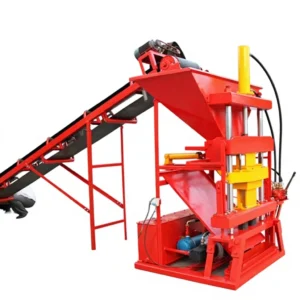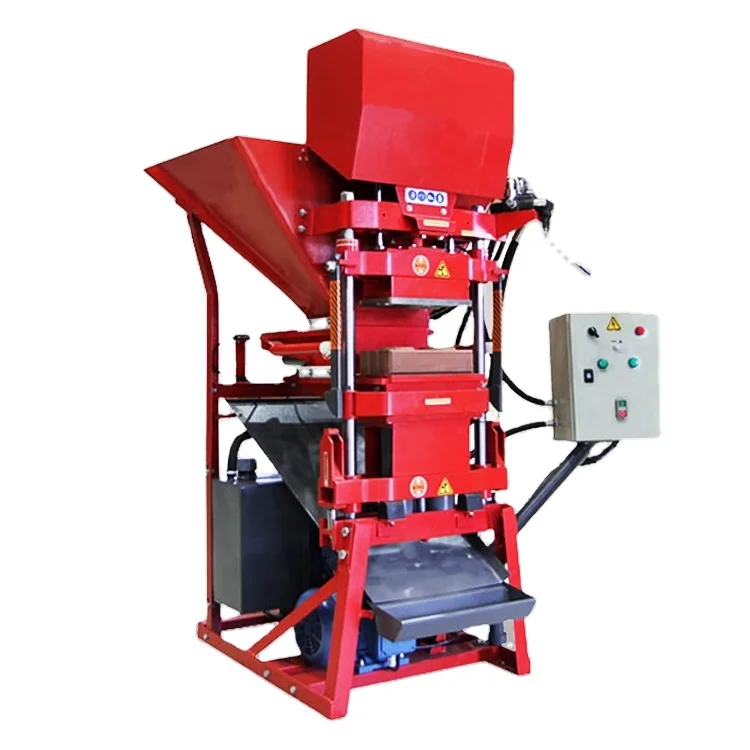
Line-Synchronized Configuration — The ECO 2700 is specified as one press within a full clay interlocking brick production line, with upstream mixer output, pallet circulation, and downstream stacking matched to its shaping cycle so no station sits idle.
Technical Specifications
| Parameter | Value |
|---|---|
| Model | ECO 2700 |
| Product Type | Clay Interlocking Brick Making Machine |
| Overall Dimensions (L×W×H) | 1000×1000×1800 mm |
| Shaping Cycle | 15–20 seconds (basis not stated in source — confirm block format / material / thickness) |
| Hydraulic Pressure | 16 MPa |
| Rated Power | 5.5 kW |
| Total Weight | 1000 kg |
| Voltage & Frequency | 380V, 3-phase, 50Hz (configurable to local supply) |
| Mould Format | Interlocking clay brick (specific dimensions to be confirmed) |
| Control System | To be confirmed (manual / PLC options available) |
| Pallet Size | To be confirmed based on curing area and forklift |
| Certification | CE (certificate scope to be verified) |
| Warranty | 1 year |
Application Suitability
| Application | Material or Output |
|---|---|
| Small-scale clay interlocking brick plant | Local clay blended with sand, laterite, or volcanic ash |
| On-site brick forming for building contractors | Excavated site soil mixed with stabilizer for immediate wall construction |
| Workshop production for first-time block entrepreneurs | Sourced clay with cement or lime binder for interlocking wall units |
| Format expansion for existing masonry product lines | Clay and aggregate blends to add interlocking brick alongside hollow blocks or pavers |
What a 15-Second Cycle Means When the Mixer Can’t Keep Up
A fast press cycle only matters if raw material arrives and pallets return at the same pace — otherwise the clay interlocking brick machine production line stalls between every stroke.
I have watched a press sit idle for five or six seconds per cycle simply because the pan mixer was undersized for the press throughput, turning a rated shaping speed into a fraction of its potential daily output. The ECO 2700 completes a shaping stroke every 15 to 20 seconds, which means the upstream mixer must deliver a fresh batch within that window, and the pallet return loop must clear and reposition a board in the same time. [NEED_CITE: line cycle synchronization principles in masonry production] When these stations are quoted separately and sized independently, the buyer ends up with a bottleneck that no amount of press optimization can fix.
How Raw Material Feeding Sets the Line Rhythm
The clay interlocking brick machine production line begins well before the press. Raw clay must be broken, screened, and fed at a steady rate into the mixer. If the hopper and belt are sized for a smaller press, the ECO 2700 will draw material faster than it arrives, forcing the operator to pause the cycle or accept under-mixed batches. Consistent feed rate and moisture content determine whether the 16 MPa hydraulic pressure produces uniform block density or bricks that crack during curing.
Pallet Circulation as the Hidden Bottleneck
The ECO 2700 weighs 1000 kg and occupies a compact 1000×1000 mm footprint, which is favorable for tight site layouts. But a tight footprint also means pallet travel distance is short and pallets must be cleaned, dried, and returned quickly. If the curing rack system or pallet stacker is not included in the initial line specification, workers end up carrying wet boards by hand — and the press waits. [NEED_CITE: pallet handling integration in block production lines] The pallet size must also match the buyer’s existing forklift tine width and curing area dimensions, not just the press platen.
Matching Pressure to the Local Clay Mix
Hydraulic pressure at 16 MPa must be evaluated against the specific clay blend the buyer will actually use. Clay with high sand content requires different compaction force than pure laterite or volcanic ash mixes. I spent a full week on a job in Indonesia where the clay had far more sand than the test samples used during factory commissioning, and interlocking bricks kept losing corners on demoulding until we adjusted both the mix ratio and the pressure settings. The ECO 2700 should be commissioned against the buyer’s real aggregate, not a catalogue default.
Reading the Specs That Actually Matter for Line Design
The 5.5 kW rated power determines the electrical supply sizing not just for the press but for the entire clay interlocking brick machine production line — mixer motor, conveyor drives, and pallet handling equipment all draw from the same panel. The 380V three-phase 50Hz default must be confirmed against the buyer’s site transformer, especially in markets where 415V or 220V three-phase is standard. The compact overall dimensions leave minimal margin for pallet guide rails and splash guards, so the line layout drawing must account for these additions before foundations are poured. Shaping cycle of 15 to 20 seconds assumes a specific brick format and material consistency; any change in block thickness or clay moisture content will shift this figure.
When the Quotation Stops at the Press
Leaving pallet handling, stacking, and curing out of the initial quotation means the buyer faces unplanned costs after the machine arrives. Workers stacking freshly pressed interlocking bricks by hand introduces handling damage, inconsistent curing, and slower throughput than the press can physically deliver. [NEED_CITE: hidden costs in block plant commissioning] A line that was never specified as a system also means voltage, control language, and safety interlocks may differ between stations — the mixer might arrive with a Chinese-language panel while the press has English labels, complicating operator training on day one.
Why Specifying the Whole Line Here Makes Sense
Block machinery is the single focus here, so the ECO 2700 press, its moulds, pallets, and handling equipment are specified as one matched system rather than assembled from separate vendors. Configuration is set against the buyer’s actual clay mix, local aggregate, and target brick format — not a generic catalogue default. Mould design covers the interlocking brick dimensions the buyer’s market actually sells, including custom drawings. Automation level is selectable, allowing a buyer to start with manual pallet handling and add automatic stacking later. Installation includes line commissioning and operator training so the full clay interlocking brick machine production line runs before the engineering team leaves site.
Documentation & Verification
- Line layout drawing showing ECO 2700 station positions, pallet paths, and mixer placement
- Capacity calculation stating the interlocking brick format assumed for the 15–20 second cycle
- Hydraulic and electrical schematics covering the press and all connected line stations
- Voltage, frequency, and control language confirmation sheet for every motor in the line
- Factory test record using the buyer’s specified clay mix and target brick format
- CE declaration documentation with scope covering the full line configuration
Installation, Commissioning & Support
- Foundation pad sized to the 1000×1000 mm ECO 2700 footprint plus pallet return clearance
- Dedicated 3-phase circuit rated for 5.5 kW press load plus all line motors combined
- Machine arrives with mould installed; pallet system and mixer assembled on site
- Commissioning includes pressure and cycle adjustment against the buyer’s local clay blend
- Operator training covers press operation, mould change, and full line start-up sequence
- Wear parts list with hydraulic seals and mould liner replacement intervals
What to Share Before Requesting a Quote
To configure the ECO 2700 within a complete production line, share your target interlocking brick dimensions, the local clay type and any aggregate you plan to blend, and your expected daily output target. Include your site voltage and frequency, available curing area dimensions, and whether you already have forklifts or pallet racks on site. If you have an existing mixer or conveyor, provide its model and capacity so the line can be designed around it.
Frequently Asked Questions
Q: How do I verify the ECO 2700 output capacity for my brick format?
A: The shaping cycle is listed as 15–20 seconds, but that figure depends on the specific interlocking brick dimensions, wall thickness, and clay moisture content. Request a capacity calculation that names your exact brick format and states the cycle time per piece, then multiply by your planned operating hours to get a realistic daily output rather than relying on a generic hourly rating.
Q: What happens if the mixer output doesn’t match the press cycle?
A: If the mixer delivers material slower than every 15–20 seconds, the ECO 2700 will idle between strokes and your daily output drops. The line specification should state mixer batch size and discharge time so the mixer and press are sized as a matched pair, not as separate purchases that happen to share a workshop.
Q: How do I choose the right pallet size for my curing area?
A: Pallet dimensions must fit the ECO 2700 platen, your curing rack spacing, and your forklift tine width simultaneously. Share your curing area layout and forklift model before the line is specified so pallet size is chosen against your actual site equipment, not a default that may require new racks or handling gear.
Q: Are voltage and control language confirmed for every station in the line?
A: The ECO 2700 defaults to 380V three-phase 50Hz with customizable voltage, but the mixer, conveyors, and stacking equipment must match. Confirm your site supply, frequency, and preferred display language for all stations before production so no single panel arrives with incompatible wiring or unreadable labels.