
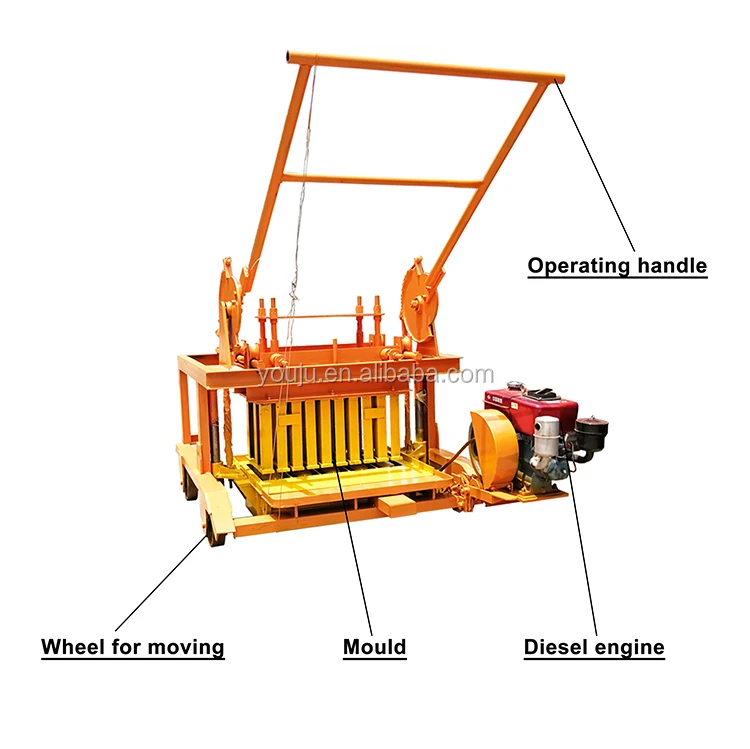
Line-Centered Design — The QMR4-45 diesel mobile block machine production line is planned around matched cycle times between mixer throughput, press moves and ground-curing logistics, not just the press alone.
Technical Specifications
| Parameter | Value |
|---|---|
| Model | QMR4-45 |
| Product Type | Diesel Movable Egg-Laying Concrete Block Machine |
| Overall Dimensions (L×W×H) | 2420×1320×1650 mm |
| Net Weight | 810 kg |
| Forming Method | Hydraulic pressure (diesel-driven) + vibration |
| Moulding Cycle | 40–45 s |
| Power Source | Diesel engine, 6 kW / 6–8 HP |
| Rated Power | 6 kW (source value — verify electric vs. hydraulic pump drive) |
| Voltage | 220 V / 380 V or customized (source value — confirm applicability with diesel primary drive) |
| Pallet Requirement | None (egg-laying type) |
| Output Capacity — 400×200×200 mm hollow | 4 pcs/mould, 3000 pcs/day (8 h shift) |
| Output Capacity — 400×150×200 mm hollow | 5 pcs/mould, 3500 pcs/day (8 h shift) |
| Output Capacity — 400×120×200 mm hollow | 6 pcs/mould, 4500 pcs/day (8 h shift) |
| Automation Level | Manual / semi-manual operation |
| Control System | Not stated in source |
| CE Compliance | Referenced in company documentation policy — confirm for this model |
Application Suitability
| Application | Material or Output |
|---|---|
| Remote housing projects without grid power | Hollow blocks from local crushed stone, river sand and cement |
| Contractor on-site block yards | 400×200×200 mm and 400×150×200 mm hollow blocks laid directly on prepared ground |
| Small-scale entrepreneur first plant | Hollow blocks from available aggregate with diesel-only operation |
| Infrastructure project field production | Kerb-grade and wall-grade hollow blocks in shifting site locations |
What "3000 Blocks a Day" Leaves Out About Your mobile block machine production line
Daily figures assume a specific block format, mixer readiness and enough cured ground area for an 8-hour run — none of which are included in a press-only quote.
I have watched a mobile block machine production line stall by mid-morning because the pan mixer was sized for a 60-second batch while the press cycled every 40 seconds. The operator stood idle, diesel burning, waiting for the next batch. Capacity on paper said 3000 blocks; actual count barely reached half. [NEED_CITE: typical mixer-to-press cycle mismatch in small block yards]
Line Sizing Starts at the 40–45 Second Moulding Cycle
Every station upstream and downstream of the QMR4-45 must clear material within that 40–45 s window, or the press sits idle and the diesel engine burns fuel for nothing. A mobile block machine production line is only as fast as its slowest station, and on egg-laying setups the bottleneck is almost always the mixer or the ground-curing logistics.
Mixer Batch Volume and Raw Material Feed Rate
The mixer must deliver a finished batch every two to three press cycles to account for travel time between laying positions. For the 400×200×200 mm hollow format producing 4 blocks per cycle, that means a batch volume large enough to feed continuous moves without the operator walking back to wait. Raw material stockpiles — cement, sand, aggregate — must sit within wheelbarrow or hopper distance so loading does not become the next bottleneck. [NEED_CITE: batch sizing methodology for mobile egg-laying block presses]
Ground Curing Area and Machine Travel Path
Egg-laying operation removes pallets from the equation, which means blocks cure where they are laid. A full 8-hour shift at 40–45 s cycles demands a flat, prepared concrete surface large enough to hold several thousand blocks without the machine crossing its own fresh output. The line layout must show travel lanes, curing zones and stockpile positions before the press arrives on site.
How Vibration Force and Hydraulic Pressure Shape Block Density
The QMR4-45 uses a diesel-driven hydraulic pump feeding both the press head and the vibration mechanism. Hydraulic pressure sets the compaction force while vibration settles the mix into the mould cavity; together they determine whether a 400×200×200 mm hollow block leaves the mould with clean webs and consistent wall thickness. If local aggregate is angular or poorly graded, vibration amplitude and cycle duration must be adjusted — a parameter the operator tunes on-site, not a fixed catalogue number. The 810 kg machine weight also contributes: a heavier frame resists lift during vibration, transferring more energy into the block rather than shaking the machine itself.
The Cost of Skipping Line Layout Before You Order
When a buyer purchases a mobile press without a supporting line drawing, the mixer ends up too far from the stockpile, the curing area runs out by noon, and wheelbarrow traffic crosses fresh blocks. I have seen crews hand-carry wet blocks to distant ground because no one planned the travel path. Output drops, block edges chip, and the contractor blames the machine. [NEED_CITE: common site preparation failures in off-grid block production]
Why Source the Line Here
Block machinery is a single focus, so the QMR4-45 arrives with its mixer, feed arrangement and ground-curing plan specified as one matched system rather than separate purchases bolted together later. Configuration is set against your actual mix design and local aggregate, not a catalogue default. Mould formats cover the hollow blocks your market sells, with custom drawings available if your region uses a non-standard size. Automation level is selectable — start manual and add a powered feeder later without replacing the press. Installation guidance includes operator training on the diesel hydraulic system so your crew can tune vibration and pressure to their specific material from day one.
Documentation & Verification
- Line layout drawing with mixer position, machine travel path and curing area sized per block format
- Capacity calculation stating which hollow block format the daily output figure assumes
- Voltage and frequency confirmation for any ancillary electric stations on your site supply
- Factory test record on your specified aggregate and mix ratio before dispatch
- Operation manual covering diesel engine, hydraulic system and vibration mechanism as one unit
Installation, Commissioning & Support
- Flat concrete ground prepared to 2420×1320 mm minimum travel lane width for the QMR4-45 footprint
- Diesel fuel storage positioned away from cement stockpile to avoid contamination of the 6 kW engine intake
- Ancillary mixer wired to confirmed local voltage and frequency before the line starts
- First-run vibration and hydraulic pressure adjustment on your actual aggregate mix
- Wear parts list for hydraulic seals and mould liners included at delivery
What We Need to Plan Your Line
Tell us which hollow block formats sell in your market and your target daily output so we can size the mixer and curing area around the QMR4-45 cycle. Share your local aggregate type and whether grid electricity is available for ancillary stations. Confirm your site dimensions so we can draft a travel path and ground-curing layout before the machine ships.
Frequently Asked Questions
Q: How is daily output verified across the whole line, not just the press cycle?
A: We calculate output per block format — for example 3000 pcs/day for 400×200×200 mm hollow blocks over an 8-hour shift — then confirm the mixer batch cycle and curing area can sustain that rate without the press waiting between moves.
Q: What site preparation is needed before the line starts producing?
A: You need a flat concrete surface large enough for an 8-hour curing area, diesel fuel storage, and raw material stockpiles within wheelbarrow distance of the mixer. We provide a layout drawing before shipment.
Q: Which ancillary stations still need grid electricity on a diesel-driven line?
A: The press itself runs on diesel, but the pan mixer and any powered feeder may require site electricity. We confirm voltage and frequency for those stations against your local supply before building.
Q: How does the layout change if I add solid blocks or pavers later?
A: Solid blocks and pavers change the mould, cycle time and block weight. The curing area may need repositioning because heavier formats require shorter carrying distances. We revise the line drawing accordingly.


