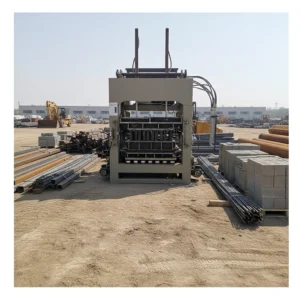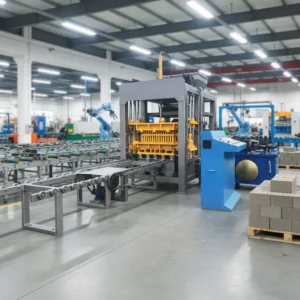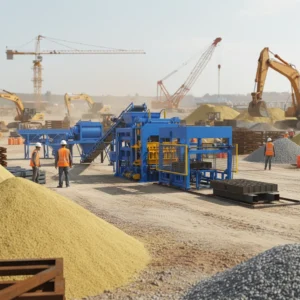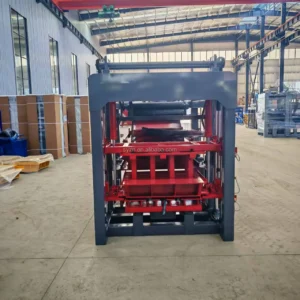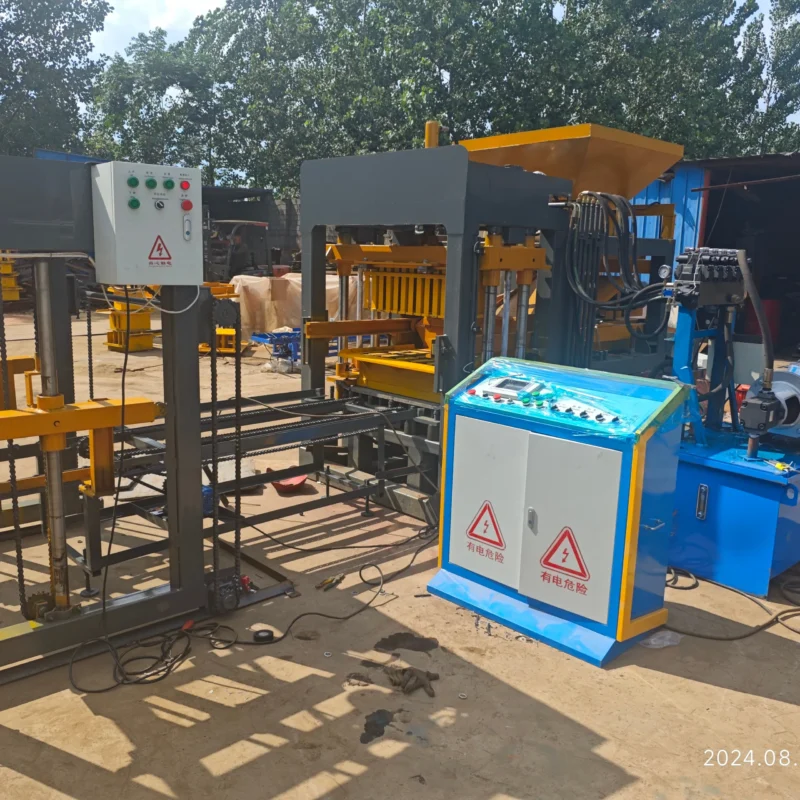
Matched Line Throughput — the QT4-18 block production line equipment is specified station by station so the mixer, conveyor, press, and pallet return each hold the same cycle rhythm without one bottleneck starving the next.
Technical Specifications
| Parameter | Value |
|---|---|
| Product Type | Semi-Automatic Concrete Block Making Machine |
| Model | QT4-18 |
| Overall Dimensions | 3900 × 1600 × 2300 mm |
| Molding Cycle | 15–25 s (basis not stated in source — confirm block format, material, and thickness before quoting daily output) |
| Vibration Force | 40–50 kN |
| Rated Power | 24 kW (rated or peak not specified in source) |
| Mixer Model | JQ350 |
| Pallet Size | 850 × 550 × 25 mm |
| Total Weight | 3 T |
| Applied Products | Paver, solid block, hollow block, curbstone |
| Raw Materials | Crushed stones, sand, cement, dust, fly ash |
| Output Capacity | 1200–1680 pcs/hr based on 400×200×200 mm hollow block, 15–20 s cycle, 4 pcs/mould |
| Output Capacity | 9600–13440 pcs/8hr based on 400×200×200 mm hollow block |
| Output Capacity | 1800–2400 pcs/hr based on 400×150×200 mm hollow block, 15–20 s cycle |
| Output Capacity | 14400–19200 pcs/8hr based on 400×150×200 mm hollow block |
| Output Capacity | 3240 pcs/hr based on 240×115×53 mm solid brick, 15–20 s cycle |
| Output Capacity | 16200–19440 pcs/8hr based on 240×115×53 mm solid brick |
| Automation Level | Semi-automatic, automatic stacker available as line component |
| Hydraulic Station | Included |
| Mould Change System | Manual mould change supported across multiple block formats |
| Voltage & Frequency | Not stated in source — confirm before production |
| Control System | Not stated in source — confirm before production |
| PLC Language Options | Not stated in source — confirm before production |
Application Suitability
| Application | Material or Output |
|---|---|
| Hollow block production for building contractors | 400×200×200 mm and 400×150×200 mm formats from crushed stone, sand, and cement |
| Solid brick manufacturing for local supply yards | 240×115×53 mm standard brick using fly ash, dust, and cement blends |
| Paving block output for municipal and landscape projects | Interlocking and rectangular pavers from graded aggregate and cement |
| Curbstone and kerb production for roadworks | Heavy-section kerb units from dense aggregate mixes |
| On-site production for housing developments | Self-contained line running local aggregate sourced within the project region |
Why the Press Is Never Left Waiting in a Balanced Block Production Line Equipment Layout
Every station upstream and downstream of the QT4-18 is timed to the press molding cycle so material arrives and pallets return before the ram completes its stroke.
A block plant that quotes a fast cycle at the press often disappoints once running because the mixer batch size does not match the press hopper, or the pallet conveyor cannot return cured boards quickly enough. I once traced a plant running well below nameplate output back to a pallet return belt that added several seconds per cycle — the press sat idle while operators pushed boards by hand. When block production line equipment is specified as one matched set rather than a collection of separate purchases, those timing gaps disappear before the first foundation bolt is tightened [NEED_CITE: importance of line balancing in concrete block manufacturing].
Station-to-Station Timing Across the QT4-18 Line
The JQ350 mixer is selected so its batch discharge rate feeds the QT4-18 press hopper continuously through the 15–25 second molding window. If the mixer were undersized, the press would pause between cycles waiting for the next batch of concrete, and the block production line equipment would never reach the throughput figures on paper.
How Pallet Circulation Sets the Real Ceiling
Pallet size at 850 × 550 × 25 mm determines how many boards are needed to fill the curing racks before they return to the press. With semi-automatic operation, pallets move via trolley and manual handling, so the quantity on order must cover the full curing loop plus a working buffer. A pallet shortage forces the press to stop even when concrete and moulds are ready [NEED_CITE: pallet circulation requirements in semi-automatic block plants].
Reading the Numbers Behind Vibration and Hydraulic Pressure
The 40–50 kN vibration force works together with hydraulic pressure to compact the concrete mix inside the mould cavity. Higher vibration alone does not guarantee block strength if the hydraulic ram does not apply sufficient top pressure to close the particle gaps. For hollow blocks at 400×200×200 mm, the four-cavity mould produces a stated output of 1200–1680 pieces per hour at a 15–20 second cycle — but those figures hold only when the vibration frequency, hydraulic pressure, and mix moisture are all tuned to the local aggregate. The pallet thickness of 25 mm also matters: thinner boards flex under vibration and produce uneven density, while thicker boards add weight that slows manual pallet handling downstream.
The Hidden Cost of Specifying Only the Press
When a quotation covers the press alone and leaves pallet handling, stacking, and curing as the buyer’s responsibility, the plant opens with operators lifting wet blocks by hand onto whatever boards they can source locally. That arrangement caps daily output far below the machine’s rated capability and accelerates pallet wear from forklifts not matched to the board dimensions. Buying block production line equipment as a full set — mixer, conveyor, press, pallets, and stacking — removes those gaps from day one [NEED_CITE: cost impact of incomplete line quotations in block manufacturing].
Why Sourcing the Line from One Supplier Changes the First Month
Configuration starts from the buyer’s actual mix design and local aggregate, not a catalogue default, so the JQ350 mixer ratio and press vibration are aligned before shipment. Mould design covers the formats the buyer’s market sells, including custom drawings for non-standard block shapes. Pallet quantity and material are recommended based on the curing area layout and the forklift already on site. Automation can begin at semi-automatic with trolley-assisted handling and move to full stacking and cubing as volume grows, using the same press frame. Documentation arrives as one set — line layout, capacity calculation per block format, hydraulic and electrical schematics, and factory test records — so commissioning does not stall over missing drawings.
Documentation & Verification
- Line layout drawing with capacity stated per block format and assumed cycle time
- Machine specification sheet covering QT4-18 press, JQ350 mixer, and pallet dimensions
- Hydraulic and electrical schematic showing station interlocks and control wiring
- Pallet specification with material grade and recommended quantity for curing loop
- Factory test record run on the buyer’s target block format before dispatch
- Voltage, frequency, and control language confirmation sheet signed before production
Installation, Commissioning & Support
- Foundation plan sized to the 3900 × 1600 mm press footprint and 3 T operating weight
- Electrical supply matched to the 24 kW rated power with dedicated circuit breaker
- Press arrives with hydraulic station pre-assembled and tested at the factory
- On-site commissioning includes vibration and pressure tuning to the buyer’s aggregate blend
- Operator training covers mould change procedure across hollow, solid, paver, and curbstone formats
- Wear parts list identifies vibration table pads, hydraulic seals, and mould liners for first reorder
What to Include in Your Inquiry
Provide the block format your market sells and the daily output you need so the line can be configured around a realistic cycle time. Confirm the local aggregate type and cement grade so the JQ350 mixer and press settings are matched before build. State your site voltage, frequency, and preferred control language so electrical panels and displays are correct on arrival [NEED_CITE: electrical standards for industrial machinery by export region].
Frequently Asked Questions
Q: How is daily output calculated for each block format, and what cycle time is assumed?
A: Output figures are based on specific block dimensions and a stated molding cycle. For example, 400×200×200 mm hollow blocks yield 9600–13440 pieces per 8-hour shift at a 15–20 second cycle with four cavities per mould. Each format on the quotation lists its own assumed cycle and output, so there is no single number applied across different block sizes.
Q: What happens to line throughput if the mixer or conveyor cannot keep up with the press?
A: The press pauses between cycles waiting for the next concrete batch or an empty pallet, and actual daily output drops well below the rated figure. That is why the JQ350 mixer and belt conveyor are sized to the QT4-18 hopper demand, so material and pallets arrive before the molding cycle completes.
Q: How are pallet quantity and material selected to match the curing area and existing forklift?
A: Pallet count must cover every board in the curing racks plus those circulating back to the press. The 850 × 550 × 25 mm pallet size is confirmed against the buyer’s rack spacing and forklift fork width so boards fit without modification to existing handling equipment.
Q: Can the automation level be upgraded from semi-automatic to full stacking and cubing later?
A: Yes. The QT4-18 line starts with trolley-assisted pallet handling and manual stacking, and an automatic stacker and cubing station can be added as production volume grows. The press frame, moulds, and pallet size remain unchanged through the upgrade.
Q: Which line components are included in the quotation and which are optional?
A: The standard quotation covers the QT4-18 press, JQ350 mixer, belt conveyor, hydraulic station, moulds for the specified block format, and pallets at a recommended quantity. Automatic stacking, cubing, and curing rack handling systems are listed as optional additions so the buyer can match the investment to their current production stage.