
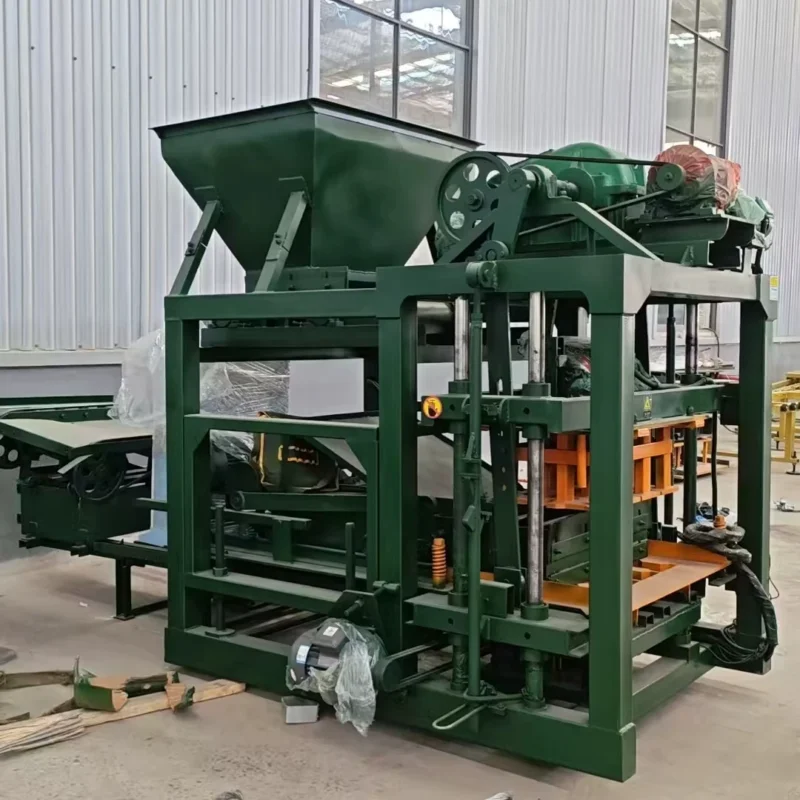
Complete Line Stationary Block Making Machine – Production Line
Line-as-a-system design — mixer, press, pallet and trolley are specified together so the host machine never idles waiting for material or handling.
Technical Specifications
| Parameter | Value |
|---|---|
| Model | QTJ4-25 |
| Product Type | Stationary Block Making Machine |
| Rated Power | 17.9 kW |
| Overall Dimensions (L×W×H) | 6400 × 1500 × 2700 mm |
| Net Weight | 2500 kg |
| Molding Cycle | 25 s |
| Vibration Frequency | 2800 r/min |
| Exciting Force | 60 kN |
| Pallet Size | 850 × 550 × 20 mm |
| Included Mixer | JQ350 |
| Automation Level | Semi-automatic |
| Stacking Method | Manual trolley to curing area |
| Control System | Hydraulic station with relay logic (PLC available on request) |
| Output Capacity | 960 pcs/h, 7680 pcs/day (based on 400×200×200 mm hollow block, 4 pcs/mould) |
Application Suitability
| Application | Material or Output |
|---|---|
| Hollow block production | Crushed stone, sand, cement, fly ash for 8-inch, 6-inch, 5-inch and 4-inch formats |
| Solid block production | Dense aggregate and cement mixes for load-bearing masonry |
| Paving block production | Fine aggregate and pigment blends for interlocking and rectangular pavers |
| Curbstone production | High-strength mixes for kerb and edge restraint formats |
What "960 Pieces per Hour" Actually Means on the Shop Floor
Capacity figures only hold when every station in the stationary block making machine production line keeps pace with the press cycle.
Quoted output often assumes the press runs uninterrupted for a full shift. In reality, material arrives late from the mixer, pallets are not staged in time, or the curing area is too far for manual trolley handling to keep up. I have walked onto sites where a machine rated for 7,680 blocks per day on a 400×200×200 mm hollow block was producing barely half that, simply because the JQ350 mixer batch time was not matched to the 25-second molding cycle. The press sat idle while operators waited for the next batch. [NEED_CITE: cycle time matching across block line stations]
How Stations Connect Around the Press
The QTJ4-25 stationary block making machine production line is arranged so the JQ350 mixer discharges into a conveyor belt that feeds the host machine hopper. The conveyor rate must deliver a fresh batch before the hopper runs dry mid-cycle. Downstream, formed blocks sit on 850×550 mm pallets that operators push onto a manual trolley and wheel to the curing yard. If the curing yard is more than a short trolley run away, pallets pile up at the press exit and the molding cycle slows. Every station connection in this semi-automatic line is a potential bottleneck, and the layout must be planned before the equipment arrives.
Why Pallet Specification Drives the Whole Curing Layout
Pallets are the unit of work that moves through every station. The 850×550 mm pallet size on the QTJ4-25 determines how many blocks ride per cycle, how many pallets fit on a single trolley, and how the curing yard must be racked. If a buyer’s existing forklift or trolley cannot handle that dimension, pallets must be manhandled by two workers instead of one, and curing rack spacing has to be rebuilt. I have seen plants where the pallet size was chosen from a catalogue default without anyone measuring the curing area, forcing a complete re-layout within the first month of operation. [NEED_CITE: pallet dimension standards in small block plants]
Reading the Specs That Matter Beyond the Brochure
The 60 kN exciting force at 2800 r/min is delivered through vertical vibration of the bed mould combined with compression vibration from the upper mould head. This dual action consolidates the mix from both directions, which directly affects block density and early demoulding strength. If the local aggregate is rounded river gravel rather than crushed stone, the vibration force may need adjustment through the hydraulic station to prevent surface cracking. The 17.9 kW rated power covers the host machine, mixer, and conveyor together; the buyer’s electrical panel must provide a dedicated circuit at the correct voltage and frequency, confirmed before the control cabinet leaves the workshop. A mismatch there means weeks of waiting for a transformer on site.
The Hidden Cost of an Incomplete Line Quotation
A quotation that covers only the press and one mould leaves the buyer to source pallets, trolleys, and curing racks locally at whatever dimensions happen to be available. When those do not match the 850×550 mm pallet footprint, operators spend more time moving blocks than forming them. Mould change time is another frequent surprise: if the machine arrives with a single hollow block mould and the buyer later orders a paver mould, the changeover procedure may not have been demonstrated during commissioning, turning what should be a format switch into a half-shift project. [NEED_CITE: mould change procedure documentation for semi-automatic presses]
What a Matched Line Buys You
Block machinery is the only thing this workshop builds, so the QTJ4-25 line is configured as one system rather than assembled from unrelated suppliers. Mixer capacity, conveyor feed rate, pallet size, and trolley type are all set against the buyer’s actual block format and local aggregate before the order goes to production. Mould options — hollow, solid, paver, curbstone — are designed in-house, and a custom mould drawing is provided when the buyer supplies a format sketch. Voltage, frequency, and control language are written into the technical agreement so the cabinet powers up on the first day. Installation support includes operator training on mould change and daily maintenance routines.
Documentation & Verification
- Line layout drawing showing station spacing and pallet flow path
- Capacity calculation sheet stating the block format assumed for each output figure
- Mould drawing and format list with cycle time per format
- Hydraulic and electrical schematic with confirmed voltage and frequency
- Factory test record run on the buyer’s specified block format before dispatch
- Operation and maintenance manual in the agreed control language
Installation, Commissioning & Support
- Foundation plan sized to the 6400×1500 mm machine footprint and vibration load
- Dedicated circuit for the 17.9 kW total line load at confirmed voltage and frequency
- Machine arrives in bolted sections; reassembly and alignment completed on site
- First-run commissioning includes mixer batch time tuning to the 25-second molding cycle
- Operator training covers mould change, pallet staging, and daily greasing points
- Wear parts list provided with recommended reorder intervals for vibration springs and hydraulic seals
Before You Send the Inquiry
Provide your target block formats and the daily output you need for each one, along with the local aggregate type available in your area. Confirm the voltage, frequency, and preferred control language for your site so the electrical cabinet is built correctly from the start. If you already have pallets, trolleys, or a curing yard in place, share their dimensions so the line can be matched to what you have rather than forcing a full rebuild after arrival.
Frequently Asked Questions
Q: How is daily output calculated, and which block format does each figure assume?
A: The 960 pieces per hour and 7,680 pieces per day figures are based on 400×200×200 mm hollow blocks at four pieces per mould with a 25-second cycle. Output for solid blocks, pavers, or smaller hollow formats will differ because cycle time and pieces per mould change. A capacity sheet stating the assumed format is provided with every quotation.
Q: What supporting equipment is included, and where do bottlenecks typically appear?
A: The line includes the JQ350 mixer, conveyor belt, host machine, one mould set, pallets, and a manual trolley. The most common bottleneck is between the mixer discharge and the press hopper when batch timing does not align with the molding cycle, or at the curing end if trolley travel distance is too long for one operator.
Q: How do pallet dimensions affect curing area layout and handling equipment?
A: The 850×550 mm pallet size determines trolley capacity, curing rack spacing, and forklift compatibility. Buyers with existing handling equipment should confirm those dimensions match before ordering, otherwise pallets and racks may need to be sourced or modified locally to fit the line.
Q: What is involved in changing moulds between block formats?
A: Mould change requires releasing the bed mould clamps, lifting out the current mould, positioning the new one, and re-aligning the upper mould head. The procedure is covered during commissioning training. Buyers planning frequent format switches should request a second mould set at the time of order so changeover can be practiced on site from day one.


