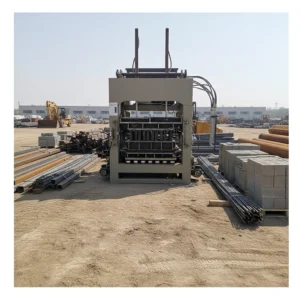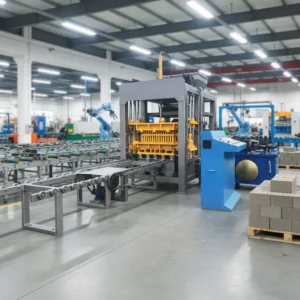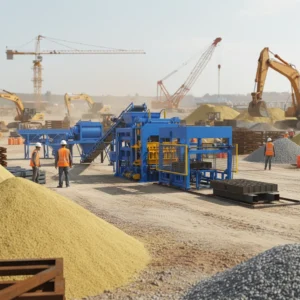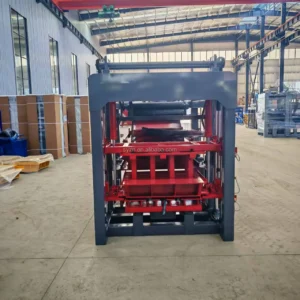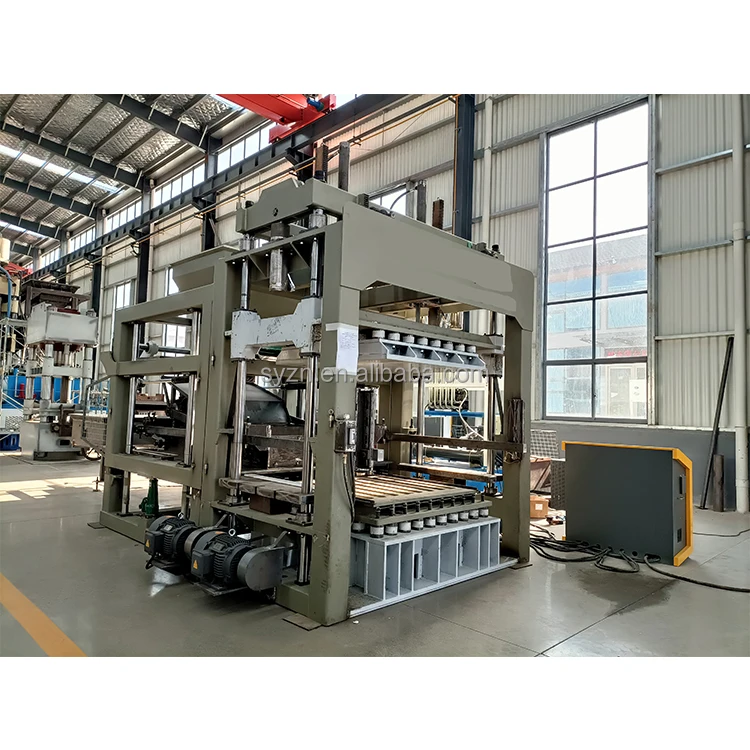
Single Focus Integration — The QT8-15 operates within a synchronized block production line where raw material feeding, mixing, pallet handling, stacking, and curing are specified as one matched system rather than assembled from unrelated suppliers.
Technical Specifications
| Parameter | Value |
|---|---|
| Model | QT8-15 |
| Product Type | Automatic Hydraulic Block Making Machine |
| Overall Dimensions (L×W×H) | 8300 × 1860 × 3000 mm |
| Rated Pressure | 21 MPa |
| Main Vibration Form | Platform Vibration |
| Vibration Frequency | 2800–4500 r/min |
| Vibration Force | 45 kN |
| Pallet Size | 950 × 900 mm |
| Molding Cycle | 15–20 s (basis to be confirmed by block format and mix) |
| Overall Power | 55.5 kW |
| Demolding Method | Hydraulic |
| Total Mass | 8 T |
| Factory Area | 300 m² |
| Raw Materials | Crushed stone, sand, cement, fly ash, gravel, slag |
| Warranty | 1 year for the whole machine (excluding spare parts) |
| Loading | 1×40HQ container (basic equipment) |
Application Suitability
| Application | Material or Output |
|---|---|
| Hollow block production | Crushed stone, sand, cement blends |
| Solid block production | Fly ash, gravel, cement mixes |
| Paving block manufacturing | Colored aggregate with cement binder |
| Interlocking block forming | Slag, sand, and cement combinations |
| Kerbstone and curb production | Dense crushed stone and cement ratios |
| Colored paver runs | Pigmented sand-cement surface mixes |
Why "Cycles Per Hour" Means Nothing Without the Rest of the Line
A press that completes a cycle every 15–20 seconds only delivers that rate if upstream mixing and downstream pallet return keep exact pace.
Many quotations quote the QT8-15 molding cycle in isolation, leaving buyers to discover after commissioning that the mixer batch time runs longer than the press cycle, or the pallet conveyor cannot return boards fast enough. The result is an operator standing idle at the press, waiting for material or pallets, and actual daily output falling well short of expectations [NEED_CITE: block production line synchronization and throughput gaps].
How Station Timing Determines Real Throughput
When configuring a block production line around the QT8-15, each station from raw material intake to cured block stacking must be calculated against the 15–20 second press cycle. The mixer must deliver a fresh batch to the hopper before the press completes its current mold fill. If the mixer takes 25 seconds per batch while the press cycles at 15 seconds, every third cycle stalls.
The pallet return loop must also match. After blocks are demolded, wet boards travel along a conveyor to the stacking area, and empty pallets must circle back to the press feed station within the same window. A pallet conveyor that runs slower than the press creates a bottleneck that no amount of press speed adjustment can fix. This is where a turnkey block making plant design separates itself from a simple machine purchase.
Matching Pallet Specification to Your Curing Area
The QT8-15 runs on 950 × 900 mm pallets, but that dimension only works if the buyer’s existing curing racks and forklift can handle it. A plant that standardized on 850 × 700 mm pallets for an earlier machine will find that new racks and handling equipment must be purchased, or the pallet size must be adjusted before the line is finalized.
Pallet material also matters. Bamboo pallets, PVC pallets, and steel pallets each have different weights, flex characteristics, and service lives under vibration loading. The choice affects forklift load capacity, curing rack deflection limits, and the frequency of pallet replacement. Specifying the pallet without referencing the curing infrastructure already on site creates a mismatch that surfaces only after the first production run [NEED_CITE: pallet material selection for concrete block curing systems].
Reading the Numbers That Actually Shape Output
The 21 MPa rated hydraulic pressure and 45 kN vibration force work together to compact the mix into the mold cavity. Hydraulic pressure alone does not guarantee block density — it is the vibration frequency range of 2800–4500 r/min that distributes the material evenly before the hydraulic head applies final compaction. If the vibration force is insufficient for a stiff, low-slump mix, the block emerges with voids and inconsistent strength regardless of how much pressure is applied.
The 55.5 kW overall power draw covers the press itself, but a block production line also powers the mixer motor, belt conveyors, pallet return conveyor, and stacking system. Total connected load for the full line typically exceeds the press rating significantly, and the buyer’s transformer and distribution panel must be sized for the combined draw, not the press alone.
The 8 T total mass of the QT8-15 requires a reinforced concrete foundation with level tolerances specified in the installation documents. A floor slab that flexes under dynamic vibration loading will shift the platform alignment, accelerating wear on mold guides and hydraulic cylinder seals.
The Cost of Treating the Press as a Standalone Purchase
When a buyer sources the press, mixer, conveyors, and stacker from separate vendors with no single party responsible for line synchronization, the gaps between stations become nobody’s problem. The mixer vendor claims their batch time is standard. The conveyor vendor says their belt speed is adjustable. The press vendor points to the molding cycle on the spec sheet. Yet the line runs at a fraction of its rated throughput, and the buyer absorbs the labor cost of manual pallet handling and stacking to keep output moving [NEED_CITE: hidden costs of unsynchronized block production equipment].
Why Sourcing the Full Line Changes the Outcome
Block machinery as a single focus means the QT8-15 press, its molds, pallets, and every handling station are specified as one coordinated system. Configuration is set against the buyer’s actual mix design, local aggregate characteristics, and target block format rather than a catalogue default that assumes generic material.
Pallet size, material, and return conveyor speed are confirmed against the buyer’s existing curing area dimensions and forklift capacity before the order is placed. Voltage, frequency, and PLC display language are verified for every station on the line, not just the press, so commissioning is not delayed by a control panel that arrives in the wrong language.
Mold design covers the formats the buyer’s market actually sells, and the mold change system is specified so that format switches take minutes rather than consuming most of a shift. Installation support covers the full line from raw material hopper to stacking station, with operator training addressing each station’s role in maintaining cycle synchronization.
Documentation & Verification
- Line layout showing station positions, conveyor lengths, and pallet flow path for the QT8-15 configuration
- Capacity calculation stating which block format and mix design the cycle time assumes
- Hydraulic and electrical schematics covering every station, not the press in isolation
- Pallet specification sheet matched to the buyer’s curing rack and forklift dimensions
- Voltage, frequency, and PLC display language confirmation across all line components
- Factory test record demonstrating press cycle, mixer batch time, and pallet return synchronization
Installation, Commissioning & Support
- Reinforced concrete foundation required to support the 8 T mass and dynamic vibration loads without deflection
- Dedicated power circuit sized for 55.5 kW press draw plus all upstream and downstream station motors
- Equipment shipped dismantled in a 40HQ container with reassembly sequencing documented for site crews
- First-run commissioning verifies mixer batch timing against the 15–20 s press cycle before full production begins
- Operator training covers mold change procedure, pallet feed alignment, and fault response at each station
- Wear parts list identifies hydraulic seals, vibration springs, and mold liners with recommended replacement intervals
What to Prepare Before Requesting a Line Proposal
To size a complete block production line around the QT8-15, the configuration must start from the buyer’s actual conditions rather than a default layout. Share the target block formats, daily output requirement, local aggregate type and cement ratio, available factory area and ceiling height, existing voltage and frequency supply, and the pallet dimensions already in use at the curing area. If upstream batching equipment or downstream forklifts are already on site, include their specifications so the line can be designed around them rather than against them.
Frequently Asked Questions
Q: How is line capacity calculated and which block format is the figure based on?
A: Line capacity is calculated per block format because a 400×200×200 mm hollow block occupies more mold volume and requires a longer fill cycle than a 200×100×60 mm paver. The capacity proposal states the assumed format, mix design, and molding cycle so the buyer can compare quoted throughput against actual product mix.
Q: How do upstream mixing and downstream stacking cycle times match the 15–20 s press cycle?
A: The mixer batch time, conveyor transfer speed, and pallet return loop are each calculated to complete within the press cycle window. If any station runs longer, the line layout is adjusted — either by specifying a larger mixer, a faster conveyor, or a dual-pallet feed — so the press never waits.
Q: What pallet size and material are specified, and how do they relate to existing infrastructure?
A: The 950×900 mm pallet is confirmed against the buyer’s curing rack spacing and forklift fork width before the order is finalized. Material selection — bamboo, PVC, or steel — depends on vibration load, curing temperature, and expected pallet replacement intervals at the buyer’s site.
Q: Does the quotation cover the press only or the full production line?
A: The quotation scope is stated explicitly: it can cover the QT8-15 press alone, or extend to raw material feeding, mixing, pallet handling, stacking, and curing rack systems. Each station is priced and specified individually so the buyer sees what is included and what remains site-supplied.
Q: What voltage, frequency, and control language are confirmed before dispatch?
A: Voltage and frequency are confirmed for every motor and control panel on the line, not just the press. PLC display language is set to the operator’s working language before the control cabinets leave the factory, preventing commissioning delays caused by untranslated alarm messages and menu screens.