
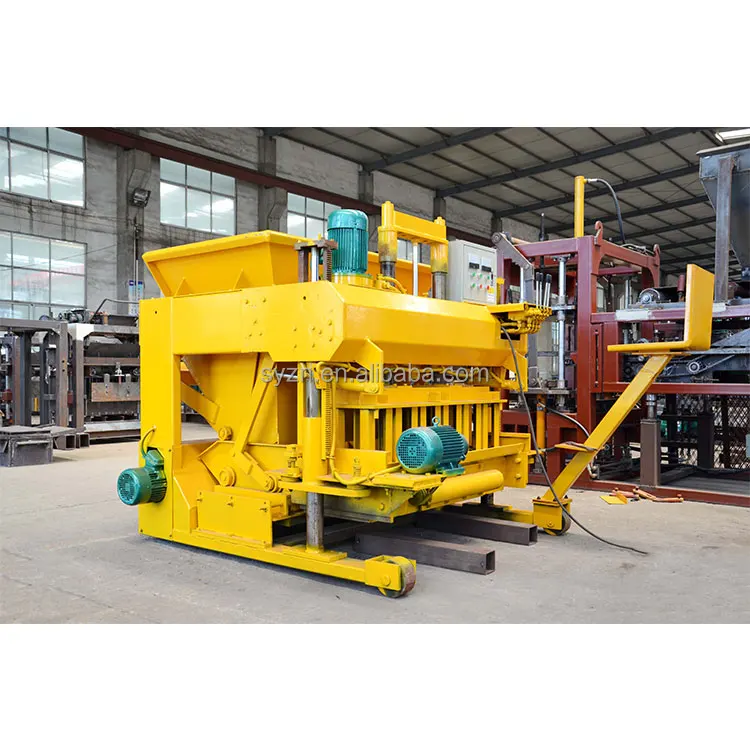
Matched system design — QMY6-25 mobile block machine is specified together with feeding, mixing and curing handling stations so the press never waits for upstream or downstream bottlenecks.
Technical Specifications
| Parameter | Value |
|---|---|
| Model | QMY6-25 |
| Product Type | Mobile Hydraulic Block Making Machine |
| Main Vibration Form | Three-dimensional excitation |
| Vibration Frequency | 3200 Hz |
| Moulding Cycle | 25–30 s |
| Overall Power | 9.6 kW |
| Moving Method | Automatic moving with hydraulic steering |
| Overall Dimensions (L×W×H) | 2000 × 2100 × 1650 mm |
| Pallet Requirement | No pallet required (egg-laying type) |
| Output Capacity (400×200×200 mm hollow block, 6 pcs/mould) | 1080 pcs/h |
| Output Capacity (400×150×200 mm hollow block, 7 pcs/mould) | 1260 pcs/h |
| Output Capacity (400×120×200 mm solid block, 9 pcs/mould) | 1620 pcs/h |
| Output Capacity (400×100×200 mm solid block, 12 pcs/mould) | 1800 pcs/h |
| Shift Output (8 h) | 8600–14400 pcs depending on block format |
| Hydraulic System | Hydraulic steering and press (pressure rating to be confirmed) |
| Control System | To be confirmed (PLC / relay / manual) |
| Voltage & Frequency | To be confirmed with buyer site supply |
| Automation Level | Mobile, single-operator capable |
| Mould Format | Hollow and large solid blocks, custom mould sizes available |
| Assembly State | Fully assembled mobile unit |
| Warranty | 1 year for whole machine, excluding spare parts |
Application Suitability
| Application | Material or Output |
|---|---|
| On-site hollow block production for building contractors | Crushed stone, sand, cement and water without fixed plant infrastructure |
| Housing project block supply across multiple locations | 400×200×200 mm and 400×150×200 mm hollow blocks moved between sites |
| First plant setup with limited space | 400×120×200 mm and 400×100×200 mm solid blocks without pallet fleet |
| Remote construction sites without curing rack handling | Egg-laying production directly on prepared ground |
Why Quoted Capacity Rarely Matches Real Output on a Mobile Line
The number on the spec sheet means nothing unless it names the exact block format and mould cavity count behind it.
I have watched site managers in the Gulf plan a ten-hour shift around a promised hourly figure, only to find the mixer cannot feed fast enough or the curing area fills before the press finishes. The QMY6-25 mobile block machine production line must be read as a chain of stations, not a single press. When feeding, mixing, pressing and curing handling are timed to the same cycle, the output holds; when one station lags, the whole line drops [NEED_CITE: line balancing principles for mobile concrete production].
Matching Every Station Around the Press
The 25–30 s moulding cycle sets the pace that every other station must meet. A mixer that batches in three-minute intervals must deliver enough volume to cover at least six cycles, otherwise the press idles. Mobile block machine production line planning starts with this cycle time and works outward to feeding rate, water dosing and aggregate stockpile distance.
Curing Area Size Decides Real Shift Output
Without pallets, the blocks cure where they are laid. A site that prepares only a small flat area forces the operator to stop and wait for earlier blocks to harden before moving the machine forward. When the curing zone is sized for a full eight-hour run, the QMY6-25 keeps walking without interruption.
Reading the Specification Table Honestly
Three-dimensional excitation at 3200 Hz is tuned for pallet-free pressing where the block must hold its shape the moment the mould lifts. Hydraulic steering lets a single operator reposition the unit between cycles without a separate tractor. The 9.6 kW overall power covers vibration, hydraulics and travel on a self-contained mobile unit, which matters when site generators are shared with other equipment [NEED_CITE: power allocation for mobile construction machinery].
What Happens When Line Timing Is Ignored
A mixer that discharges too slowly leaves the press waiting, and a mobile block machine that waits still draws power and burns shift hours. If the curing ground is not level or not large enough, blocks crack under their own weight before the next pass. These are not machine faults; they are line design gaps that turn a strong press into an under-performing site [NEED_CITE: common causes of mobile block line downtime].
Why Source the Full Line Here
Block machinery is our single focus, so the QMY6-25 is specified together with its mixer, feeder and curing handling as one matched set. Configuration is built around the buyer’s actual mix design and local aggregate, not a catalogue default. Moulds are supplied for the formats the buyer’s market sells, with custom drawings available. Automation level can start at single-operator manual and grow as the site adds pallet handling or stacking later. Installation support includes operator training on cycle timing across every station.
Documentation & Verification
- Capacity calculation stating block format, mould cavity count and cycle time for each output figure
- Line layout drawing showing feeding, mixing, pressing and curing station arrangement
- Voltage, frequency and control language confirmation sheet signed before dispatch
- Mould drawing and format list matched to buyer’s target block dimensions
- Factory test record run on buyer’s specified mix design before shipment
- Wear parts list with part numbers for first replacement order
Installation, Commissioning & Support
- Prepared ground must be level and sized for full shift output across chosen block format
- Power supply must match confirmed voltage and frequency with dedicated circuit for 9.6 kW total draw
- Machine ships fully assembled; only mould and hopper require on-site mounting
- First run includes cycle timing check between mixer discharge and press moulding cycle
- Operator training covers hydraulic steering, mould change and vibration adjustment per mix
- Wear parts shipped with first order so replacements are on site before first change-out
Preparing a Useful Inquiry
Tell us the block format and daily volume your site must deliver, the local aggregate type you plan to use, and the curing ground area you can prepare. Confirm the site voltage and frequency, and whether existing mixers or feeders will join the line.
Frequently Asked Questions
Q: How is daily output calculated and which block format is each figure based on?
A: Every output number is tied to a specific block size and mould cavity count. The 1080 pcs/h figure assumes a 400×200×200 mm hollow block with six cavities per mould, while 1800 pcs/h assumes a 400×100×200 mm solid block with twelve cavities. Shift output scales from these hourly rates across an eight-hour day, provided upstream and downstream stations keep pace.
Q: How must feeding and mixing stations be timed so the press never waits?
A: The 25–30 s moulding cycle sets the target. The mixer must deliver a full batch within that window, and the feeder must replenish aggregate fast enough to keep the mixer running continuously. When any station is slower, the press idles and shift output drops below the stated rate.
Q: What electrical details must be confirmed before the line ships?
A: Voltage, frequency and control display language must match the site supply and operator preference. If these are confirmed after arrival, commissioning stalls while transformers or control boards are sourced locally, delaying first production.
Q: Which local aggregates has this mobile line been configured around?
A: The three-dimensional vibration at 3200 Hz is adjustable to match different aggregate gradings, from fine sand to crushed stone. The line configuration step sets vibration amplitude and cycle time around the buyer’s actual mix design so block strength meets local standards.
Q: What is included in the line scope beyond the press itself?
A: The quotation can cover only the QMY6-25 press, or extend to raw material feeding, mixing, and curing handling stations arranged around it. Each station is sized to the same cycle time so the mobile block machine production line runs as a balanced system.


