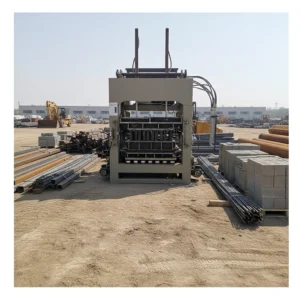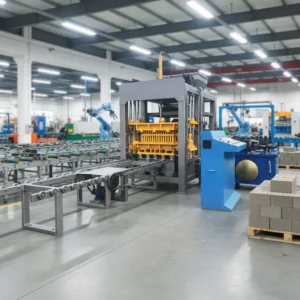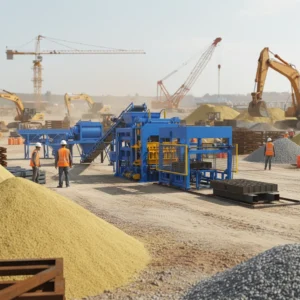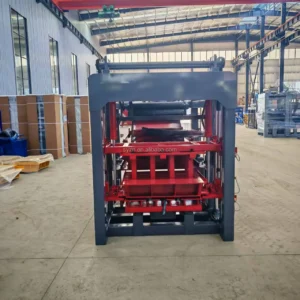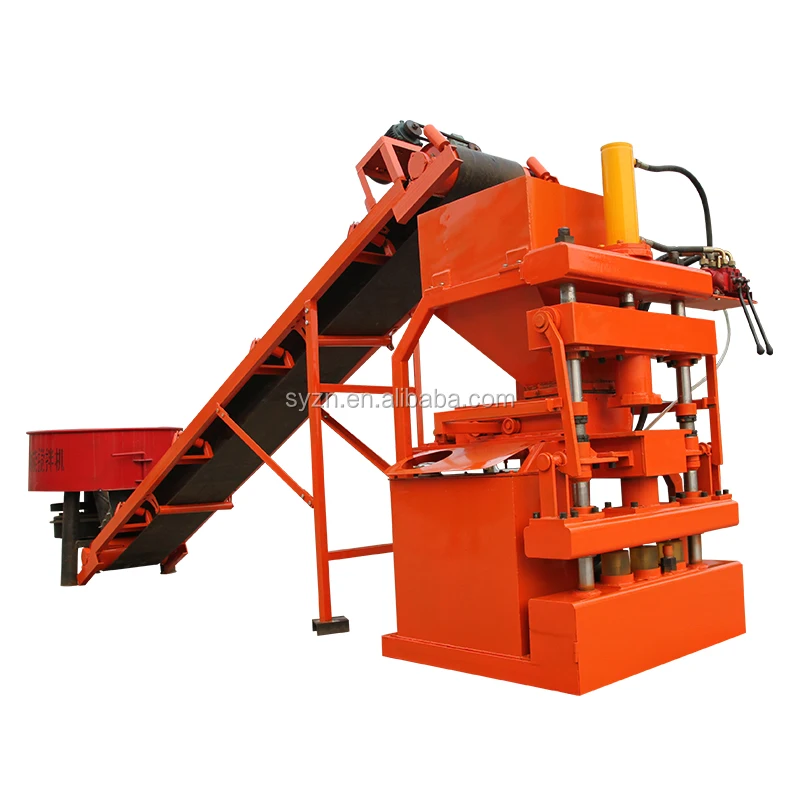
Matched System Lineup — raw material feeding, mixing, pallet circulation, and stacking are configured as one coordinated sequence around the LY1-10 semi-automatic block making machine production line, not sourced as separate islands.
Technical Specifications
| Parameter | Value |
|---|---|
| Model | LY1-10 |
| Product Type | Semi-Automatic Clay Brick Making Machine |
| Rated Power | 1.5 kW |
| Molding Cycle | 45 s |
| Theoretical Output | 360 pcs/h, 2880 pcs/day based on 300×150×100 mm block, 1 pc/mould (basis to be confirmed for other formats) |
| Overall Dimensions (L×W×H) | 1300 × 1800 × 2400 mm |
| Net Weight | 400 kg |
| Vibration Type | Bed mould vertical vibration + upper mould compression vibration |
| Control System | Semi-automatic |
| Raw Materials | Concrete, sand, cement, fly ash, lime, gypsum |
| Voltage | Configurable to buyer’s local supply |
Application Suitability
| Application | Material or Output |
|---|---|
| Small workshop solid brick production | Sand, cement, and fly ash mixes |
| On-site block making for housing projects | Concrete and local aggregate blends |
| Masonry unit production for local distributors | Cement, lime, gypsum combinations |
| Contractor-run mobile production yards | Crushed stone and sand with cement binder |
What "2880 Pieces Per Day" Actually Requires Upstream and Downstream
A press that cycles every 45 seconds demands a line where every surrounding station keeps pace, or the daily output figure becomes fiction.
I spent years servicing block lines where the press sat idle between cycles because the mixer discharged too slowly or the operator was still dragging pallets by hand. A semi-automatic block making machine production line only reaches its stated throughput when material feed, pallet supply, and off-bearing are all timed to the molding cycle. When one station lags, the entire line absorbs the delay — and the shortfall compounds across an eight-hour shift [NEED_CITE: typical block line takt time losses from unsynchronized stations].
How the 45-Second Molding Cycle Dictates Line Rhythm
The LY1-10 completes one press cycle in 45 seconds, which means the mixer must deliver a fresh batch to the hopper within that window and a cured pallet must be swapped out in time for the next press. Every semi-automatic block making machine production line built around this press inherits that tempo. If the upstream batching station takes 60 seconds to discharge, the press loses 15 seconds per cycle — adding up to hundreds of missed cycles per shift.
Where Semi-Automatic Ends and Manual Labour Begins
Semi-automatic configuration places the operator at the pallet feed and off-bearing stations. The press handles vibration, compression, and mould release, but pallets must be manually loaded onto the bed and fresh blocks carried to the curing area. Understanding this boundary is essential when planning labour allocation and deciding whether future automation of pallet handling is justified [NEED_CITE: labour allocation models for semi-automatic block plants].
Interpreting the Numbers That Matter on the Shop Floor
The dual vibration system — bed mould vertical vibration combined with upper mould compression vibration — works to compact the mix uniformly across the mould cavity. This demands a consistent material feed; if the mixer delivers batches with varying moisture or aggregate ratio, block density will shift from pallet to pallet. The 1.5 kW rated power reflects a compact press suited to smaller workshops, which in turn limits the maximum vibration force and hydraulic pressure available. Buyers should match this to lighter mixes such as sand-cement or fly ash blends rather than heavy crushed-stone formulations. Pallet size is not stated in the specification source and must be confirmed before ordering, because it directly determines curing rack dimensions and forklift compatibility.
The Hidden Cost of Specifying the Press Alone
Quoting a block press without confirming pallet handling, stacking method, and curing rack layout leaves gaps that surface only after installation. Buyers discover that blocks must be stacked by hand, that pallets do not fit existing curing racks, or that the forklift cannot reach the top shelf. These problems are not machine defects — they are line design omissions [NEED_CITE: common post-installation gaps in block production lines].
Why Line-Level Configuration Matters Here
Block machinery is our single focus, which means the LY1-10 is never specified as a standalone press. The mixer discharge rate, pallet dimensions, and stacking method are all confirmed before the quotation is issued. Machine configuration is set against the buyer’s actual mix design and local aggregate rather than a default catalogue setting. Moulds are supplied for the specific block formats the buyer’s market demands, including custom drawings. Automation level can be selected at semi-automatic now and upgraded later without replacing the press. Factory testing runs the full cycle with simulated material feed and pallet handling so the line rhythm is verified before shipment.
Documentation & Verification
- Line layout drawing with capacity stated per block format, not a single headline number
- Machine specification sheet confirming vibration type, power rating, and dimensions
- Mould drawing and format list matching the buyer’s confirmed product range
- Pallet specification document noting size, material, and load rating
- Voltage and control language confirmation signed off before production
- Factory test record showing full cycle with material feed simulation
Installation, Commissioning & Support
- Foundation pad must accommodate the 1300 × 1800 mm footprint with clearance for pallet access
- Electrical supply must match confirmed voltage and frequency before the 1.5 kW motor is energized
- Machine ships as a single unit at 400 kg, requiring only a standard forklift for offloading
- First run includes cycle timing verification between press, mixer, and pallet stations
- Operator training covers mould change procedure and vibration adjustment for different mixes
- Wear parts list provided with mould and vibration component replacement intervals
What We Need to Configure Your Line
Tell us the block format and dimensions your market actually buys, along with the daily output you need to hit. Share your local raw materials — sand type, cement grade, available fly ash or lime — so we can match the mixer and batching station to your mix design. Confirm your site voltage, frequency, and the language your operators read on a control panel.
Frequently Asked Questions
Q: How do I verify the quoted capacity against the block format I actually produce?
A: The published output of 2880 pieces per day is based on a 300×150×100 mm block at one piece per mould. If your format is larger or uses a multi-cavity mould, the cycle count stays the same but pieces per cycle change. We provide a capacity table calculated specifically for your confirmed block format before the order is placed.
Q: What upstream and downstream stations must be included so the press is not left waiting?
A: The 45-second molding cycle requires a mixer that discharges within that window, a pallet supply station with cured pallets ready to load, and an off-bearing area where fresh blocks are removed before the next press. We specify each station’s cycle time to match the press tempo.
Q: How are pallet size and material selected to match my curing area and forklift?
A: Pallet dimensions determine how many blocks fit per layer on your curing racks and whether your existing forklift can handle the loaded weight. We confirm your rack spacing and forklift capacity before finalizing pallet specifications, so nothing needs modifying after delivery.
Q: What electrical and control details must be confirmed before shipment?
A: Voltage, frequency, and phase must match your site supply. The control panel language should match your operators’ reading ability. These details are confirmed in writing before production begins to prevent commissioning delays after the machine arrives.
Q: Can the semi-automatic layout be upgraded to automatic pallet handling later?
A: Yes. The LY1-10 press station remains the same; automatic pallet feeding, stacking, and cubing modules are added around it. We design the initial semi-automatic layout with space and interface points reserved for that future expansion.