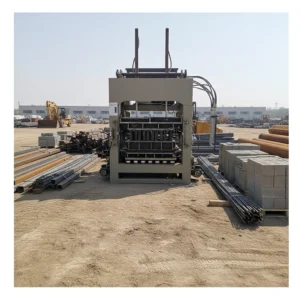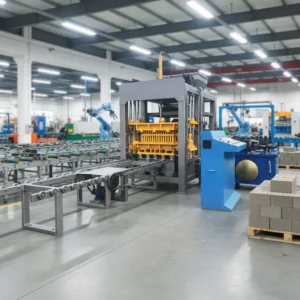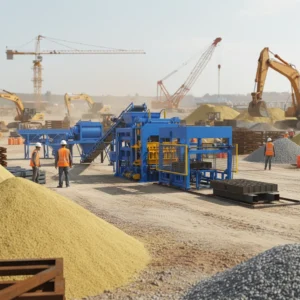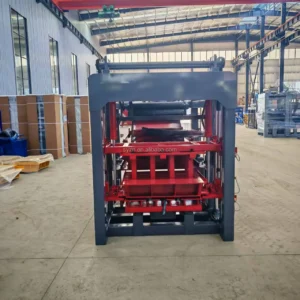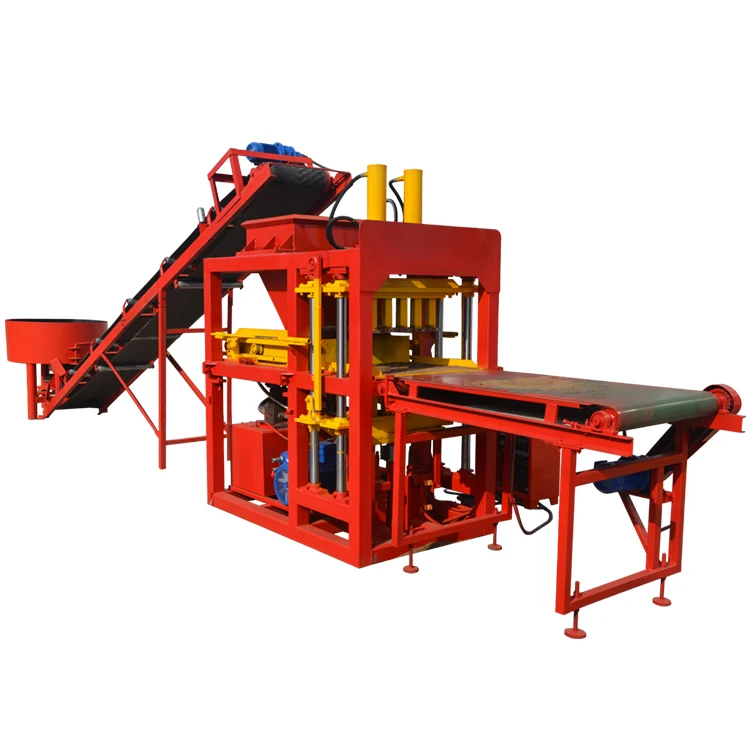
Station-by-Station Cycle Alignment — The LY4-10 automatic clay interlocking brick making machine is positioned as the center point of a complete block production line, with raw material feeding, mixing, pallet handling, and output stacking configured so every station matches the press tempo.
Technical Specifications
| Parameter | Value |
|---|---|
| Model | LY4-10 |
| Product Type | Automatic Clay Interlocking Brick Making Machine |
| Rated Power | 11 kW |
| Control System | PLC control system |
| Hydraulic System | Equipped (MPa rating to be confirmed) |
| Overall Dimensions | 2260 × 1500 × 2380 mm |
| Molding Cycle | 10–15 s (basis not stated in source — confirm block format, material, thickness) |
| Output per Cycle | 4 bricks per cycle (basis not stated in source — confirm block format and dimensions) |
| Raw Materials | Clay, soil, earth, mud, concrete, cement, fly ash, water |
| Mould Change | Interlocking brick format changeover by mould replacement (changeover time to be confirmed) |
| Automation Level | Automatic operation — material feeding, mould pressing, mould lifting |
| Vibration Force | To be confirmed (kN rating not stated in source) |
| Voltage & Frequency | To be confirmed against target market standard |
| Pallet Size | To be confirmed (dimensions and material not stated in source) |
Application Suitability
| Application | Material or Output |
|---|---|
| Clay interlocking brick production | Local clay or soil blended with cement and water |
| Cement-stabilized earth blocks | Earth, mud, and fly ash mixes with cement binder |
| Interlocking format changeover | Multiple brick profiles produced by swapping moulds on the same press |
| On-site contractor production | Mobile or semi-fixed plants using locally sourced soil and aggregate |
Why the Line Bottleneck Is Never the Press Itself
A press rated at 10–15 seconds per cycle only delivers that tempo if every upstream and downstream station keeps pace.
I once watched a block plant in the Pearl River Delta lose thousands of bricks in a single shift because the mixer discharged forty seconds slower than the press expected. The LY4-10 sat idle between every cycle while operators waited for the next batch. The block production line equipment was rated correctly on paper, but the real daily throughput told a different story. This happens more often than buyers expect, and the root cause is almost always a station mismatch that nobody checked before the line was bolted to the floor. [NEED_CITE: common causes of throughput loss in concrete block production lines]
Matching the Mixer Discharge to the Press Ingest Window
The supporting equipment for block plant operations must deliver a homogeneous mix to the LY4-10 hopper before the press finishes its current cycle. If the mixer takes longer than the molding window, the press idles. Batching accuracy, mixer drum speed, and conveyor transfer rate all converge on this single handoff point. We calculate the required mixer discharge rate against the press cycle and the block format being produced, so the supporting equipment for block plant configuration is never guessed from a catalogue default.
Pallet Circulation and the Hidden Queue
Pallets carry each pressed brick through curing and back to the press. If the return loop is slower than the press output, pallets run out and the LY4-10 stops. The pallet specification — size, material, and total inventory — must be matched to the curing rack spacing and the forklift the buyer already operates on-site. Block production line equipment quotations that omit pallet quantity and return conveyors leave the buyer stacking output by hand, which defeats the purpose of an automatic press. [NEED_CITE: pallet circulation requirements for automatic block presses]
Reading the Specs That Actually Matter
The 11 kW rated power of the LY4-10 defines the electrical load at the press station, but total line load must include the mixer, conveyors, and any stacking station. Voltage and frequency must be confirmed in writing before production begins; arriving with a 380 V motor in a 440 V region delays commissioning by weeks. The PLC control system governs material feeding, mould pressing, and mould lifting, yet the display language must also be specified so operators can troubleshoot without a translator. Molding cycle figures of 10–15 seconds only hold when the block format, material moisture, and hydraulic pressure are all within the tested range.
What Happens When Stations Are Specified Separately
Buyers who source the press, mixer, and pallet system from different suppliers often discover the interfaces do not align. Conveyor heights miss the hopper lip. Pallet dimensions leave a gap on the curing rack that causes bricks to tip. The hydraulic pump capacity may exceed the electrical panel rating, tripping breakers during peak draw. These mismatches surface only after installation, when the block production line equipment is already bolted down and rewiring or re-piping means lost production days. [NEED_CITE: integration risks when sourcing block line components separately]
Why the Line Is Quoted as One System
The LY4-10 is specified alongside its raw material feeder, mixer, pallet feed mechanism, and stacking arrangement so that every station is timed to the press cycle. Mould options are listed by the interlocking formats the buyer’s market actually purchases, not by every mould the factory can produce. Automation level is selectable — a buyer can begin with manual pallet handling and add automatic stacking later without replacing the press. Pallet size is confirmed against the buyer’s curing area dimensions and existing forklift capacity before the order is finalized. Voltage, frequency, and PLC display language are locked in writing so commissioning starts on day one. Factory testing runs the full cycle with the buyer’s target block format before the machine is crated.
Documentation & Verification
- Line layout drawing with capacity calculated per interlocking brick format, not a single hourly figure
- Machine specification sheet listing confirmed voltage, frequency, and PLC display language
- Mould drawing and format list for each interlocking profile the buyer selects
- Pallet specification showing size, material, and quantity matched to curing rack layout
- Hydraulic and electrical schematics for local component sourcing and independent troubleshooting
- Factory test record running the buyer’s chosen block format at confirmed cycle time
Installation, Commissioning & Support
- Foundation plan sized to the LY4-10 overall dimensions of 2260 × 1500 × 2380 mm with anchor bolt positions
- Dedicated electrical circuit rated for 11 kW plus upstream mixer and conveyor loads at confirmed voltage
- Press arrives in modular assembly state with labelled connections for on-site reassembly
- First-run commissioning includes cycle time verification against the buyer’s target interlocking format
- Operator training covers PLC navigation, mould changeover procedure, and daily lubrication points
- Wear parts list identifies hydraulic seals and mould liners with local sourcing equivalents
What to Include in Your Inquiry
Send the interlocking brick format and dimensions you plan to produce, along with the daily output target and the clay or soil mix available at your site. Confirm the voltage and frequency standard in your region, the PLC display language your operators require, and the pallet size and forklift capacity you already have. If you are integrating the LY4-10 into an existing line, share the mixer discharge rate, conveyor height, and curing rack dimensions so the supporting equipment for block plant layout can be matched before quotation.
Frequently Asked Questions
Q: How is the daily output of the LY4-10 calculated, and which block format is that figure based on?
A: Daily output depends on the interlocking brick format, the confirmed molding cycle within the 10–15 second range, and the number of operating hours. We state capacity per format rather than a single headline number, because a thicker or larger brick requires a longer press cycle and changes the calculation.
Q: Which upstream and downstream stations must match the press cycle?
A: The mixer discharge rate, raw material feeder, and pallet return loop must all complete their tasks within the molding cycle of the LY4-10. If any station is slower, the press idles. We time each station during line design so the supporting equipment for block plant operations sustains continuous production.
Q: What pallet size does the LY4-10 require, and how does it affect curing?
A: Pallet dimensions are confirmed against the interlocking brick format and the buyer’s curing rack spacing. Material choice — typically bamboo or PVC — depends on local humidity and forklift tine spacing. Ordering pallets as part of the block production line equipment package avoids size mismatches.
Q: Can the line run my local clay or soil mix?
A: The LY4-10 accepts clay, soil, earth, mud, concrete, cement, and fly ash blends. We review the buyer’s mix design and, where possible, run a factory test with a representative sample before shipment to confirm that block strength and cycle time meet expectations.
Q: What is included in the quotation versus what must I supply on-site?
A: The quotation covers the LY4-10 press, mould, feeder, and any agreed supporting equipment for block plant integration. The buyer typically provides the curing area, water supply, power connection, pallet inventory if not ordered, and the foundation slab to the supplied drawing.