
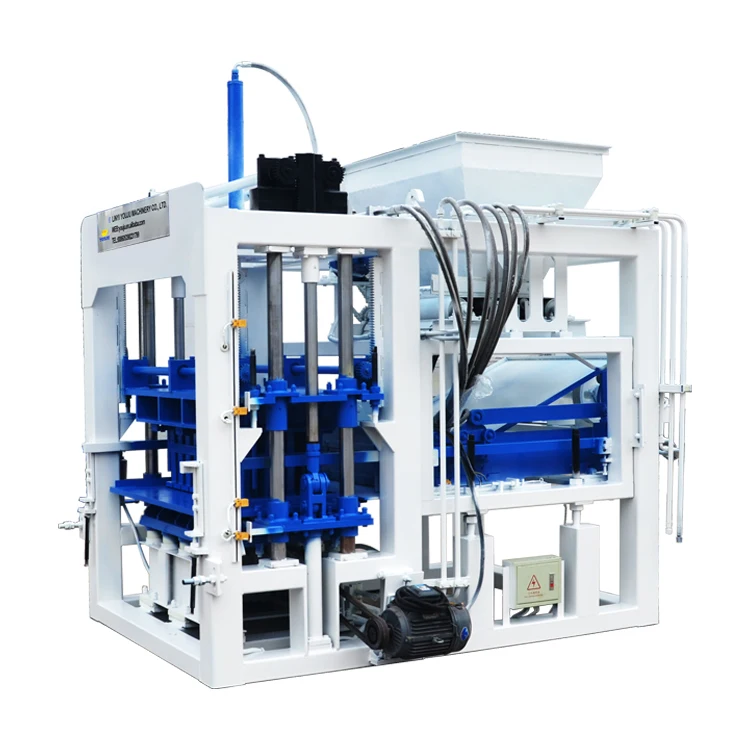
Complete Line Synchronization — the QT5-15 automatic concrete block making machine production line is specified as a matched system from raw material feeding through stacking, not sold as a standalone press with disconnected stations.
Technical Specifications
| Parameter | Value |
|---|---|
| Model | QT5-15 |
| Product Type | Fully Automatic Concrete Block Making Machine |
| Overall Dimensions (L×W×H) | 7400×1950×2800 mm |
| Rated Hydraulic Pressure | 21 MPa |
| Main Vibration Form | Hydraulic platform vibration |
| Vibration Frequency Range | 2800–4500 rolls/min |
| Cycle Time | 15–20 seconds (basis to be confirmed by block format) |
| Total Motor Power | 26.5 kW |
| Pallet Size | 1100×550 mm |
| Net Weight | 6 T |
| Control System | PLC with fault diagnosis and remote monitoring |
| Assembly State | Stationary |
| Automation Level | Full automatic |
| Voltage | Configurable to buyer’s site requirements (basis to be confirmed) |
Application Suitability
| Application | Material or Output |
|---|---|
| Hollow block production for building walls | Crushed stone, cement, sand aggregate mixes |
| Standard solid brick manufacturing | Fly ash, cement, and local sand blends |
| Multi-cellular brick for lightweight construction | Lightweight aggregate and cement slurry |
| Paving brick for roads and walkways | High-density aggregate with cement binder |
What the Quoted Daily Output Figure Rarely Tells You
A cycle time is meaningless unless the pallet return conveyor, mixer discharge rate, and stacker keep the same rhythm.
I have spent years walking block plants across Africa and South Asia where the press itself runs fine, but the feeding hopper empties before the mixer can refill it, or the pallet feeder jams every few minutes, forcing the operator to intervene by hand. The automatic concrete block making machine production line is only as fast as its slowest supporting station. When quotations list output based on press cycle time alone, the gap between that number and what actually reaches the curing yard widens quickly [NEED_CITE: typical throughput loss when supporting stations are underspecified]. The QT5-15 configuration approach addresses this by sizing every upstream and downstream station against the same format-specific cycle time.
Synchronizing Every Station Around the Press Cycle
The automatic concrete block making machine production line centers on the QT5-15 press, but real throughput depends on how raw material feeding, mixing, pallet handling, and stacking connect. When the mixer delivers a batch slower than the press consumes it, the hydraulic platform sits idle. Station-level cycle balancing ensures the feeder, mixer, and pallet return conveyor all resolve to the same 15–20 second window, adjusted for the block format in production.
Pallet Handling as the Hidden Bottleneck
Pallets travel from the press to the curing rack and back, covering more distance than any other component in the line. The 1100×550 mm pallet size must match the curing area layout and the forklift capacity already on site. If pallet return speed falls behind press output, finished blocks pile up at the press exit and the operator resorts to manual stacking — the exact scenario a full automatic line is meant to prevent [NEED_CITE: pallet handling impact on block plant daily throughput].
Reading the Specs Against Your Actual Block Format
The QT5-15 operates at 21 MPa rated hydraulic pressure paired with variable-frequency vibration ranging from 2800 to 4500 rolls per minute. Lower frequency during material feeding lets the mix settle into the mould cavity, while higher frequency during compaction drives density. For hollow blocks at 400×200×200 mm, the platform vibration must distribute force evenly across the full 1100×550 mm pallet area to prevent weak edges. The PLC control monitors pressure and vibration in real time, diagnosing faults at the panel rather than requiring the operator to trace each station manually. Total motor power of 26.5 kW covers the press station; the full line draw depends on mixer, conveyor, and stacker motors added during configuration.
When Supporting Equipment Is Left Off the Quotation
The most common complaint I hear on site is that daily output falls noticeably short of the signed contract figure. The press was specified correctly, but the quotation covered the press alone. Pallets were stacked by hand, the mixer ran at half the needed discharge speed, and curing racks were moved with a wheelbarrow. The buyer paid for automation they never received because the supporting stations were treated as optional extras rather than integral parts of the line [NEED_CITE: block plant quotation scope gaps reported by importers].
Why Sourcing the Full Line from One Specification Point Matters
Block machinery as a single focus means the QT5-15 press, moulds, pallets, and handling equipment are specified as one matched system rather than assembled from separate suppliers. Configuration is set against the buyer’s actual mix design and local aggregate, not pulled from a catalogue default. Mould design covers the formats the buyer’s market sells, with custom drawings available for non-standard shapes. Automation level is selectable, so a plant can start with semi-automatic pallet handling and add full stacking later. Installation includes operator training so the crew understands line-wide cycle balance from day one.
Documentation & Verification
- Line layout and capacity calculation stating the exact block format assumed for each throughput figure
- Machine specification sheet covering the QT5-15 press and all matched supporting stations
- Pallet specification confirming size, material, and quantity aligned with curing yard capacity
- Hydraulic and electrical schematics for the full line, not the press alone
- Voltage, frequency, and PLC display language confirmed in writing before production
- Factory test record showing cycle times verified across all connected stations
Installation, Commissioning & Support
- Foundation plan scaled to the 7400×1950 mm press footprint plus conveyor run length
- Dedicated power circuit sized for 26.5 kW press draw plus mixer and conveyor loads
- Station-by-station commissioning with cycle time measured at each connection point
- PLC fault diagnosis walkthrough so operators can trace stops without external support
- Pallet return conveyor tension and alignment check before full-speed production starts
- Wear parts and mould list supplied at shipment for first-year maintenance scheduling
What We Need to Configure Your Line
To size every station correctly, share the block formats you plan to produce, the target daily output for each format, and the raw materials available locally. Confirm your site voltage, frequency, and preferred PLC display language. If you already have a curing yard and forklift, provide the pallet dimensions and rack layout so the handling equipment matches what is already on the ground.
Frequently Asked Questions
Q: How is the daily output figure calculated for the QT5-15 line?
A: Each output figure is based on a specific block format, mould cavity count, and cycle time. For example, the 400×200×200 mm hollow block figure assumes 5 pieces per mould at the stated cycle range. We provide a written capacity calculation showing the format and assumptions behind every throughput number before you confirm the order.
Q: Does the quotation cover the full line or only the press?
A: The quotation scope depends on what you request. We can quote the QT5-15 press alone or as a complete line with mixer, pallet feeder, return conveyor, and stacking system. Every station is listed separately so you can see exactly which equipment is included and which is optional.
Q: How do we match pallet size to our existing curing setup?
A: The standard pallet size is 1100×550 mm, but we confirm your curing rack dimensions and forklift capacity before finalizing. If your existing racks require a different pallet length or thickness, we adjust the pallet specification and the return conveyor width accordingly.
Q: What happens when one station runs faster or slower than the press?
A: Each station is sized against the same format-specific cycle time. If the mixer discharge is slower than the press consumption, the PLC pauses the press rather than letting it run empty, protecting mould life. We balance discharge rates and conveyor speeds during configuration so no station becomes a bottleneck.


