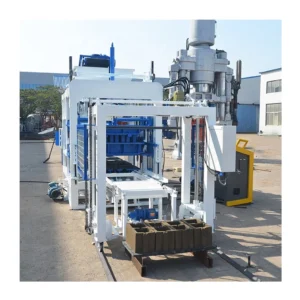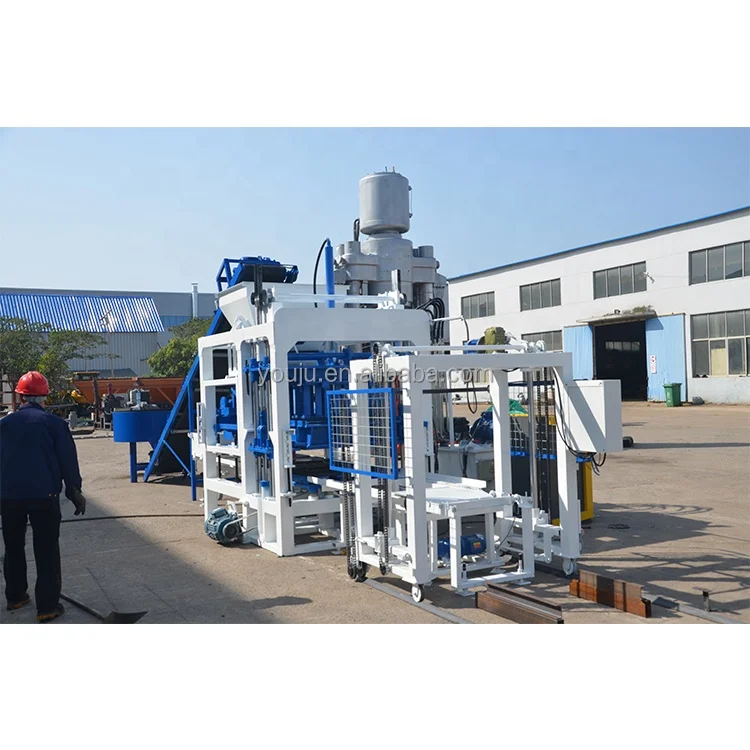
QT4-18 Line Integration — mixer, conveyor, pallet feeder and stacker specified against the host cycle so no station waits on another.
Technical Specifications
| Parameter | Value |
|---|---|
| Product Type | Semi-Automatic Block Making Machine |
| Model | QT4-18 |
| Overall Dimensions | 2500×1750×2200 mm |
| Rated Pressure | 16 MPa |
| Vibration Form | Platform Vibration |
| Pallet Size | 950×550 mm |
| Molding Cycle | 18–25 s (basis to be confirmed per block format) |
| Overall Power | 27.5 kW |
| Control System | PLC control with frequency converter |
| Electrical Components | Schneider |
| Mold Lifting Mechanism | Double-sided synchronous gears |
| Pallet Feeder Power | Hydro-cylinder |
| Supporting Equipment Options | JQ500 pan mixer, 8 m / 6 m belt conveyor, stacker, block clamper, trolley, cement silo, batching plant |
Application Suitability
| Application | Material or Output |
|---|---|
| Hollow block production | Crushed stone, sand, cement, fly ash |
| Solid brick forming | Concrete mix with local fine aggregate |
| Paving block manufacturing | High-density concrete with pigment layers |
| On-site contractor production | Portable batching with site-sourced aggregate |
| First plant startup | Semi-automatic line with manual pallet handling |
Why the Block Making Machine Production Line Often Delivers Less Than Quoted
A press that waits for the mixer or pallet feeder never reaches its rated cycle, no matter what the spec sheet says.
Many quotations list the host machine in isolation, ignoring how material moves from the hopper to the mold and how cured blocks leave the press. I have seen a semi-automatic line in the Middle East lose a large share of its expected output simply because the pan mixer batch time did not align with the press cycle. The press sat idle while the crew waited for the next mix. Stations must be matched on time, not just capacity [NEED_CITE: line balancing principles for concrete block production].
Station Sequence and Material Flow
A complete block making machine production line around the QT4-18 begins at the JQ500 pan mixer, where raw materials enter the distribution belt hopper for thorough blending before transfer. The 8 m or 6 m belt conveyor then carries the mixed material to the host machine hopper. Choosing between the two conveyor lengths depends on how much floor space the curing yard demands and where the mixer sits relative to the press. Every connection point must be timed so the press hopper never runs dry mid-cycle.
Pallet Handling and Product Discharge
The hydro-cylinder pallet feeder pushes a fresh pallet into position in sync with the demould stroke, keeping the molding platform active without manual intervention at that station. Once blocks are pressed, the block receiver — driven by a motor, reducer and triangle belt — carries them toward the curing area. The stacker then lifts blocks layer by layer, and a trolley transports them onward. If any one of these stations moves slower than the press cycle, the entire block making machine production line bottlenecks at that point [NEED_CITE: pallet handling synchronization in semi-automatic block plants].
Reading the Specifications in Context
The 16 MPa rated pressure and platform vibration work together to compact the concrete mix into the mold cavity, determining block density and surface finish. The 950×550 mm pallet size should match the curing rack dimensions and the forklift the buyer already operates — ordering a non-standard pallet creates downstream handling problems that have nothing to do with the press itself. The 18–25 s molding cycle applies to a specific block format and mix; a taller hollow block or a stiffer mix will push the cycle toward the upper end. Schneider electrical components and PLC control with frequency converter allow the operator to adjust vibration timing and feeder speed without rewiring the panel.
What Mismatched Stations Cost on the Floor
When the belt conveyor is too short for the site layout, the mixer ends up crowding the press foundation and forklift access becomes difficult during pallet restocking. If the stacker cannot keep pace with the receiver conveyor, blocks pile up at the discharge end and operators start pulling them off by hand — exactly the manual step the line was supposed to remove. These problems surface only after installation, when repositioning concrete foundations is expensive and time-consuming [NEED_CITE: site layout errors in block plant installation].
Why Source the Full Line from One Configuration Point
Every station from the JQ500 mixer to the trolley is selected against the QT4-18 cycle time rather than pulled from a generic catalogue. The pallet size, conveyor length and stacker capacity are confirmed together before the quotation is issued, so no station arrives undersized. Layout drawings show mixer placement, belt conveyor routing, press foundation, curing area and pallet return path on one plan. Voltage, frequency and PLC display language are confirmed before production, avoiding commissioning delays. Moulds and hydraulic wear parts are listed with the initial shipment so the first replacement does not halt the line.
Documentation & Verification
- Line layout showing mixer, conveyor, press, curing yard and pallet return for your site dimensions
- Capacity calculation per block format with molding cycle assumptions stated
- Hydraulic and electrical schematic matching Schneider component list and PLC configuration
- Pallet specification confirming 950×550 mm size and material against your curing rack and forklift
- Factory test record on your selected block format before dispatch
Installation, Commissioning & Support
- Foundation drawing covering 2500×1750 mm press footprint plus mixer and conveyor stations
- 27.5 kW total power requirement with dedicated circuit and confirmed voltage and frequency
- Belt conveyor assembled on-site with chosen 8 m or 6 m length routed to mixer position
- PLC parameter tuning for vibration timing and pallet feeder synchronization during commissioning
- Operator training on mold change procedure, hopper feed rate and stacker layer adjustment
- Wear parts list covering hydraulic seals, vibration springs and conveyor belt spares for first year
What to Include in Your Inquiry
Send us your target block formats with dimensions, the daily output you need for each format, and the raw materials available at your site including aggregate grading. Confirm your workshop length, width and clear height so the belt conveyor and curing yard fit without compromise. Let us know the local voltage and frequency, the PLC display language your operators prefer, and any existing mixers or forklifts the line must connect with.
Frequently Asked Questions
Q: Which supporting equipment stations are included in the quotation versus optional add-ons?
A: The standard quotation covers the QT4-18 host machine, hydro-cylinder pallet feeder and block receiver conveyor. The JQ500 pan mixer, belt conveyor, stacker, block clamper, trolley, cement silo and batching plant are listed as supporting options. We confirm which stations you need during the line layout stage so the quotation matches the actual configuration shipped.
Q: How does the belt conveyor length affect line footprint and material flow?
A: An 8 m conveyor places the mixer farther from the press, giving more room for pallet storage and forklift movement around the host machine. A 6 m conveyor suits tighter workshops but requires the mixer closer to the press foundation. The choice affects where raw material is staged and how the crew moves between batching and molding stations.
Q: What is the pallet recycle path and does it interfere with the curing area?
A: After the stacker lifts blocks off the pallet, the empty pallet returns along a side path back to the pallet feeder. The layout drawing confirms this return route stays clear of the curing racks so forklifts loading cured blocks do not cross the pallet flow. We verify clearance against your specific curing yard dimensions before finalizing the plan.
Q: How to match mixer batch cycle with press molding cycle to avoid idle time?
A: The JQ500 pan mixer batch time must be shorter than or equal to the QT4-18 molding cycle multiplied by the number of blocks per mold. We calculate this ratio during configuration and adjust the mixer batch size or add a holding hopper if the mix cycle runs longer than the press demand. This prevents the host machine from waiting between cycles.
Q: Can the stacker and trolley system handle the output volume without manual intervention?
A: The stacker lifts blocks layer by layer from the receiver conveyor, and the trolley carries stacked layers to the curing yard. Capacity depends on block format and the number of layers per stack. We confirm during layout that the stacker cycle and trolley travel distance together keep pace with the press output so blocks do not accumulate at the discharge end.