
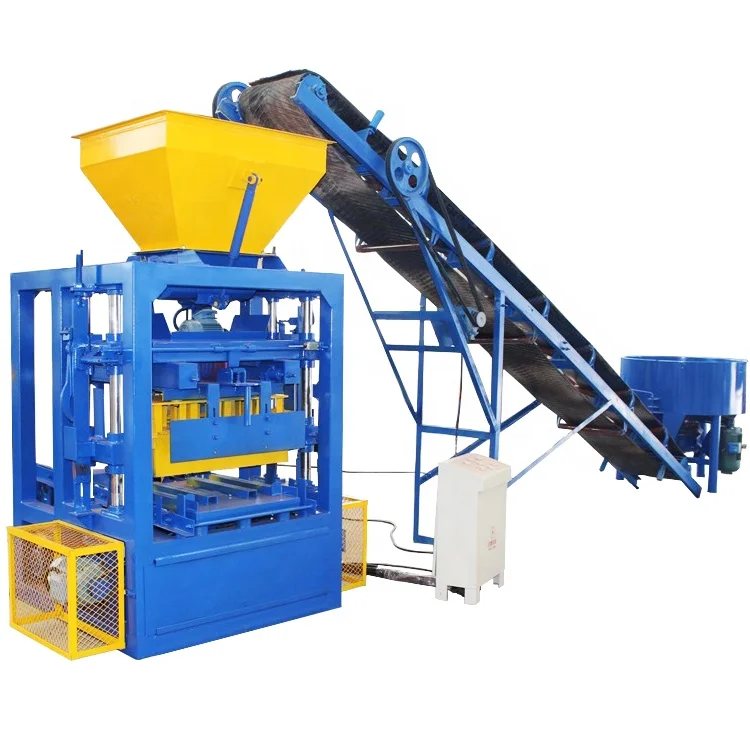
Matched System Design — The QTJ4-24 line arrives with mixer, conveyor, and pallet handling already balanced against the press cycle, so no single station becomes the bottleneck.
Technical Specifications
| Parameter | Value |
|---|---|
| Model | QTJ4-24 |
| Product Type | Semi-Automatic Concrete Block Making Machine |
| Overall Dimensions | 3600mm × 1700mm × 2560mm (working state) |
| Net Weight | 1750 kg |
| Molding Type | Platform Vibration |
| Pallet Size | 850mm × 450mm |
| Overall Power | 14.25 kW |
| Lower Vibration Power | 2 × 3 kW motors |
| Upper Vibration Power | 1.5 kW |
| Mould Format (Hollow) | 390mm × 190mm × 190mm (4 pcs/mould) |
| Mould Format (Solid) | 240mm × 115mm × 53mm (21 pcs/mould) |
| Elevating System | Cone-shape motor with JZQ250 speed reducer |
| Delivery Device | Cycloidal pin wheel speed reducer with chains and V-belt |
| Frame Type | Dragon gate style, super steel |
| Control System | Electronic controlling part (PLC availability to be confirmed) |
| Mixer Included | JQ350 pan mixer |
| Conveyor Included | 6m belt conveyor |
| Assembly State | Stationary |
| Voltage & Frequency | (basis to be confirmed) |
| Output Capacity | (basis to be confirmed) |
| Cycle Time | (basis to be confirmed) |
Application Suitability
| Application | Material or Output |
|---|---|
| Small-scale block plant start-up | Hollow blocks (390 × 190 × 190 mm) from cement, sand and crushed aggregate |
| On-site contractor production | Solid bricks (240 × 115 × 53 mm) for single-project housing builds |
| Secondary low-volume line | Specialised format blocks using locally sourced lightweight aggregate |
| Workshop-scale paver runs | Interlocking or paving formats matched to 850 × 450 mm pallet |
Why "Cycles per Hour" Misleads Block Plant Buyers
A press cycle number means nothing until you know which block format it assumes and whether upstream stations can keep pace.
Most quotations for a semi-automatic block machine production line quote a single throughput figure derived from the fastest, smallest format the press can run. The moment you switch to a taller hollow block that demands a longer vibration hold, the real daily output drops. At the same time, if the pan mixer batch size and discharge speed do not align with the press demand, the operator spends half the shift watching an empty hopper. I have walked onto sites where a high-spec press sat idle for twenty minutes every hour simply because the belt conveyor could not deliver material fast enough to match the vibration cycle [NEED_CITE: block machine line capacity calculation methods].
Every Station Sized Against the Press Cycle
The JQ350 pan mixer discharges into the 6m belt conveyor at a rate calculated to refill the press hopper before the next moulding cycle begins. On a semi-automatic block machine production line, this timing matters more than raw motor power. The QTJ4-24 runs platform vibration through dual 3 kW lower motors and a 1.5 kW upper motor, so material must arrive in a consistent volume to maintain compaction density across every pallet.
Pallet Flow Determines Real Shift Output
An 850 × 450 mm pallet moves from the press to the stacking area after each cycle. If stacking is manual and the curing yard is far from the press, pallets pile up at the exit and the operator cannot feed the next one in time. This semi-automatic block machine production line offers an optional auto stacker that layers three to six rows per pallet, clearing the press exit so the next cycle starts without delay.
What the Vibration System Actually Does to Block Density
Platform vibration transmits force upward through the pallet into the mould cavity. The dual 3 kW lower motors provide the primary compaction energy, while the 1.5 kW upper vibration settles the surface layer and closes micro-cracks before the block leaves the press. On a dragon gate frame built from super steel, the four wear-resisting vertical guide shafts keep the mould aligned during each vibration burst. If the frame flexes under repeated loading, guide shaft wear accelerates and block dimensions drift outside tolerance [NEED_CITE: vibration compaction principles in concrete block forming]. Mismatched vibration force and local aggregate grading produce blocks that crumble at the edges during pallet transfer, a problem that shows up only after the first week of production.
The Hidden Cost of Quoting Without Line Context
When a buyer purchases a press alone and sources the mixer and conveyor separately, the three stations rarely share the same cycle logic. A mixer that takes ninety seconds per batch while the press demands material every sixty seconds creates a starvation gap that compounds across a ten-hour shift. Stacking bottlenecks work the other way — pallets blocked at the press exit force the operator to pause the machine, and every paused cycle is lost output that no amount of overtime recovers [NEED_CITE: production line bottleneck analysis in small block plants]. Voltage and frequency assumptions left unresolved until the machine arrives on site can delay commissioning by days if the local supply does not match the motor nameplate.
Why This Line Is Specified as One System
The press, JQ350 mixer, and 6m belt conveyor are configured together so batch volume and feed speed match the QTJ4-24 cycle from day one. Pallet size is selected against the buyer’s existing curing area dimensions and forklift capacity, not pulled from a standard catalogue. Mould options for hollow blocks and solid bricks are designed to fit the 850 × 450 mm pallet without adapter plates. Automation starts semi-automatic and can accept an auto stacker when shift volume justifies the addition. Voltage, frequency, and control language are confirmed in writing before production begins, so the machine powers on without transformer swaps or rewiring.
Documentation & Verification
- Line layout drawing showing capacity per block format, not a single headline number
- Factory test record run on buyer-specified hollow and solid block moulds
- Pallet specification sheet matched to curing rack spacing and forklift fork width
- Electrical schematic with confirmed voltage, frequency, and control panel language
- Wear parts and mould list identifying items needed before the first replacement cycle
Installation, Commissioning & Support
- Foundation pad sized to 3600 × 1700 mm footprint with anchor bolt template provided
- Dedicated circuit rated for 14.25 kW total draw with voltage confirmed before wiring
- Machine shipped in working-state configuration for straightforward on-site positioning
- JQ350 mixer and 6m conveyor aligned to press feed height during commissioning visit
- Operator training covers mould change procedure and vibration timing adjustment per format
- Spare guide shafts and vibration motor brushes included in the first shipment
What to Include in Your Inquiry
Share the block formats you sell locally, the daily volume your market absorbs, and the aggregate materials available within hauling distance of your site. Confirm the voltage and frequency at your plant, the language your operators read, and the dimensions of any existing curing racks or forklifts. If you already run a mixer or conveyor on another line, send those specifications so the semi-automatic block machine production line can be configured to connect without redundant equipment.
Frequently Asked Questions
Q: How is daily output calculated for each block format on this line?
A: Output is calculated per format, not as a single line total. The quotation states the cycle time for the specific hollow block or solid brick mould you will run, multiplied by the number of pieces per mould and the planned shift hours. This removes the guesswork of comparing machines that quote only their fastest format.
Q: Does the quotation include pallets, stacking and curing rack handling?
A: The QTJ4-24 line quotation lists pallets, the optional auto stacker, and curing rack requirements as separate line items so nothing is left to manual improvisation on day one. Pallet material and size are chosen to match your existing forklift and curing area, not selected from a default stock list.
Q: What voltage and control language options are confirmed before shipment?
A: Voltage, frequency, and control panel language are confirmed in writing before the machine enters production. This prevents the situation where a press arrives on site and cannot be powered until a transformer is sourced or the PLC display is reprogrammed into a language your operators can read.
Q: Can the line be upgraded later with an auto stacker or additional automation?
A: The QTJ4-24 is designed to accept an auto stacker after initial operation, stacking three to six layers per pallet. The semi-automatic block machine production line frame and pallet dimensions remain unchanged, so the upgrade bolts on without replacing the press, mixer, or conveyor already installed.
Q: How do the mixer, conveyor and press cycle times match so the press is not starved?
A: The JQ350 pan mixer batch size and the 6m belt conveyor speed are calculated against the QTJ4-24 vibration cycle so material reaches the hopper before the next press stroke. This prevents the operator from pausing the press to wait for the next batch, which is the most common cause of lost output on small block lines.


