
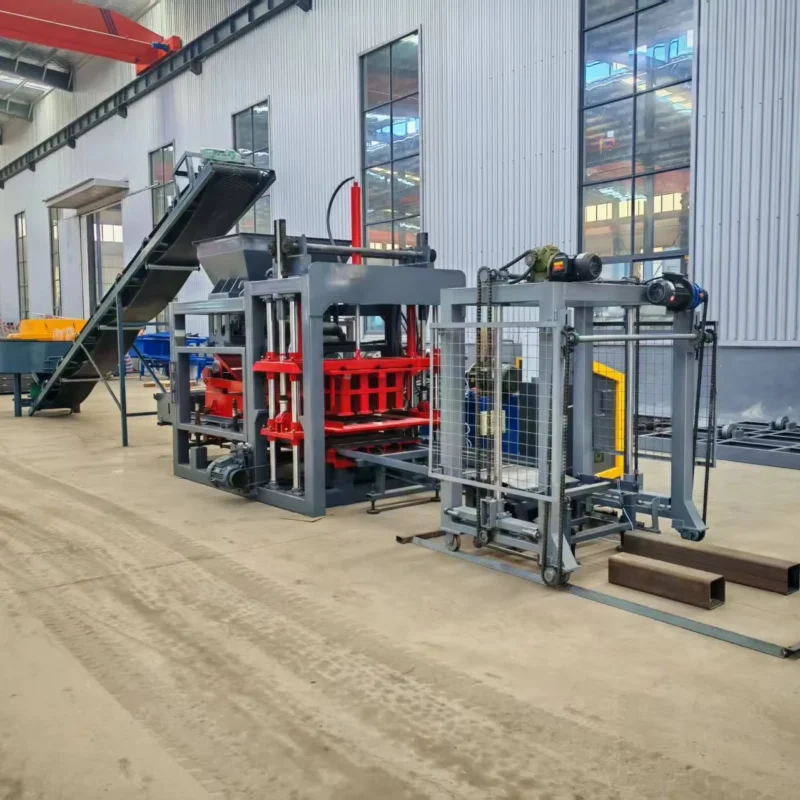
Line-Wide Cycle Matching — every station from mixer discharge to pallet stacking is timed against the QT4-15 press cycle so the host machine never idles waiting for upstream feed or downstream clearance.
Technical Specifications
| Parameter | Value |
|---|---|
| Model | QT4-15 |
| Product Type | Automatic Hydraulic Block Making Machine |
| Overall Dimensions | 7100×1600×2610 mm |
| Host Machine Dimensions | 2800×1800×2550 mm |
| Rated Pressure | 16 MPa |
| Main Vibration Form | Platform Vibration |
| Vibration Frequency | 4600 r/min |
| Vibration Force | 40 kN |
| Pallet Size | 950×550×20/25 mm |
| Molding Cycle | 15–25 s |
| Overall Power | 27.5 kW |
| Host Machine Power | 19.2 kW |
| General Water Consumption | 4 T/day |
| Total Mass | 5 T |
| Control System | Siemens PLC with customizable program |
| Motor Brand | Siemens or ABB (buyer selectable) |
| Hydraulic System | Double proportional hydraulic valve, Calyca or Youken brand |
| Automation Level | Automatic |
| Output Capacity (Hollow Brick 390×190×190 mm) | 720–960 pcs/h (4 pcs/mold, 15–20 s cycle) |
| Output Capacity (Porous Brick 240×115×90 mm) | 2520–3360 pcs/h (14 pcs/mold, 15–20 s cycle) |
| Output Capacity (Standard Brick 240×115×53 mm) | 5930–6720 pcs/h (28 pcs/mold, 15–17 s cycle) |
| Voltage & Frequency | Basis not stated in source — confirm with buyer’s local standard |
| PLC Display Language | Basis not stated in source — confirm before production |
| Warranty | 1 year (excluding spare parts) |
Application Suitability
| Application | Material or Output |
|---|---|
| Hollow block production for mid-scale plants | Crushed stone, cement, and sand aggregate mixes |
| Porous brick manufacturing | Lightweight aggregate and cement blends for permeable formats |
| Standard solid brick for on-site construction | Local sand, gravel, and cement with site-sourced materials |
| Paving brick runs for building material distributors | Dense aggregate mixes requiring high compaction pressure |
What "Cycle Time" Means When the Mixer Is Still Discharging
A 15-second press cycle only counts if the mixer, pallet feeder, and stacker all complete their work within that same window.
The most frequent complaint I hear from buyers who purchased a block making machine production line without line-wide coordination is that the quoted output never materializes. The press finishes its cycle, sits idle waiting for the next pallet, and daily throughput drops well below what was promised. With the QT4-15 as the central station, the raw material feeding, mixing, pallet circulation, stacking, and curing rack handling must each be specified against the same 15–25 second molding cycle. Without this alignment, the turnkey block plant you paid for becomes a press surrounded by bottlenecks [NEED_CITE: line-wide capacity calculation methods in concrete block manufacturing].
Matching Every Station to the Press Cycle
The QT4-15 operates as the press station within a complete block making machine production line. Its Siemens PLC program coordinates mixer discharge timing, pallet feed intervals, and stacking cycles so the host machine maintains continuous operation. When the mixer takes longer to discharge a stiff mix design, the PLC adjusts the pallet feed sequence to prevent a gap. This line-wide synchronization is what separates a standalone press from a functioning turnkey block plant.
Why the Slowest Station Defines Your Real Output
A common specification error is quoting line capacity based on the press alone. In reality, if the pallet feeder requires 20 seconds to position the next board and the press cycles in 15 seconds, the actual throughput follows the feeder’s pace. Line capacity must be calculated from the slowest station, and every station surrounding the QT4-15 — from raw material batching through curing rack handling — should be selected or adjusted to match the press cycle. This is the basis on which realistic daily output commitments are made [NEED_CITE: bottleneck analysis in stationary block production lines].
Pressure, Vibration, and Mix Design Alignment
The QT4-15 delivers 16 MPa rated hydraulic pressure combined with 40 kN platform vibration at 4600 r/min. These values determine how densely the aggregate mix is compacted inside the mold cavity. A mix with coarse local stone requires different pressure-vibration balance than a fine sand blend, and getting this wrong leads to inconsistent block strength across the pallet. The double proportional hydraulic valve system, available with Calyca or Youken components, allows fine-tuning of the pressure profile to match the specific mix design the buyer will actually run. The 950×550 mm pallet size must also be evaluated against the curing rack spacing and forklift capacity already present at the buyer’s facility — specifying the wrong pallet dimension creates handling delays downstream of the press.
When Stations Are Not Timed Together
Buyers who focus only on the press specification often discover, after installation, that the pallet return conveyor cannot keep pace with the molding cycle. Fresh blocks sit on the press table while the operator manually clears pallets, and the quoted hourly capacity becomes irrelevant. Line-wide timing gaps also surface during mold changeovers — if the new format requires a different pallet feed speed and the system is not reconfigured, the first several cycles after a change produce off-spec output. These issues are not press failures; they are line design failures [NEED_CITE: pallet circulation and cycle matching in block production].
Why Buyers Choose This Line Configuration
Block machinery remains our single focus, so the QT4-15 is never quoted as a standalone press but always as part of a matched system where machine, mold, pallet, and handling equipment are specified together. The configuration is set against the buyer’s actual mix design and local aggregate rather than a catalogue default. Molds are designed and supplied for the specific formats the buyer’s market demands, including custom drawings when standard options do not fit. Automation level is selectable, allowing a buyer to start with semi-automatic pallet handling and expand to full automatic stacking and cubing later. Installation and commissioning support includes operator training so the line runs at its matched cycle rate from day one.
Documentation & Verification
- Line layout and capacity calculation stating the block format assumed at each station
- Machine specification sheet with hydraulic pressure and vibration force matched to mix design
- Pallet specification cross-referenced with curing rack spacing and forklift capacity
- Voltage, frequency, and PLC display language confirmed in writing before production
- Factory test record on the buyer’s target block format before dispatch
- Hydraulic and electrical schematic for local maintenance reference
Installation, Commissioning & Support
- Foundation requirements based on the 7100×1600 mm overall footprint and 5 T total mass
- Power supply matching the 27.5 kW overall power draw with dedicated circuit for the 19.2 kW host machine
- Pallet size 950×550 mm verified against existing curing rack spacing before line assembly
- Siemens PLC program configured for the buyer’s confirmed voltage, frequency, and display language
- Operator training on mold change procedure and cycle time adjustment for different block formats
- Wear parts and mold maintenance schedule provided at commissioning
Before You Request a Quote
To configure the QT4-15 within a production line that matches your site, we need your target block formats with dimensions, required daily output, and the local aggregate materials you plan to use. Your existing curing area dimensions, forklift capacity, and available voltage and frequency determine pallet and electrical specifications. If you are adding this line alongside existing equipment, let us know what is already on site so the turnkey block plant integrates correctly.
Frequently Asked Questions
Q: How is line-wide capacity calculated, and which station determines the real daily output?
A: Line capacity is governed by the slowest station, not the press alone. Each station — mixer discharge, pallet feed, press cycle, stacking — is timed individually. The QT4-15 press cycle of 15–25 seconds sets the target, and every surrounding station is configured to match. The capacity figure we provide states which block format it assumes, so you know exactly what throughput to expect for each product you run.
Q: How do pallet size, curing rack spacing, and forklift capacity need to align across the line?
A: The QT4-15 uses a 950×550 mm pallet, but this dimension must match the curing rack slots and the forklift fork width already at your site. If the curing racks were built for a different pallet size, fresh blocks cannot be racked without manual transfer, creating a bottleneck downstream. We confirm these dimensions with you before the pallet feeder and stacking equipment are built.
Q: Which stations must be cycle-matched so the press is never left idle?
A: The mixer discharge, pallet feeder, press cycle, and stacker must all complete their operations within the same time window. If the pallet feeder takes longer than the QT4-15 molding cycle, the press waits. We calculate each station’s cycle time during layout design and adjust conveyor speeds, mixer gate timing, and stacker sequences so the line runs continuously without gaps between cycles.
Q: What automation level is included in the quotation, and what is quoted separately?
A: The QT4-15 itself is an automatic press with Siemens PLC control. However, pallet feeding, automatic stacking, curing rack handling, and cubing are line stations that can be specified at different automation levels. Your quotation lists each station separately so you can see exactly which parts of the line are automatic, which are semi-automatic, and where a future upgrade can be added as your production volume grows.


