
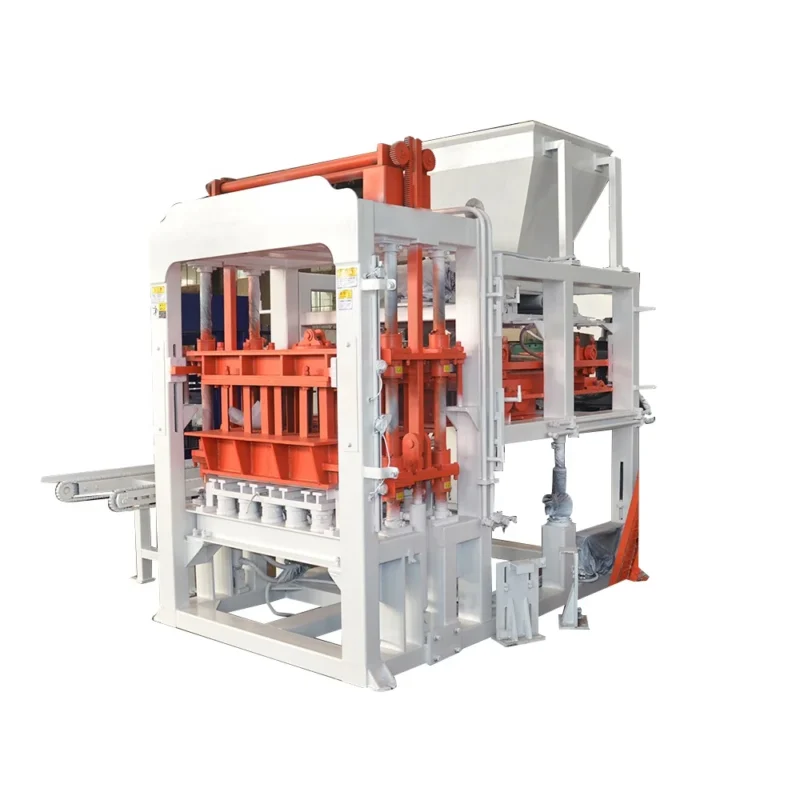
Stationary line integration — The QT5-15 press is specified against the cycle rhythm of its feeding, pallet handling and stacking stations so no single machine dictates the output ceiling of the whole stationary block machine production line.
Technical Specifications
| Parameter | Value |
|---|---|
| Model | QT5-15 |
| Product Type | Stationary Hydraulic Block Making Machine |
| Overall Dimensions (L×W×H) | 7400×1950×2800 mm |
| Rated Pressure | 21 MPa |
| Main Vibration Form | Hydraulic platform vibration |
| Cycle Time | 15–20 seconds (basis not stated in source — confirm block format, material and thickness) |
| Vibrating Frequency | 2800–4500 rolls/minute |
| Motors Power | 26.5 kW |
| Pallet Size | 1100×550 mm |
| Net Weight | 6 T |
| Voltage & Frequency | According to buyer requirement |
| Control System | PLC with fault diagnosis and remote monitoring |
| Automation Level | Fully automatic |
| Theoretical Output – 240×115×90 mm | 16 pcs/mould, 2,880–3,600 pcs/h, 23,040–28,800 pcs/8h |
| Theoretical Output – 400×115×53 mm | 32 pcs/mould, 7,680–8,800 pcs/h, 61,440–70,400 pcs/8h |
| Theoretical Output – 400×200×200 mm | 5 pcs/mould, 900–1,200 pcs/h, 7,200–9,600 pcs/8h |
| Vibration Control | Synchronization vibration, adjustable frequency (low for feeding, high for compaction) |
| Assembly State | Stationary |
Application Suitability
| Application | Material or Output |
|---|---|
| Hollow block production | Crushed stone, cement, sand and fly ash blends for load-bearing and non-load-bearing walls |
| Multicellular brick production | Lightweight aggregate and cement mixes for partition and infill walls |
| Paving brick production | Fine aggregate and cement with pigment additives for pedestrian and vehicular surfaces |
| Standard solid brick production | Dense aggregate and cement for structural masonry |
| On-site block production for housing projects | Locally sourced aggregate blended with cement, pressed and cured within the project compound |
When the Host Press Is Ready but the Line Is Not
A block press can only run as fast as its slowest upstream or downstream station.
Buyers often compare machines on cycle time alone, yet the real constraint on a stationary block machine production line is usually the pallet return speed or the mixer discharge rate. I once configured a line where the press completed a cycle in 18 seconds but the pallet feeder needed 25 seconds to reposition — the press sat idle for a third of every shift. That idle time is invisible on a quotation sheet but shows up immediately in the daily tally. [NEED_CITE: production line bottleneck analysis in concrete product manufacturing]
Matching Every Station to the Press Cycle
The QT5-15 completes a moulding cycle in 15–20 seconds depending on the block format and mix stiffness. Every surrounding station — raw material batching, mixing, pallet feeding, stacking and curing rack transfer — must be sized to that same window. If the mixer takes 30 seconds to discharge a batch that feeds two cycles, the press loses half a cycle every round. When we lay out a stationary block machine production line, we start from the press cycle and work outward, assigning a maximum allowable duration to each station so the press never waits.
Pallet Circulation and the Hidden Timing Trap
With a pallet size of 1,100×550 mm, the line requires a continuous loop of pallets moving from the press to the stacker, onto the curing rack, and back to the pallet feeder. The number of pallets in rotation must cover the full curing period plus press travel time; otherwise the pallet feeder runs dry. Buyers sometimes reduce pallet count to save cost, only to find the press halting every few minutes. [NEED_CITE: pallet circulation calculation for stationary block lines] We calculate the exact pallet count based on the buyer’s curing duration and rack capacity before the order is placed.
Reading the Specs That Decide Line Output
The 21 MPa rated pressure and the hydraulic platform vibration together determine how densely the mix is compacted. Higher pressure shortens the vibration window needed to reach target strength, which in turn influences cycle time. The vibration frequency range of 2,800–4,500 rolls/minute lets the operator dial in a low frequency during material feeding — allowing the mix to flow into the mould evenly — then switch to high frequency for compaction. This two-stage vibration control is critical when switching between a dry hollow block mix and a wetter paving brick mix, because each demands a different energy input. The PLC fault diagnosis system monitors pressure and vibration parameters continuously, sending alerts when values drift outside the set band, which supports faster troubleshooting across the entire stationary block machine production line rather than letting a fault propagate through downstream stations.
The Cost of Skipping the Line-Level Calculation
When the supporting equipment is sourced separately or left off the quotation entirely, the buyer is left stacking blocks by hand and wheeling pallets back with a forklift. That manual handling introduces variable timing, so the press cycle stretches unpredictably. Over a full shift, the gap between quoted capacity and actual output widens. I have seen plants where the block press was rated for thousands of pieces per shift but the manual pallet return limited real output to a fraction of that figure. [NEED_CITE: manual versus automated pallet handling impact on block press utilization] The discrepancy only becomes obvious after installation, when change orders and retrofitting cost more than specifying the full line upfront.
Why This Line Approach Works Here
The QT5-15 is supplied as one matched system: press, moulds, pallets and handling equipment are specified together rather than assembled from separate vendors, so cycle times align from day one. The pallet size of 1,100×550 mm is cross-checked against the buyer’s existing curing rack dimensions and forklift capacity before the line drawing is finalised. Moulds for hollow blocks, multicellular bricks, paving bricks and solid bricks are designed to the same press parameters, so format changes do not require mechanical adjustments to the feeder or stacker. Voltage and frequency are confirmed against the buyer’s site supply before production starts, preventing commissioning delays. Configuration is set against the buyer’s actual mix design and local aggregate, not a catalogue default. [NEED_CITE: concrete block mix design variation by region and aggregate source]
Documentation & Verification
- Line layout drawing with capacity calculation stated per target block format and cycle time assumptions for each station
- Machine specification sheet covering the QT5-15 press, hydraulic ratings and motor power
- Mould drawing and format list for every block type included in the quotation
- Pallet specification with dimensions, material grade and load rating matched to curing rack design
- Voltage, frequency and PLC display language confirmation signed before production
- Factory test record documenting cycle times on the buyer’s chosen block format before dispatch
Installation, Commissioning & Support
- Foundation pad must accommodate the 7,400×1,950 mm footprint and 6 T operating weight with anchor bolt provisions
- Dedicated power circuit required for the 26.5 kW motor load, voltage and frequency confirmed per buyer site
- Press and supporting stations shipped in dismantled form for container loading, reassembled on site in sequence
- PLC fault diagnosis and remote monitoring activated during first run to verify sensor calibration across the line
- Operator training covers mould change procedure, vibration frequency adjustment and daily maintenance checkpoints
- Wear parts list supplied with the initial shipment to cover the first replacement cycle
What to Prepare Before Requesting a Quote
To size the full stationary block machine production line accurately, share your target block formats with dimensions, the daily output you need per format, and the local aggregate and cement types you plan to use. Include your workshop length, width and clear height, plus details of any existing curing racks or forklifts. Confirm your site voltage, frequency and the PLC display language your operators need.
Frequently Asked Questions
Q: How is realistic daily output calculated for my target block format?
A: We start from the QT5-15 cycle time of 15–20 seconds for your specific block dimension, then verify that the mixer batch size, pallet feeder speed and stacker cycle all complete within the same window. The line layout drawing states the output per format with these assumptions written out, so the number you see is what the full line delivers, not just the press alone.
Q: What supporting equipment is included in the quotation?
A: The quotation covers the QT5-15 press, selected moulds, pallets, raw material feeder, mixer, pallet feeder, stacker and curing rack handler as one package. Each item is listed with its individual cycle time matched to the press. Items such as cement silos or external curing shelters are noted separately if they fall outside the standard line scope.
Q: How do I confirm pallet size against my existing curing racks?
A: Share your curing rack internal width, depth and tier spacing along with your forklift fork dimensions. We cross-check the 1,100×550 mm pallet against those measurements and adjust pallet material or thickness if needed before the line drawing is released for production.
Q: When must voltage, frequency and PLC language be confirmed?
A: These must be confirmed in writing before the QT5-15 enters production. Late changes after wiring is complete cause commissioning delays on site. We include a voltage and language confirmation form with the quotation so the details are locked early.
Q: What does the installation sequence look like for a full stationary line?
A: Foundation work comes first, followed by press positioning, then upstream mixer and feeder installation, and finally downstream stacker and pallet return. Operator training runs during the first production shifts so your team learns cycle timing, mould changes and fault response on the actual line.


