
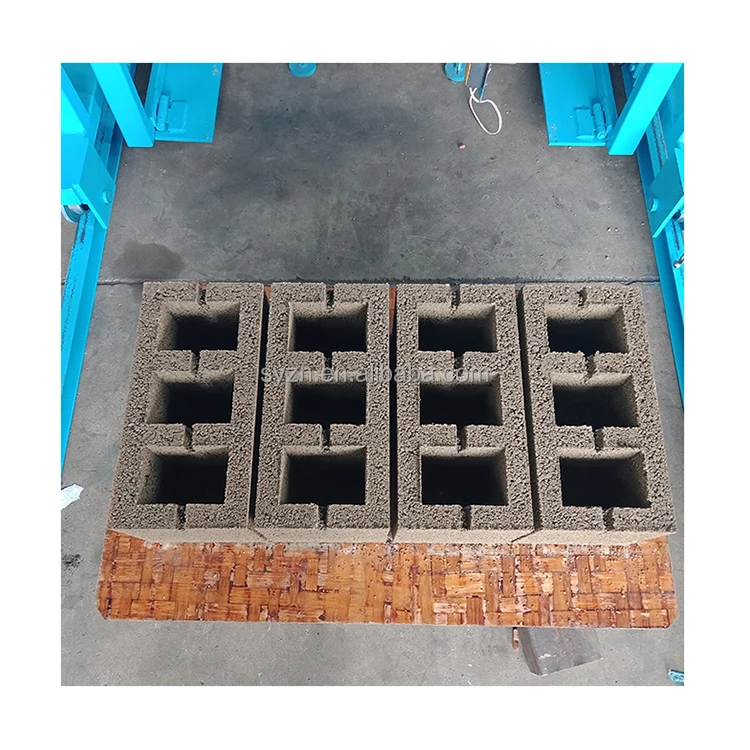
Matched line synchronization — the mixer discharge rate and conveyor travel speed are set against the 25-second press cycle so the QTJ4-25 forming station is never starved of material or left idling between charges.
Technical Specifications
| Parameter | Value |
|---|---|
| Model | QTJ4-25 |
| Product Type | Semi-Automatic Concrete Block Making Machine |
| Overall Dimensions (L×W×H) | 3060 × 1730 × 2580 mm |
| Total Weight | 4 T |
| Vibration Force | 45 kN |
| Press Cycle Time | 25 s |
| Pallet Size | 850 × 550 mm |
| Block Height Range | 40–280 mm |
| Belt Conveyor Length | 8 m |
| Mixer Model | JQ500 |
| Motor Brand | Siemens or ABB |
| Voltage & Frequency | 380 V, 3-phase, 50 Hz (customizable) |
| Automation Level | Semi-automatic |
| Workshop Area Required | 50–150 m² |
| Material Storage Area Required | 300–500 m² |
| Output — 400×200×200 mm hollow block | 4 pcs/mould, 480 pcs/h, 3,840 pcs/8-h shift |
| Output — 400×150×200 mm hollow block | 5 pcs/mould, 600 pcs/h, 4,800 pcs/8-h shift |
| Output — 400×100×200 mm hollow block | 7 pcs/mould, 840 pcs/h, 6,720 pcs/8-h shift |
| Output — 240×115×53 mm solid brick | 24 pcs/mould, 2,880 pcs/h, 23,040 pcs/8-h shift |
| Hydraulic Pressure | (basis to be confirmed) |
| Mould Change Time | (basis to be confirmed) |
| PLC / Control System | Electric control (brand and language to be confirmed) |
| Stacking Method | Manual |
| Warranty | 1 year (excluding wearing parts) |
Application Suitability
| Application | Material or Output |
|---|---|
| Small to medium block production plants | Hollow and solid concrete blocks from crushed stone, sand, and cement |
| On-site production for construction contractors | Interlocking pavers and curbstones using locally available aggregate |
| Fly ash block manufacturing | Fly ash blended with cement and fine aggregate for lightweight hollow blocks |
| Paver and curbstone runs for municipal projects | Colored concrete pavers and grassed bricks for landscaping |
| First-time entrepreneur block plants | Semi-automatic operation balancing lower investment with format versatility |
Why a Semi-Automatic Block Making Machine Production Line Must Be Sized Beyond the Press
The press cycle is only the starting number; every upstream and downstream station must be timed to it, or the rated output stays on paper.
A 25-second press cycle means roughly 144 cycles per hour. If the JQ500 mixer takes 40 seconds to discharge a batch into the hopper, the press sits idle for 15 seconds every cycle and daily output drops sharply. I once watched a line in West Africa lose nearly two thousand blocks a day because the belt conveyor was too slow to refill the feeder between strokes — the press itself was fine, the line around it was not. When you evaluate a semi-automatic block making machine production line, the conversation must start with how the mixer discharge rate, conveyor speed, and pallet feed interval all converge on that 25-second window [NEED_CITE: line synchronization principles for stationary block presses].
How the JQ500 Mixer and 8-Meter Conveyor Feed the Press Cycle
The JQ500 pan mixer must complete its batch, discharge into the belt conveyor hopper, and clear the chute before the next 25-second press stroke begins. An 8-meter conveyor running at the correct belt speed delivers the mixed material to the press hopper within the idle window of each cycle. If the conveyor is shortened or lengthened during site installation without recalculating travel time, material arrives late and the press waits. This is why the semi-automatic block making machine production line quotation should include a line layout drawing that shows the exact distance and angle between mixer discharge and press hopper.
Pallet Handling as the Hidden Bottleneck Downstream
Once a block is formed, the operator must pull the loaded 850 × 550 mm pallet off the press table and replace it with an empty one before the next cycle. In a semi-automatic configuration, this exchange is manual. If pallets are stacked too far from the press or the curing racks are positioned beyond comfortable carrying distance, the pallet swap stretches past the 25-second mark and the press idles. Curing rack dimensions must match the pallet footprint exactly so racks can be loaded without rearranging. Any semi-automatic block making machine production line plan that ignores the walk distance between press and curing area will underperform its own capacity table [NEED_CITE: manual pallet handling cycle impact on block output].
Reading the Capacity Table by Block Format
The output figures above are tied to specific block dimensions and mould cavities. A 400 × 200 × 200 mm hollow block yields 4 pieces per mould and 3,840 per eight-hour shift, while a 240 × 115 × 53 mm solid brick yields 24 pieces per mould and 23,040 per shift from the same press. Switching between formats changes not only the piece count but also the material volume per cycle, which affects mixer batch size and conveyor throughput requirements. A line that runs hollow blocks in the morning and pavers in the afternoon needs the mixer and conveyor sized for the heavier draw, not the average.
How Vibration Force and Pallet Size Shape Block Density
The 45 kN vibration force compacts the concrete mix inside the mould cavity while hydraulic pressure — to be confirmed with the manufacturer for this model — holds the material against the mould walls. Together they determine the green density of the block at demoulding. An 850 × 550 mm pallet must be rigid enough to transmit vibration evenly across its surface; a warped or undersized pallet causes uneven compaction and weak edges. The pallet material also dictates curing rack load capacity and forklift tine spacing across the yard, so the pallet specification should be locked in before the curing area is built.
What Happens When Line Stations Are Mismatched
A buyer who sources the press from one supplier and the mixer from another often ends up with a JQ500 that discharges faster than the conveyor can carry, or a conveyor that delivers material in surges the press hopper cannot absorb. The result is inconsistent block weight from cycle to cycle because the material head in the hopper fluctuates. In semi-automatic lines the operator compensates by manually adjusting feed timing, but this introduces variability that shows up as strength scatter in the cured blocks. Matching all stations through a single line specification removes that variable from the operator’s workload [NEED_CITE: effect of hopper level consistency on block weight uniformity].
Why Procurement Should Start with the Line Drawing
Ordering a QTJ4-25 as a standalone press and adding supporting equipment later is how workshops end up with a conveyor that blocks the forklift path or a mixer positioned where the curing racks need to go. The 50–150 m² workshop footprint and 300–500 m² material storage area are not optional guidelines — they define the geometry within which the mixer, conveyor, press, pallet return, and curing racks must coexist. A line layout drawing issued before production ensures that the 8-meter conveyor length actually fits the building and that the material stockpile does not encroach on the pallet circulation route.
Documentation & Verification
- Line layout drawing showing mixer, conveyor, press, and curing rack positions with station-to-station distances
- Capacity calculation sheet listing output per block format with the mould cavity count and cycle time stated
- Pallet specification confirming 850 × 550 mm size, material grade, and load rating per pallet
- Voltage and frequency confirmation sheet signed off before production to match site power supply
- Factory test record documenting press cycle time and mixer discharge rate under load
Installation, Commissioning & Support
- Foundation pad leveled to support the 4 T press weight and vibration load across the 3060 × 1730 mm footprint
- Dedicated 380 V three-phase circuit with breaker rated for the combined motor load of press, mixer, and conveyor
- Belt conveyor assembled on-site and tensioned after the 8 m run is verified against the line layout drawing
- Mixer discharge chute aligned to the conveyor hopper inlet and timed against the 25 s press cycle at commissioning
- Operator training covers manual pallet exchange technique, mould change procedure, and daily vibration platform inspection
- Wear parts list supplied covering vibration springs, mould liners, and conveyor belt splicing materials
What to Share with Your Inquiry
Before we configure the QTJ4-25 line for your site, the most useful details are the block formats you intend to sell and the daily volume you need per format. Share your workshop dimensions and ceiling height so we can verify the 8-meter conveyor run and curing rack placement. Confirm your local voltage, frequency, and the language you need on the control panel to avoid rewiring or reprogramming after arrival.
Frequently Asked Questions
Q: How is line output verified per block format rather than as a single cycles-per-hour claim?
A: Each capacity figure is calculated from the mould cavity count for a specific block dimension multiplied by the 25-second cycle time and an eight-hour shift. This means the 3,840 pieces per shift for 400 × 200 × 200 mm hollow blocks and the 23,040 pieces per shift for solid bricks are separate calculations, not derived from a single aggregate number.
Q: How do mixer discharge rate and conveyor speed need to match the 25-second press cycle?
A: The JQ500 must complete its batch and discharge before the next press stroke, and the 8-meter belt must deliver that material into the press hopper within the idle window. If either station runs slower than the 25-second cycle, the press waits and daily output drops proportionally to the delay.
Q: What pallet size and curing rack layout does the 850 × 550 mm pallet require?
A: Curing racks must accept shelves spaced to the pallet footprint with clearance for manual loading. Forklift tine spacing and rack column positions must accommodate 850 × 550 mm pallets without rearrangement. The curing yard area should support at least one full shift of pallets before the first cured pallets return to the press.
Q: What supporting equipment is included in the line quotation versus supplied separately?
A: The standard line includes the QTJ4-25 press, JQ500 mixer, and 8-meter belt conveyor as a matched set. Pallets, curing racks, and manual stacking stations are specified to the line but priced as separate items. Automatic stacking or cubing is not part of this semi-automatic configuration.
Q: How do workshop area and material storage requirements affect site preparation?
A: The 50–150 m² workshop must house the press, mixer, and conveyor with clear pallet circulation paths. The 300–500 m² material storage area holds aggregate, cement, and sand close enough for the mixer operator to batch without forklift delays. Both areas should be leveled and covered before the line arrives to begin commissioning on schedule.


