
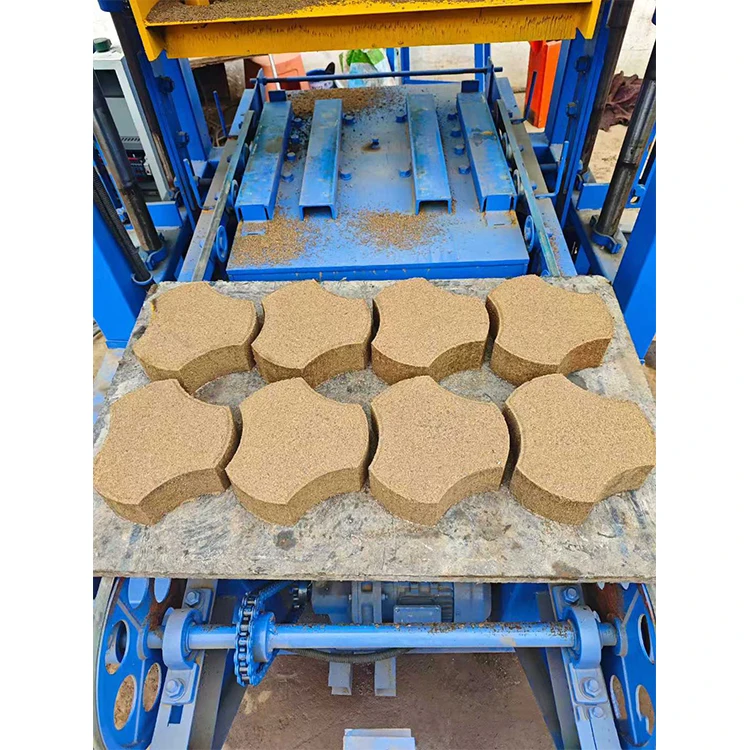
Synchronized Line Stations — every feeder, mixer, and stacker is paced against the QTJ4-24 press cycle so the stationary block making machine production line never idles between molding strokes.
Technical Specifications
| Parameter | Value |
|---|---|
| Model | QTJ4-24 |
| Product Type | Stationary Block Making Machine |
| Overall Dimensions (L×W×H) | 3600×1700×2560 mm |
| Pallet Size | 850×450 mm |
| Molding Cycle | 24–26 s (basis not stated in source — confirm block format / material / thickness) |
| Overall Power | 11.95 kW |
| Vibration Force | 45 kN |
| Net Weight | 2 T |
| Molding Method | Mechanical |
| Vibration Configuration | 2×3 kW lower vibrators + 2×1.5 kW upper vibrators |
| Reducer for Mold Lifting | 350-type |
| Material Distribution | Full-automatic spiral |
| Control System | PLC (detail to be confirmed) |
| Voltage & Frequency | Configurable — confirm before commissioning |
| Materials | Cement, sand, stone |
Application Suitability
| Application | Material or Output |
|---|---|
| Hollow block production for wall construction | Cement, sand, crushed stone aggregate |
| Paving block manufacturing for walkways and yards | Cement, sand, coarse stone mix |
| Interlocking brick forming for retaining walls | Cement, sand, graded stone |
| Solid block output for load-bearing structures | Cement, sand, dense aggregate blend |
| Small-to-medium fixed plant operations | Continuous daily runs with pallet circulation |
Why the Quoted Cycle Time Is Only Half the Story
A 24–26 second press cycle means nothing if the pallet feeder or mixer cannot keep the mold box loaded.
When buyers evaluate a stationary block making machine production line, the number they fixate on is the molding cycle. But the press does not run in isolation. Raw material must arrive at the hopper on time, the mixer must discharge a fresh batch before the spiral feeder runs dry, and the pallet return loop must deliver a clean, cured pallet back under the mold within seconds. If any of these stations lag, the press sits idle and the daily output drops well below the quoted figure. [NEED_CITE: production line synchronization and press idle time in block manufacturing]
Matching the Spiral Feeder to the Press Rhythm
The full-automatic spiral material distribution system on this stationary block making machine production line feeds the mold box without manual intervention. The key question is whether the spiral refill rate matches the 24–26 second molding window. If the spiral empties before the next cycle completes, the press waits. Line layout must account for the distance from the mixer discharge to the hopper and the spiral throughput relative to the mold volume for the heaviest block format the buyer intends to run.
Pallet Circulation and the Return Loop
The 850×450 mm pallet size determines how many pallets are needed in the circulation loop and what curing rack spacing is required. A short return loop with limited pallets means the press waits for cured blocks to be stripped and the pallet to cycle back. Plant owners planning a complete stationary block making machine production line must calculate the total pallet count against the curing time and the fork-lift stripping schedule. [NEED_CITE: pallet circulation count calculation for block plant throughput]
What the Vibration Configuration Means for Block Density
The dual upper and lower vibrator setup — two 3 kW lower units paired with two 1.5 kW upper units — delivers a combined 45 kN vibration force through the mold. In practice, lower vibrators compact the aggregate bed while upper vibrators settle the top surface and reduce voids. This matters when the buyer’s local aggregate has a high proportion of fine material: insufficient upper vibration leaves a weak top layer on hollow blocks, while excessive force on a dry mix can cause edge spalling. The mechanical molding method relies on this vibration-to-pressure balance rather than hydraulic intensification.
The Cost of Ignoring Station-to-Station Timing
A plant that installs the press without sizing the upstream mixer and downstream stacker will see wet blocks queue on the conveyor. Forklifts crossing the production floor crush uncured pallets, and operators spend shifts clearing jams instead of producing saleable output. The mixer must discharge a complete batch within the window the spiral feeder needs to refill, and the stacker — whether manual or automatic — must remove a finished pallet before the next one exits the press. [NEED_CITE: block plant bottleneck analysis at stacking and pallet return stations]
Why Line-Level Specification Matters Here
Every station around the QTJ4-24 is specified against the buyer’s target block format and local material rather than a generic catalog layout. The line layout document states which block format the cycle time assumes, so capacity expectations are grounded in reality. Pallet specifications are matched to the buyer’s existing curing area dimensions and forklift capacity. Voltage, frequency, and PLC display language are confirmed before production starts, preventing commissioning delays on site. Mould options cover the formats the buyer’s market actually trades — hollow, paving, interlocking — and custom mould drawings are available when the standard range does not fit.
Documentation & Verification
- Line layout showing station positions and pallet circulation count for the chosen block format
- Capacity calculation sheet stating the block format and mix assumed for the 24–26 s cycle
- Pallet specification matched to curing rack spacing and forklift load rating
- Voltage, frequency, and PLC language confirmation record before production
- Factory test record run on the buyer’s specified block format before dispatch
- Operation and maintenance manual covering spiral feeder and vibrator service intervals
Installation, Commissioning & Support
- Foundation plan sized to the 3600×1700 mm footprint with anchor bolt positions for vibration isolation
- Electrical supply spec covering the 11.95 kW total load with dedicated breaker per vibrator circuit
- 350-type reducer inspection and lubrication schedule for the mold lifting assembly during first-week operation
- PLC language and voltage set on site during commissioning before any production run begins
- Operator training on spiral feeder hopper level management to prevent press starvation
- Wear parts list identifying vibrator mounts and mold liner replacement intervals
What to Include with Your Inquiry
Provide the target block format and dimensions so the cycle time can be calculated against the actual mold cavity. Include your local aggregate type and moisture range so the mixer and spiral feeder are sized correctly. Confirm the available supply voltage, frequency, and preferred PLC display language. If you have existing curing racks or forklifts, share the pallet dimensions and load capacity so the return loop is designed around them.
Frequently Asked Questions
Q: How is the 24–26 second molding cycle verified, and which block format does it assume?
A: The cycle time depends on block thickness, aggregate size, and vibration settling time. A thin paving block may complete faster than a tall hollow block with coarse stone. We verify the cycle against the buyer’s chosen format during the factory test and document it in the capacity calculation sheet so daily output projections are realistic.
Q: What supporting equipment prevents the press from idling?
A: The press needs a mixer discharging fresh batches on schedule, a spiral feeder with adequate hopper capacity, and a pallet return loop with enough pallets to cover the full curing duration. If any station falls behind, the press waits and real output drops below the quoted figure.
Q: How does the 850×450 mm pallet size affect my curing area layout?
A: Pallet dimensions dictate curing rack spacing, forklift tine width, and the total pallet count in circulation. If your existing racks or forklifts do not match, you either modify the racks or adjust the pallet spec before production. We confirm this during the line layout stage.
Q: What voltage and PLC language options are available?
A: Voltage and frequency are configured to the buyer’s site supply before the machine enters production. PLC display language is set to match the operator’s preference. Both are confirmed in writing before the build starts to avoid delays at commissioning.
Q: What does the one-year warranty cover and what is excluded?
A: The warranty covers the complete machine for one year from dispatch, excluding consumable spare parts such as mold liners, vibrator mounts, and spiral feeder flighting. A wear parts list with replacement intervals is supplied so buyers can plan maintenance budgets from day one.


