
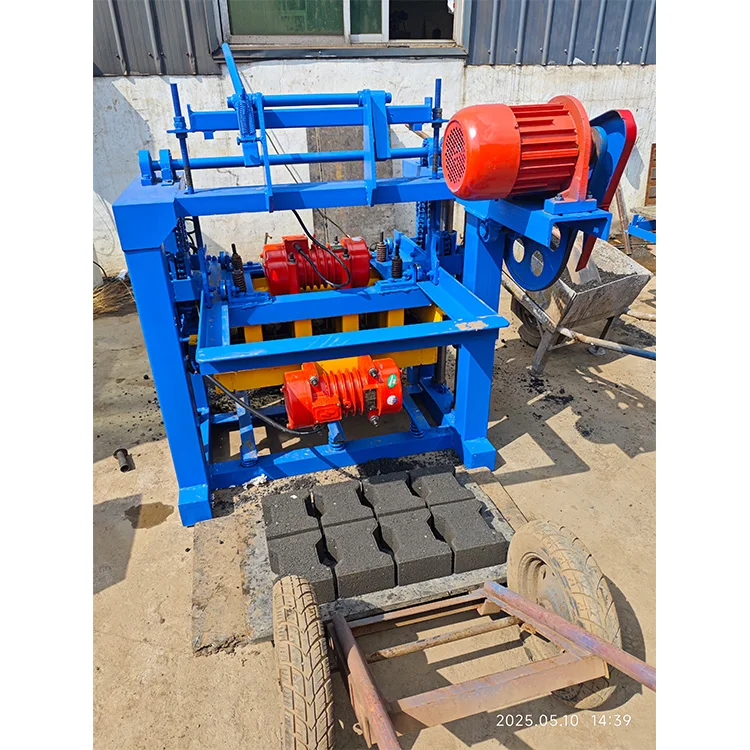
Matched line configuration — every station from mixer to curing rack is sized against the QTJ4-40 host cycle so no single point bottlenecks the rest of the semi-automatic block making machine production line.
Technical Specifications
| Parameter | Value |
|---|---|
| Model | QTJ4-40 |
| Product Type | Semi-Automatic Hydraulic Block Making Machine |
| Rated Power | 10.4 kW |
| Voltage & Frequency | According to local voltage (basis not stated in source) |
| Control System | Semi-automatic operation (basis not stated in source) |
| Overall Dimensions (L × W × H) | 1350 × 1460 × 1800 mm |
| Net Weight | 1.2 T |
| Molding Cycle | 40 s |
| Output Capacity | 360 pcs/h based on 400×200×200 mm hollow block (4 pcs/mould) |
| Output Capacity | 2,800 pcs/day based on 400×200×200 mm hollow block, 8-hour shift |
| Output Capacity | 450 pcs/h based on 400×150×200 mm block (5 pcs/mould) |
| Output Capacity | 800 pcs/h based on 225×112.5×60 mm paver (9 pcs/mould) |
| Raw Materials | Concrete, sand, cement, fly ash, lime, gypsum |
| Pallet Size | 850 × 450 × 20 mm |
| Pallet Material | Fiber glass (wooden pallet as alternative) |
| Mould Format | Hollow, solid, paver (8 inch, 6 inch, 5 inch, 4 inch) |
| Vibration System | Bed mould vertical vibration + upper mould compression vibration |
| Assembly State | Host machine + mixer + mould + pallets (mixer and pallet optional) |
Application Suitability
| Application | Material or Output |
|---|---|
| Hollow block production for building walls | Crushed stone, sand, cement, fly ash |
| Solid block production for load-bearing structures | Concrete, sand, cement, lime |
| Paver production for walkways and driveways | Concrete, sand, gypsum, cement |
| On-site block production for construction contractors | Concrete, sand, cement with local aggregate |
| First plant setup for entrepreneurs entering block market | Hollow, solid, and paver formats across multiple sizes |
Why "Pieces per Hour" Misleads Buyers Planning a Semi-Automatic Block Making Machine Production Line
A press cycle alone does not produce a sellable block — the line around it does.
Many quotations quote the QTJ4-40 press at 360 pieces per hour without explaining that this figure assumes the 400×200×200 mm hollow block and a perfectly timed pallet return loop. In real workshop conditions, the mixer discharge rhythm, pallet travel speed, and manual stacking pace each introduce a few seconds of idle time that accumulates across an eight-hour shift [NEED_CITE: typical line bottleneck analysis for semi-automatic block plants]. I have watched lines where the press sat idle waiting for the next pallet because the curing rack was full and no one had planned the return path. The semi-automatic block making machine production line only delivers its rated output when every upstream and downstream station matches the 40-second press cycle.
Station-by-Station Flow Around the Host Press
The QTJ4-40 sits at the center of a line that begins with raw material batching and ends at the curing rack. The mixer feeds concrete into the host hopper at intervals that must align with the 40-second moulding cycle; if the mixer batch takes longer than two cycles to discharge, the press waits. Downstream, each finished block on its 850×450 mm pallet travels to a stacking area where an operator or simple conveyor moves it to the curing zone. The semi-automatic block making machine production line works when the slowest station still finishes its task within one press cycle.
Where Cycle Mismatches Surface First
The most common mismatch appears between the mixer discharge height and the host hopper inlet — a problem I encountered firsthand when a customer added a makeshift belt conveyor between the two because the original elevation was off by a few centimeters, costing the project a full week of downtime. Pallet return speed is another hidden variable: if the operator must walk pallets back to the press by hand, the 40-second cycle stretches into something longer [NEED_CITE: manual pallet handling impact on block line throughput]. Every station connection should be drawn and verified before the first container is loaded.
Reading the Specs That Actually Govern Line Output
The dual vibration system — bed mould vertical vibration combined with upper mould compression vibration — determines block density and therefore the mix design the line can handle. A stiffer mix with more fly ash requires stronger vibration to compact fully, and the QTJ4-40 provides both vibration axes to handle that range. The 850×450×20 mm pallet size dictates how many blocks fit on a standard curing rack and which forklift tine spacing is needed, so confirming the curing area layout before ordering prevents a situation where pallets stack unevenly or the forklift cannot enter the rack aisle. The 10.4 kW rated power must be matched by a dedicated circuit at the buyer’s site; voltage and frequency need written confirmation before the motor is wound, because rewinding after arrival adds weeks of delay.
The Hidden Cost of Skipping Line-Level Planning
When the pallet size is chosen without checking the existing curing racks, the buyer may discover that pallets overhang the rack edges, forcing a complete rack replacement. If the mixer is sourced separately and its discharge chute does not align with the QTJ4-40 hopper, a field-welded adapter introduces vibration and spillage that were never part of the plan [NEED_CITE: field modification risks in block production lines]. Voltage mismatches discovered after the motor is already wired can stall commissioning while a replacement motor ships from the factory, turning a scheduled production start into a multi-week delay.
Why Sourcing the Line From One Supplier Matters
Block machinery is our single focus, which means the QTJ4-40, its moulds, pallets, and supporting equipment are specified as one matched system rather than assembled from separate vendors. We set the configuration against the buyer’s actual mix design and local aggregate, not a catalogue default. Mould design covers the formats the buyer’s market actually sells, including custom drawings when standard formats do not match local building codes. Automation level is selectable, so a buyer can start with manual pallet handling and add conveyor return later. Installation support includes operator training on the specific line layout delivered to site.
Documentation & Verification
- Line layout drawing with pallet flow path and station elevation for QTJ4-40 integration
- Capacity calculation sheet stating block format assumed for each output figure
- Mould drawing and format list covering hollow, solid, and paver options
- Pallet specification matched to 850×450×20 mm size and fiber glass material
- Voltage and control language confirmation document before motor winding
- Factory test record on buyer’s target block format before dispatch
Installation, Commissioning & Support
- Foundation pad sized to 1350×1460 mm footprint with anchor bolt pattern for QTJ4-40
- Dedicated 10.4 kW circuit with voltage and frequency confirmed in writing before shipment
- Mixer discharge height verified against host hopper inlet before container loading
- Mould change procedure trained on-site using buyer’s first production format
- Pallet return path and curing rack layout reviewed during commissioning visit
- Wear parts list covering vibration motor and hydraulic seals with reorder codes
Before You Send an Inquiry
To size the semi-automatic block making machine production line correctly, share the target block format and daily output you need, the local raw materials available including aggregate type and cement grade, and your workshop dimensions including ceiling height for curing rack clearance. Confirming the local voltage, frequency, and preferred control display language up front prevents commissioning delays after the equipment arrives.
Frequently Asked Questions
Q: How is daily output calculated — does it include pallet handling and curing time?
A: The 2,800 pieces per day figure assumes the 400×200×200 mm hollow block over an eight-hour shift with continuous pallet return. It does not include curing time, which typically runs overnight. If pallet handling is manual, expect the real shift output to be lower depending on operator pace and distance to the curing area.
Q: Which line stations come with the QTJ4-40 quotation?
A: The standard package includes the host machine, one mould set, and pallets. The mixer is listed as optional, meaning it can be added to the quotation or sourced locally. Pallet feeding conveyors and curing racks are not included unless specifically requested during the configuration stage.
Q: How does pallet size affect my curing rack and forklift layout?
A: The 850×450×20 mm fiber glass pallet determines the rack shelf width and the forklift tine spacing required. If your existing racks were built for a different pallet dimension, they may need modification. Confirming rack and forklift specs before ordering avoids mismatches on the first production day.
Q: What electrical details must be confirmed before production starts?
A: Voltage, frequency, and the PLC or control display language must be confirmed in writing. The 10.4 kW motor is wound to the specified voltage; changing it after production requires rewinding or replacement. The control language affects how quickly operators can troubleshoot alarms during the first weeks of production.


