
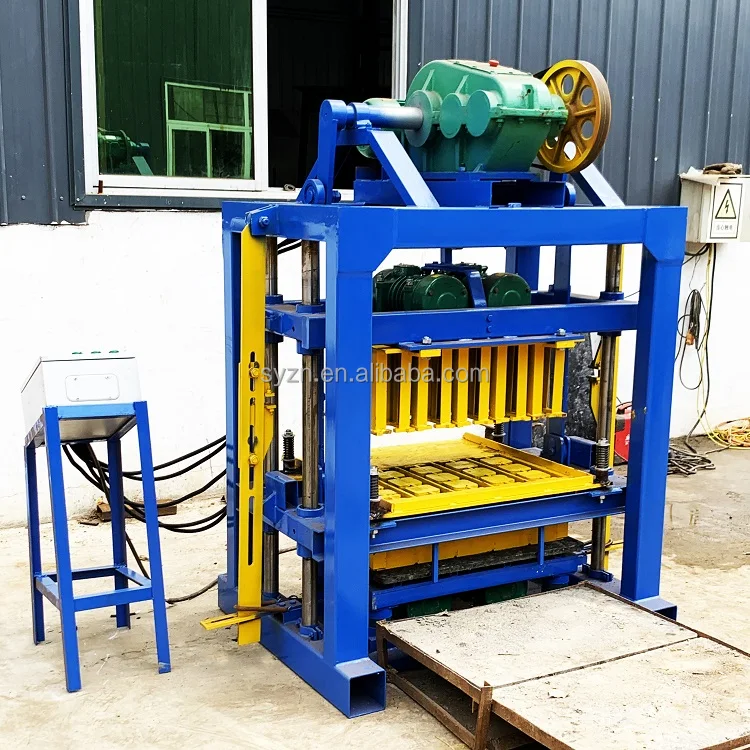
Matched System Lineup — the QTJ4-40 sits inside a complete block production line setup where mixer batch size, pallet flow and curing rack spacing are calculated together so the 40-second press cycle is never starved or blocked.
Technical Specifications
| Parameter | Value |
|---|---|
| Model | QTJ4-40 |
| Product Type | Manual Hydraulic Cement Brick Making Machine |
| Overall Dimensions (L×W×H) | 1350×1460×1800mm |
| Rated Power | 10.4kW |
| Molding Cycle | 40s |
| Vibration Type | Bed mould vertical vibration + upper mould compression vibration |
| Pallet Size | 850×450×20mm |
| Net Weight | 1.2T |
| Automation Level | Semi-automatic |
| Mould Compatibility | Hollow, solid, paver blocks in various sizes (8 inch, 6 inch, 5 inch, 4 inch) |
| Assembly State | Host machine, block mould, pallets; mixer optional |
| Output Capacity (Hollow Block 400×200×200mm) | 4 pcs/mould, 360 pcs/hour, 2880 pcs/day |
| Output Capacity (Hollow Block 400×150×200mm) | 5 pcs/mould, 450 pcs/hour, 3600 pcs/day |
| Output Capacity (Solid Brick 225×112.5×60mm) | 9 pcs/mould, 800 pcs/hour, 6400 pcs/day |
Application Suitability
| Application | Material or Output |
|---|---|
| Small to medium-scale block plants | Hollow blocks from crushed stone, sand and cement |
| On-site construction block manufacturing | Solid bricks and pavers for project-specific volumes |
| First block plant for entrepreneurs | Multiple formats from a single press with format changeover |
| Secondary line for existing plants | Paver and kerbstone production without disrupting the primary line |
When the Quotation Stops at the Press, the Line Stops at the Pallet
A block production line equipment quotation that covers only the press leaves the buyer to solve pallet handling, stacking and curing alone.
I have watched a semi-automatic press produce wet blocks faster than the operator could move them off the pallet, turning the curing area into a bottleneck that cut actual daily output well below the press rating. The mixer keeps feeding, the press keeps cycling, but the finished product piles up on the floor waiting for a forklift that is already busy somewhere else. This mismatch is the single most common reason a new line underperforms in its first month [NEED_CITE: common causes of block line underperformance in first-year operation].
How Upstream and Downstream Stations Must Track the 40-Second Cycle
The QTJ4-40 completes a molding cycle every 40 seconds, which sets the heartbeat for every station in the block production line equipment arrangement. The mixer must deliver a fresh batch within that window, the pallet feeder must present a clean pallet before the press opens, and the wet-side conveyor or manual transfer must clear the loaded pallet before the next cycle begins. If any one of these stations runs even a few seconds slow, the press idles and daily output drops accordingly.
Pallet Size as the Thread That Ties the Line Together
The 850×450×20mm pallet is not just a press accessory — it defines the curing rack slot width, the forklift tine spacing, and the curing area footprint. A buyer who already operates a forklift with standard 1000mm forks needs to confirm the pallet will sit stable on those tines before the line ships. Changing pallet dimensions after installation means rebuilding curing racks and re-striping the curing floor, a disruption that halts production for days [NEED_CITE: pallet handling and curing area planning for block plants].
Reading the Specs That Actually Shape Line Output
The bed mould vertical vibration combined with upper mould compression vibration determines how densely the concrete is compacted inside the mould box. Higher vibration force with matched hydraulic pressure produces a denser block, but only if the mix design and local aggregate grading support it — a mix that is too dry will crumble, while one that is too wet will slump on the pallet before curing begins. The 10.4kW rated power must be supported by a dedicated circuit at the buyer’s local voltage and frequency, confirmed before production so the motor and control panel arrive ready to connect. Mould compatibility across 8-inch, 6-inch, 5-inch and 4-inch formats means the line can shift between hollow blocks, solid bricks and pavers, but each format change requires the operator to swap the mould and recalibrate the fill depth, which must be factored into daily capacity planning.
What Happens When Pallet Flow Is an Afterthought
When the pallet supply and curing rack capacity are not sized to the press output, wet blocks sit on the pallets longer than intended, the pallets are not returned to the feeder in time, and the press waits. The result is a line that technically runs all day but produces far fewer blocks than the cycle time suggests, and the buyer blames the press for a problem that lives in the material handling gap [NEED_CITE: material flow bottlenecks in semi-automatic block lines].
Why This Line Is Specified as One System
Every station from raw material feeding through to curing rack handling is sized against the QTJ4-40’s actual cycle time and pallet dimensions, not pulled from a catalogue default. The mixer batch volume is calculated so that one full batch arrives at the press hopper within the 40-second window. The pallet specification is confirmed against the buyer’s existing curing area and forklift. Voltage, frequency and control language are locked before production begins. Mould drawings cover the formats the buyer’s market actually sells, with custom designs available to buyer drawings. Installation support includes operator training so the crew understands how format changes affect the rhythm of every station in the line.
Documentation & Verification
- Line layout and capacity calculation stating the block format assumed at each station
- Machine specification sheet with pallet size, vibration type and rated power confirmed
- Mould drawing and format list covering hollow, solid and paver options
- Pallet specification matched to the buyer’s curing rack and forklift dimensions
- Voltage, frequency and control language confirmation sheet before production
- Factory test record on the buyer’s chosen block format before dispatch
Installation, Commissioning & Support
- Foundation pad leveled to the 1350×1460mm footprint with anchor bolt pockets
- Dedicated circuit rated for 10.4kW at the confirmed local voltage and frequency
- Host machine, mould and pallets shipped assembled; mixer connected on site
- First-run parameter setting for vibration time and fill depth on the buyer’s mix
- Operator training covering mould change procedure and pallet return flow
- Wear parts and mould list provided at quotation for the first service interval
Before You Request a Quote
To size the block production line equipment correctly, we need to know the block formats your market sells and the daily volume you plan to run per format. Share your local raw material — sand type, aggregate grading, cement grade — so the mixer and press can be set to your actual mix. Confirm the curing area dimensions and the forklift you already have on site so the pallet and rack specification slots straight in.
Frequently Asked Questions
Q: How is daily line capacity calculated for each station?
A: Each station’s throughput is calculated per block format, not as a single headline number. The QTJ4-40 produces 2880 hollow blocks per day based on 400×200×200mm format, or 6400 solid bricks based on 225×112.5×60mm format. The mixer output, pallet supply and curing rack capacity are all matched to whichever format you plan to run most.
Q: What upstream and downstream equipment must match the 40-second cycle?
A: The mixer must deliver a batch within 40 seconds, the pallet feeder must present a clean pallet before the press opens, and the wet-side transfer must clear the loaded pallet before the next cycle. If any station runs slow, the press idles and daily output drops.
Q: How should pallet size and material be chosen?
A: The standard 850×450×20mm pallet must fit your curing rack slot width and your forklift tine spacing. We confirm both before production so the pallets, racks and forklift work together from day one without requiring separate handling investment.
Q: What electrical details need confirmation before shipping?
A: Voltage, frequency and control panel display language must be locked before the motor and wiring are built. This avoids a situation where the line arrives and cannot be connected to the local supply without rewiring or replacing components.
Q: Which line stations can be added or upgraded later?
A: The semi-automatic configuration allows the buyer to start with manual pallet handling and add automatic stacking or curing rack handling later. The press itself remains the same; only the downstream stations change as volume grows.


