
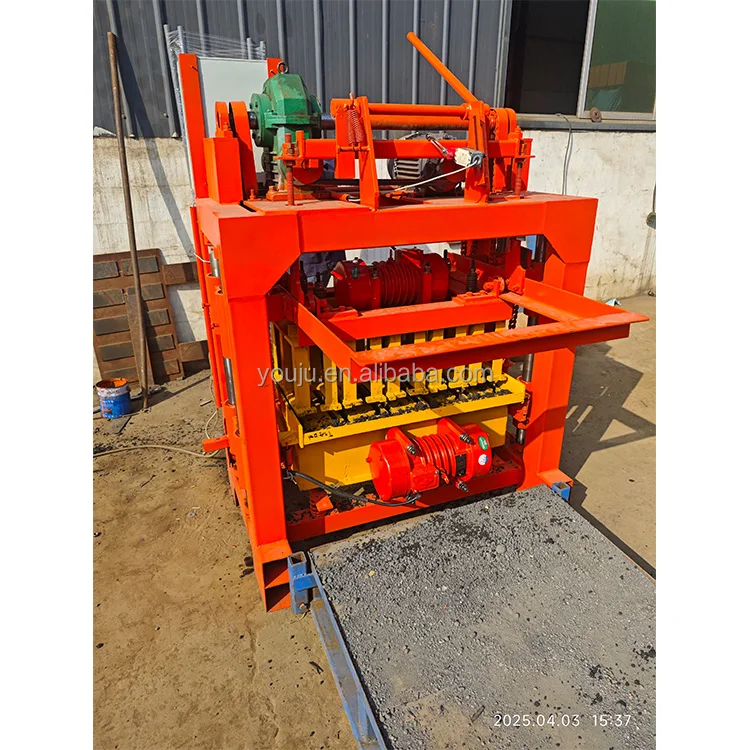
Complete Line Matching — The QTJ4-40B2 is specified as the press station within a full block production line, where mixer cycle time, pallet return speed, and stacking capacity are balanced against the press’s 2800 r/min vibration rhythm so no station waits on another.
Technical Specifications
| Parameter | Value |
|---|---|
| Model | QTJ4-40B2 |
| Product Type | Semi-Automatic Concrete Block Making Machine |
| Rated Power | 9.5 kW |
| Voltage & Frequency | Configured to buyer local standard (basis to be confirmed) |
| Control System | Manual operation (PLC availability to be confirmed) |
| Overall Dimensions (L×W×H) | 1350 × 1460 × 1800 mm |
| Net Weight | 1000 kg |
| Vibration Frequency | 2800 r/min |
| Mould Format | 390 × 190 × 190 mm, 4 pcs per mould |
| Automation Level | Semi-automatic with manual pallet handling |
| Workers Required | 3–5 |
| Warranty | 1 year |
| Patent | National patent No. 022692541 (China) |
Application Suitability
| Application | Material or Output |
|---|---|
| Hollow concrete block production | Crushed stone, cement, sand aggregate mix in 390×190×190 mm format |
| Solid block production | Dense concrete mix with custom mould swap |
| Paving block and interlocking brick | Fine aggregate blend with format-specific moulds |
| Kerbstone and porous brick | Specialized mix designs matched to local raw materials |
Why the Mixer Output Matters More Than the Press Speed
A block production line is only as fast as its slowest station upstream of the press.
When I worked the QC bench at our Linyi test workshop, I watched a contractor size a mixer to the press’s rated output but forget that the conveyor transit time and batch discharge lag added a full cycle of dead air between every mould fill. The QTJ4-40B2 sat idle while the crew waited for the next batch to arrive. Real daily throughput dropped noticeably below what the press mechanism could handle mechanically, and the bottleneck was not the press at all — it was the raw material feeding station that had never been matched to the mould cycle. This is where block production line equipment planning typically breaks down [NEED_CITE: concrete batching cycle synchronization standards].
Raw Material Feeding and Mixer Sizing for Continuous Press Operation
The 9.5 kW total power draw of the QTJ4-40B2 sets a baseline for sizing every motor upstream and downstream. When the mixer is undersized, the press completes its vibration cycle at 2800 r/min and then sits waiting for the next charge of concrete. The mixer batch volume must deliver enough material to fill four 390×190×190 mm cavities before the press finishes its current cycle, otherwise block production line equipment operates below its mechanical capacity for significant portions of every shift.
Pallet Return, Stacking and the Downstream Balance
Each mould cycle produces four blocks on a single pallet, and those pallets must cycle back to the press feeding station before the next vibration sequence begins. If the pallet return path is too long or the stacking crew cannot clear cured pallets fast enough, the press queue backs up. Semi-automatic operation with 3–5 workers requires a clearly defined pallet loop, and any block production line equipment layout must map that loop against the curing rack dimensions and the forklift capacity already on site [NEED_CITE: pallet circulation requirements in stationary block plants].
What the Numbers Mean on the Shop Floor
The 2800 r/min vibration frequency compacts the concrete mix into the mould cavity, and this frequency must be matched by adequate hydraulic or mechanical pressure to achieve consistent block density. The QTJ4-40B2 operates as a vibration-driven machine, so the mix design — specifically the water-cement ratio and aggregate grading available locally — directly determines whether the blocks reach the required strength without additional hydraulic compression. The 1350 × 1460 × 1800 mm footprint is compact enough for a first fixed plant, but the surrounding block production line equipment still needs clearance for pallet movement on at least two sides. At 1000 kg net weight, the machine can be repositioned with a standard forklift during initial layout, but once anchored, the mixer, conveyor, and curing rack positions become fixed around it.
When Stations Are Not Matched to Each Other
The hidden cost of an unmatched line is not a single broken machine — it is the cumulative idle time across every shift. A mixer that delivers one batch every four minutes to a press that cycles every forty seconds means the press stands still for the majority of its working day. Workers get pulled into manual material handling tasks that were supposed to be mechanized, and the daily output never reaches what any single station could produce alone. I have seen first-time plant owners blame the press for low output when the actual constraint was a conveyor belt running at half the required feed rate [NEED_CITE: bottleneck identification methodology in production lines].
Why Line Configuration Matters More Than Individual Machine Specs
Block machinery is our single focus, so the QTJ4-40B2 is never quoted in isolation — the machine, mould, pallet, and handling equipment are specified as one matched system. Configuration is set against the buyer’s actual mix design, local aggregate availability, and target block format rather than pulled from a catalogue default. Mould design and supply covers the formats the buyer’s market actually sells, and the automation level is selectable so a plant can start with semi-automatic pallet handling and add stacking automation later. Installation and commissioning support includes operator training on the full line sequence, not just the press controls.
Documentation & Verification
- Line layout with capacity calculation stating the block format assumed at every station
- Pallet specification matched to curing rack spacing and existing forklift capacity
- Voltage, frequency, and control language confirmation across all line stations before dispatch
- Factory test record on the buyer’s target block format before shipment
- Hydraulic and electrical schematic covering press, mixer, and conveyor circuits
Installation, Commissioning & Support
- Foundation pad leveled to the 1350 × 1460 mm base footprint with anchor bolt provisions
- Dedicated 9.5 kW circuit with voltage and frequency confirmed to local grid standard
- Machine arrives assembled; mixer and conveyor require on-site positioning relative to the press
- First-run test on buyer’s local aggregate mix to verify block density and cycle timing
- Operator training covers mould change sequence, pallet loading, and full line start-up procedure
- Wear parts list covers vibration components and mould surfaces for first replacement planning
What to Prepare Before Requesting a Quotation
Share your target block format and the daily output you need from the finished line. Confirm the raw materials available locally — aggregate type, cement grade, and any industrial by-products you plan to use — along with your site voltage and frequency. Let us know the curing area dimensions and any existing forklift or pallet racking so the block production line equipment layout can be designed around what you already have on the ground.
Frequently Asked Questions
Q: How do I match the mixer batch size to the QTJ4-40B2 cycle so the press does not wait for material?
A: The mixer must deliver a complete batch for four 390×190×190 mm cavities within the press cycle time. We calculate the required batch volume and discharge rate against your specific mix density and conveyor transit distance, then size the mixer motor and drum capacity so material arrives before the press finishes vibration. This prevents idle gaps that reduce daily output.
Q: What pallet size and return system keeps this press running continuously through a shift?
A: Pallet dimensions must match both the press bed and your existing curing rack spacing. We specify pallet material and thickness based on the vibration frequency and block weight, then design the return loop so cleared pallets reach the feeding station before the next cycle. Forklift capacity and curing area layout determine the pallet quantity required.
Q: Where does the bottleneck shift when moving from manual stacking to automatic cubing?
A: With manual stacking, the constraint is typically how fast workers can clear cured pallets. Adding automatic cubing downstream removes that labour bottleneck but shifts attention to the conveyor speed between the curing rack and the stacker. The press cycle then becomes the pacing station, and upstream mixer output must be verified to keep up.
Q: How are voltage and frequency confirmed across all line stations before shipment?
A: Every motor on the line — press, mixer, conveyor, and any stacker — must share the same voltage and frequency standard. We confirm your local grid specification during the quotation stage and wire all control panels and motor terminals accordingly, including PLC display language where applicable, so commissioning is not delayed by electrical mismatches on arrival.


