
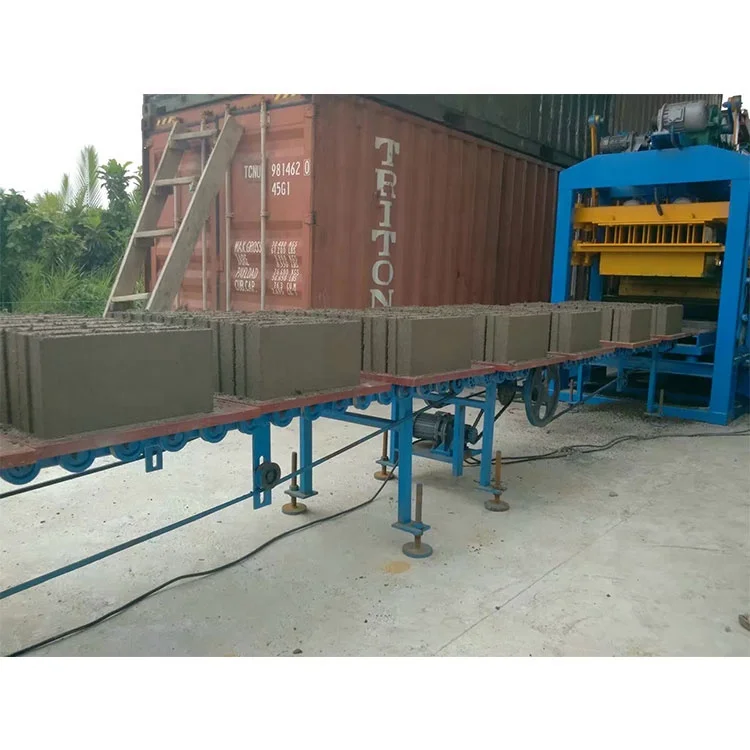
Line-Balanced Configuration — every station from raw material feeding through to stacking is sized against the QTJ4-25’s 25-second cycle so the press never waits on upstream or downstream equipment.
Technical Specifications
| Parameter | Value |
|---|---|
| Product Type | Semi-Automatic Concrete Block Making Machine |
| Model | QTJ4-25 |
| Overall Dimensions (L × W × H) | 3000 × 1800 × 2680 mm |
| Total Mass | 3.5 T |
| Overall Power | 16.58 kW |
| Vibration Force | 60 kN |
| Vibration Form | Platform Vibration |
| Vibration Frequency | 2800–4500 r/min |
| Pallet Size | 850 × 480 mm |
| Molding Cycle | 25 s |
| Demolding Method | Mechanical |
| Factory Area Required | 300 m² |
| Guide Column | Four-column overlong guide design |
| Frame Material | National standard manganese steel |
| Surface Treatment | Chrome-plated |
| Output (Hollow Block) | 580 pcs/h based on 400×200×200 mm, 4 pcs/mould (basis to be confirmed) |
| Output (Porous Brick) | 1400 pcs/h based on 240×115×90 mm, 9 pcs/mould (basis to be confirmed) |
| Output (Solid Brick) | 3300 pcs/h based on 240×115×53 mm, 21 pcs/mould (basis to be confirmed) |
| Voltage & Frequency | Configurable to destination market (confirm before production) |
| Control System | Confirm with supplier |
Application Suitability
| Application | Material or Output |
|---|---|
| Small to medium block plants | Hollow blocks, solid blocks from crushed stone, sand, cement, fly ash |
| On-site construction production | Interlocking blocks and pavers using local gravel and slag |
| First-plant entrepreneurs | Standard concrete blocks with manual pallet circulation |
| Format expansion for existing producers | Colored pavers and curbstones alongside current product lines |
| Project-based local manufacturing | Curbstone and porous brick from site-available aggregate blends |
Why "Pieces per Hour" Tells Only Half the Story for Semi-Automatic Block Making Machine Production Line Planning
A quoted cycle rate means nothing unless the mixer, pallet return loop, and stacking station all keep pace.
When buyers compare semi-automatic block making machine production line proposals, the headline number is almost always the press cycle count per hour. Yet the actual daily output depends on how fast the upstream mixer can deliver a consistent batch, how quickly pallets return from the curing area, and whether manual stacking can clear the press table before the next cycle completes. If any one of those stations runs slower than the 25-second molding cycle, the press sits idle and the real throughput drops well below the brochure figure [NEED_CITE: block plant bottleneck analysis methodology]. Capacity calculations must therefore state the block format, the pallet size, and the supporting equipment assumptions so the buyer can verify each link in the chain.
Matching the Mixer Output to the Press Appetite
The QTJ4-25 consumes a fresh batch every 25 seconds, which means the mixer must discharge a measured volume of concrete within that window to avoid press starvation. For a semi-automatic block making machine production line, undersized mixers are a frequent cause of intermittent production pauses that erode daily output. The mixer’s discharge height, gate speed, and batch volume must be verified against the press hopper capacity and the raw material feed configuration chosen for the site.
Pallet Circulation and the Curing Area Gap
An 850 × 480 mm pallet leaves the press every cycle and must travel to the curing rack, be stripped of cured blocks, and return to the pallet feeder before the next molding round. On a semi-automatic block making machine production line, this loop is often the tightest constraint because pallet handling is still partly manual. If the curing area is located far from the press or the forklift capacity is mismatched to the pallet weight when loaded, the return trip stretches beyond the cycle time and the press waits [NEED_CITE: pallet circulation rate impact on block plant throughput]. Line planning must therefore map the pallet travel distance and confirm the forklift specification before the layout is finalized.
Reading the Numbers That Matter for Block Density
The 60 kN vibration force combined with platform vibration at 2800–4500 r/min determines how tightly the concrete mix is compacted inside the mould cavity. Higher frequency with adequate force produces denser blocks with better compressive strength, but only if the mix design and local aggregate gradation are compatible. A semi-automatic block making machine production line configured for a sand-cement ratio that cannot be sourced locally will yield inconsistent block strength regardless of the vibration settings. The four-column overlong guide design keeps the mould box aligned during high-frequency vibration, reducing uneven wear on the mould liner and extending the interval between mould replacements. Meanwhile, the 3.5 T total mass of the QTJ4-25 provides the static weight needed to stabilize the frame against vibration-induced movement, meaning the machine does not require a deep foundation pit — a 300 m² factory area with a level concrete slab is sufficient for the press and its immediate supporting stations.
The Hidden Cost of a Mismatched Supporting Line
When the pallet feeder cannot keep up with the press cycle, operators begin hand-feeding pallets to avoid downtime, which introduces safety risks and inconsistent pallet positioning. Misaligned pallets cause uneven block thickness and increased scrap rates that are rarely traced back to the line imbalance. Similarly, if the stacking station is omitted from the quotation entirely, freshly pressed blocks pile up at the press exit and must be moved by hand, creating a labour bottleneck that negates the semi-automatic investment [NEED_CITE: manual stacking bottleneck in semi-automatic block plants]. These consequences are preventable when each supporting station is specified against the same cycle-time benchmark as the press itself.
Why Sourcing the Full Line From One Supplier Matters Here
Block machinery is the single focus of this operation, so the QTJ4-25, its moulds, pallets, and handling equipment are specified as one matched system rather than assembled from separate vendors. Configuration is set against the buyer’s actual mix design, local aggregate availability, and target block format instead of a catalogue default. Mould design covers the formats the buyer’s market actually sells, including custom drawings when standard moulds do not match local brick dimensions. The automation level is selectable, so a buyer can begin with semi-automatic pallet handling and upgrade the stacking and cubing stations later without replacing the press. Installation support includes operator training so the crew understands not just the press but the full line sequence from mixer to curing rack.
Documentation & Verification
- Line layout drawing showing pallet circulation path and curing rack positions for the 300 m² footprint
- Capacity calculation sheet stating block format, mould cavity count, and pallet size for each output figure
- Pallet material and dimension specification matched to 850 × 480 mm press table
- Hydraulic and electrical schematic with voltage and frequency confirmation for destination market
- Factory test record on buyer’s target block format before machine dispatch
- Wear parts and mould list with recommended first-replacement intervals
Installation, Commissioning & Support
- Level concrete slab preparation within the 300 m² factory area to support 3.5 T machine mass without a pit foundation
- Dedicated power circuit sized for 16.58 kW overall load with confirmed voltage and frequency before wiring
- Press and supporting stations assembled on-site with pallet feeder alignment verified against the 850 × 480 mm pallet track
- First production run supervised to confirm 25-second molding cycle holds with the buyer’s actual mix design
- Operator training covering mechanical demolding, pallet return sequence, and daily vibration platform inspection
- Spare wear parts kit including hydraulic seals and mould liners supplied with recommended replacement schedule
Preparing Your Inquiry for Accurate Line Configuration
To build a line layout that holds its cycle time across every station, we need to know the block formats you plan to produce, the daily output target per format, and the raw materials available at your site. Please also share the dimensions of your production space and curing area, the local voltage and frequency standard, and whether you already have forklifts or curing racks that the pallet size must accommodate. If you are replacing an existing press, let us know the current supporting equipment you intend to keep so we can verify compatibility with the QTJ4-25 cycle rate.
Frequently Asked Questions
Q: How is daily output calculated for each block format on this line?
A: Each output figure is tied to a specific block dimension and mould cavity count. The 580 pcs/h hollow block rate assumes a 400×200×200 mm block with four cavities per mould, while the 3300 pcs/h solid brick rate assumes 240×115×53 mm bricks with twenty-one per mould. Daily output is calculated by multiplying the hourly rate by actual production hours, excluding pallet return delays and mould change stops.
Q: What supporting equipment must match the 25-second cycle time?
A: The mixer discharge rate, pallet feeder speed, and stacking clearance must all complete their tasks within 25 seconds to prevent the press from idling. If the mixer batch volume is too small, two mixing cycles are needed per press cycle, immediately halving throughput. Pallet return speed depends on the curing rack distance and forklift capacity, both of which must be confirmed during line layout planning.
Q: How does the 850 × 480 mm pallet size affect my existing curing setup?
A: The pallet dimensions determine the spacing of curing rack slots and the minimum fork width of the forklift used to transport loaded pallets. If your existing racks are designed for a different pallet size, they may need adaptation or replacement. Confirming the pallet specification early ensures the curing area layout and material handling equipment are compatible before the line is installed.
Q: What factory area is needed for the complete semi-automatic line?
A: The press itself requires a portion of a 300 m² factory area, but the full line including raw material storage, mixer placement, pallet circulation path, and curing racks must fit within that footprint. A detailed layout drawing is prepared once the block formats and daily output targets are confirmed, showing each station position and the pallet travel route to verify the space is sufficient.
Q: How do I confirm voltage, frequency, and control language before production?
A: These parameters must be agreed upon before the machine enters production so the electrical panel, motor ratings, and control display match the destination site. A confirmation document listing voltage, frequency, phase, and PLC or control panel language is signed off during the quotation stage to prevent commissioning delays after arrival.


