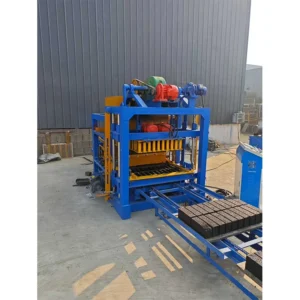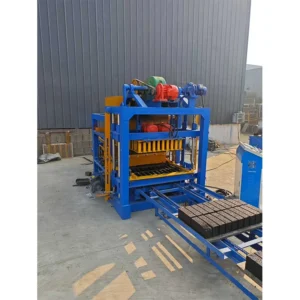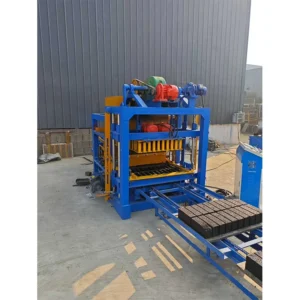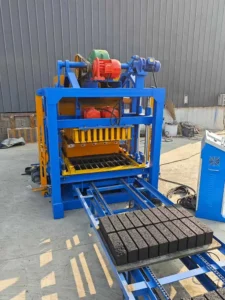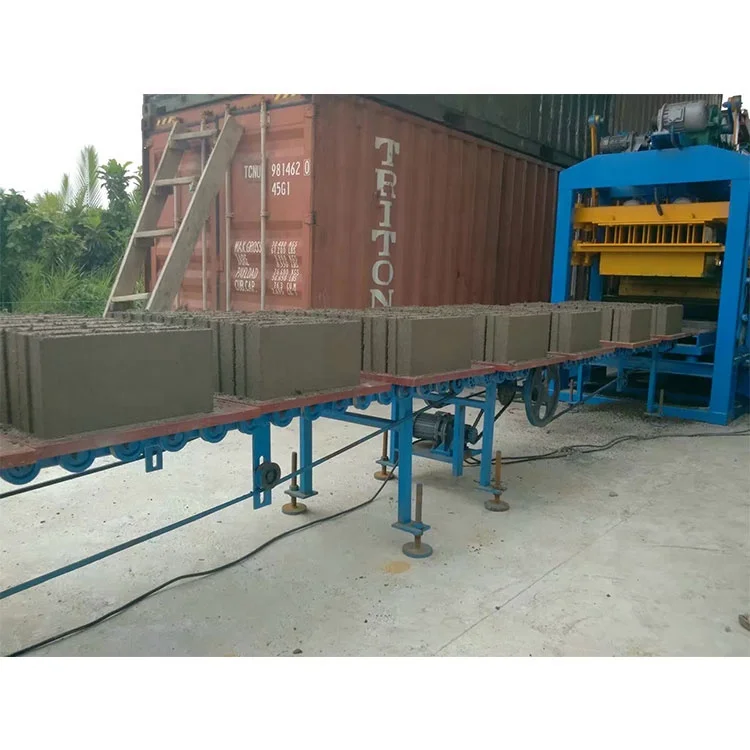
Matched Line Rhythm — the QTJ4-25 block press is specified alongside its mixer, pallet feeder and return conveyor so every station cycles at the same 25-second beat, eliminating idle press time.
Technical Specifications
| Parameter | Value |
|---|---|
| Model | QTJ4-25 |
| Product Type | Automatic Concrete Block Making Machine |
| Overall Dimensions (L×W×H) | 3000×1800×2680 mm |
| Total Installed Power | 16.58 kW |
| Vibration Force | 60 kN |
| Main Vibration Form | Platform Vibration |
| Vibration Frequency | 2800–4500 r/min |
| Pallet Size | 850×480 mm |
| Molding Cycle | 25 s |
| Total Mass | 3.5 T |
| Demolding Method | Mechanical |
| Recommended Factory Area | 300 m² |
| Guide Column Design | Four columns, overlong guide |
| Surface Treatment | Chrome-plated guide columns |
| Hollow Block Output | 580 pcs/h (based on 400×200×200mm block, 4 pcs/mould) |
| Multi-cellular Brick Output | 1400 pcs/h (based on 240×115×90mm brick, 9 pcs/mould) |
| Solid Brick Output | 3300 pcs/h (based on 240×115×53mm brick, 21 pcs/mould) |
| Control System | Not stated in source — confirm PLC / relay / manual |
| Voltage & Frequency | Not stated in source — confirm with buyer site requirement |
| Raw Materials | Crushed stone, sand, cement, fly ash, gravel, slag |
Application Suitability
| Application | Material or Output |
|---|---|
| Hollow block production | Crushed stone, sand and cement mix for load-bearing walls |
| Solid brick production | Fly ash and slag blends for masonry infill |
| Paving block production | High-density aggregate mix for driveway and walkway surfaces |
| Interlocking brick production | Colored concrete mix for landscape and retaining structures |
| Curbstone production | Coarse aggregate concrete for road-edge forming |
Why the Pallet Return Loop Decides Your Actual Throughput
A 25-second press cycle means nothing when the pallet feeder starves or the return conveyor jams.
Plant owners regularly quote the press cycle as their line capacity, then watch daily output fall short because pallets are still being moved by hand or a slow stacker backs up the return path. On the QTJ4-25, the mechanical demolding system deposits each wet block onto an 850×480 mm pallet that must clear the press table before the next cycle begins. If the return conveyor or manual transfer cannot complete that loop within 25 seconds, the press sits idle. I have walked onto sites in the Gulf where the press was rated for hundreds of blocks per shift but operators were still carrying pallets by hand to the curing yard, turning a supposedly automatic block machine production line into a bottleneck at the demolding station [NEED_CITE: typical pallet handling delays in semi-automatic block plants].
Upstream Matching: Mixer Output to Press Intake
The QTJ4-25 completes a pressing cycle every 25 seconds, drawing a fixed volume of concrete from the hopper each time. The upstream mixer must deliver a fresh batch at least as fast as the press consumes it. A mixer that takes longer than the press cycle to discharge will force the press to pause, and that pause compounds across an eight-hour shift into a significant volume loss. When we lay out an automatic block machine production line around this press, the mixer discharge rate and the hopper capacity are calculated against the 25-second cycle so the press never waits for material.
Downstream Synchronization: Pallet Flow and Curing Rack Capacity
After demolding, each loaded pallet must travel to the curing area before the next pallet enters the press. The 850×480 mm pallet dimension dictates the width of the return conveyor, the spacing of the curing rack shelves and the fork pocket orientation on the racks themselves. If the curing racks were purchased for a different pallet size, pallets will not seat correctly and blocks may tilt during the critical early-cure hours. Line planning around the QTJ4-25 starts with the pallet spec and works outward to the rack layout, forklift capacity and yard footprint, ensuring every downstream station accepts the pallet the press releases [NEED_CITE: pallet-to-curing-rack compatibility standards in concrete block production].
Reading the Numbers That Actually Matter
The 60 kN platform vibration force drives aggregate compaction from below the mould, and its effectiveness depends on pallet rigidity. A pallet that flexes under vibration absorbs energy that should be compacting the block, producing lower-density output and inconsistent compressive strength across the batch. Chrome-plated overlong guide columns keep the mould aligned through thousands of cycles, which matters most when producing thin-web hollow blocks where a millimeter of misalignment causes rejection. The 16.58 kW total power draw is modest for a block press, but it must be matched with a dedicated circuit that accounts for the vibration motor’s starting surge — a detail often missed when the press is added to an existing workshop panel.
The Cost of Treating the Press as a Standalone Purchase
Buyers who specify only the press and source pallet handling separately almost always discover the gap on commissioning day. Pallets arrive in the wrong size, the return conveyor runs at a different speed, or the stacker cannot grip the 850×480 mm format, and the line requires a second round of fabrication before it runs at the intended rhythm. On projects I have supervised, that second round adds weeks of delay and rework cost that the original quotation never mentioned [NEED_CITE: hidden integration costs when block line components are sourced separately]. The QTJ4-25 performs as designed only when every station around it is built to the same pallet spec and cycle timing.
Why Buyers Source the Full Line from One Specification Point
The machine, mould, pallet and handling equipment are specified as a single matched system rather than assembled from independent vendors. Configuration is set against your actual mix design and local aggregate, not a catalogue default, so the vibration force and cycle time produce the block density your market requires. Mould design covers the formats your buyers actually order, and custom drawings are available when a project specifies non-standard dimensions. The automation level is selectable — the QTJ4-25 starts as a mechanical-demolding press with manual pallet handling, and the line can be extended with automatic stacking and cubing later without replacing the press itself. Installation support includes operator training on the complete line, not just the press station.
Documentation & Verification
- Line layout showing QTJ4-25 press position with upstream mixer and downstream pallet return conveyor
- Capacity calculation sheet stating the block format assumed for each station’s throughput
- Pallet specification matched to 850×480 mm press requirement and your existing curing rack
- Voltage, frequency and control language confirmation sheet signed before production
- Hydraulic and electrical schematic showing press interface with mixer and conveyor circuits
- Factory test record on your target block format before dispatch
Installation, Commissioning & Support
- Foundation pad sized to the 3000×1800 mm footprint with vibration isolation for the 60 kN platform force
- Dedicated power circuit rated for 16.58 kW total draw plus vibration motor starting surge
- Machine shipped with guide columns and hopper dismantled for container loading, reassembled on site
- First-run commissioning sets vibration frequency between 2800–4500 r/min against your mix design
- Operator training covers mechanical demolding sequence and pallet return loop timing
- Wear parts list identifies chrome-plated guide column bushings and mould liner replacement intervals
What We Need to Configure Your Line
Send us your target block format and daily output requirement so we can calculate the mixer batch size and pallet circulation speed that match the QTJ4-25 press cycle. Tell us the pallet size and curing rack type already on site, or the yard dimensions available, so the return conveyor and rack handling are built to fit. Confirm your local voltage, frequency and preferred control display language so the electrical panel is wired correctly before it leaves the factory.
Frequently Asked Questions
Q: How is line capacity calculated when the QTJ4-25 cycles at 25 seconds but the mixer runs slower?
A: We calculate the actual line capacity against the slowest station, not the press alone. If the mixer discharges one batch every 40 seconds, the line capacity drops to that rate regardless of the press cycle. The layout document states the assumed block format and shows each station’s throughput so the bottleneck is visible before you order.
Q: Which supporting stations are included in the quotation and which are optional?
A: The quotation lists every station in the line — press, mixer, pallet feeder, return conveyor, stacker and curing rack handling — as separate line items. You can accept the full line or remove stations you already have on site. Nothing is hidden or assumed, so the output you are paying for is the output the line will deliver.
Q: How does pallet size affect the curing rack and forklift already on site?
A: The QTJ4-25 uses an 850×480 mm pallet. Your curing rack shelves must be spaced to accept that width, and your forklift forks must reach the pallet’s center of gravity when loaded with wet blocks. We request your existing rack and forklift specifications during the inquiry stage so the line fits the equipment you already own.
Q: Can the line start semi-automatic and upgrade to automatic stacking later?
A: Yes. The QTJ4-25 uses mechanical demolding, which allows manual pallet handling at startup. When production volume justifies it, an automatic stacker and pallet return conveyor can be added to the existing press without replacing the core machine, protecting your initial investment while raising daily output.
Q: What voltage and control language must be confirmed before the line ships?
A: The voltage, frequency and PLC display language must match your site supply and operator preference. These are confirmed in a signed sheet before production begins. Shipping a panel wired for the wrong frequency delays commissioning by weeks while replacement components are sourced locally [NEED_CITE: common commissioning delays caused by unconfirmed electrical specifications].