
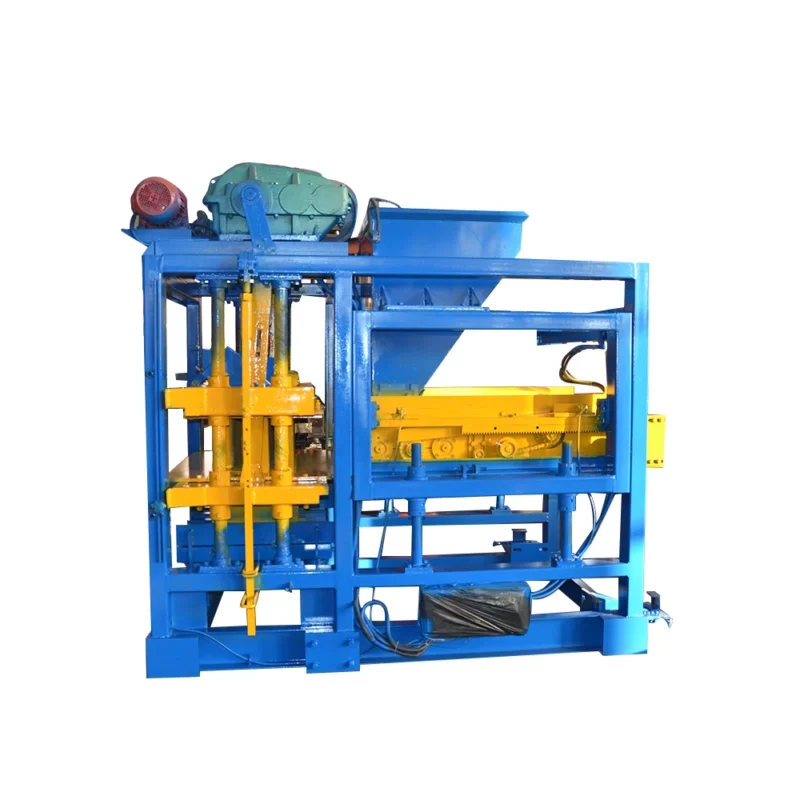
Matched Line Configuration — every QTJ4-25 press leaves our facility with its JQ350 mixer, pallet spec and manual handling trolley scoped as one system, so the press cycle never waits on upstream supply or downstream clearing.
Technical Specifications
| Parameter | Value |
|---|---|
| Model | QTJ4-25 |
| Product Type | Automatic Hydraulic Concrete Block Making Machine |
| Rated Power | 17.9 kW |
| Overall Dimensions (L×W×H) | 6400×1500×2700 mm |
| Net Weight | 2500 kg |
| Molding Cycle | 25 s |
| Output Capacity | 960 pcs/h (based on 400×200×200 mm hollow block, 4 pcs/mould) |
| Daily Output | 7680 pcs/day (based on 400×200×200 mm hollow block, 8-hour shift) |
| Vibration Frequency | 2800 r/min |
| Vibration Force | 60 kN |
| Pallet Size | 850×550×20 mm |
| Mould Format | Hollow, solid, paver, curbstone (mould change required) |
| Automation Level | Semi-automatic |
| Control System | PLC |
| Hydraulic System | Hydraulic station with high pressure |
| Configuration Included | Host machine 1 set, block mould 1 set, JQ350 mixer |
| Stacking Method | Manual (place on pallet, move with trolley) |
| Voltage & Frequency | Configurable to buyer’s local supply (confirm before production) |
| Certification | CE (verify applicability to destination market) |
Application Suitability
| Application | Material or Output |
|---|---|
| Hollow block production for masonry walls | Crushed stone, cement, sand — 8-inch, 6-inch, 5-inch, 4-inch formats |
| Solid block production for load-bearing structures | Dense aggregate mix with cement binder |
| Paving block manufacturing for walkways and yards | Fine aggregate with pigment addition for colour layers |
| Curbstone production for road edging | Heavy aggregate mix requiring extended vibration and compression |
| On-site block production for building contractors | Locally sourced aggregate matched to available sand and stone gradings |
Why "960 Pieces per Hour" Means Nothing Without the Rest of the Line
A block press rated at 960 pcs/h based on 400×200×200 mm hollow blocks will produce far fewer units if the mixer cannot keep pace or pallets run out mid-shift.
I once laid out a line for a contractor in West Africa where the block machine cycled every 25 seconds but the upstream batch mixer needed 90 seconds per charge. The press sat idle for two out of every three cycles. The crew stood around watching an expensive machine do nothing. When planning a concrete block production line turnkey, the press is only as fast as its slowest upstream station. The JQ350 mixer included with the QTJ4-25 is sized so its batch discharge aligns with the host machine cycle, but this alignment only holds if the raw material feed and water dosing are also matched. Buyers who source a larger mixer thinking "more is better" sometimes find the surge overwhelms the conveyor and causes spillage at the hopper. [NEED_CITE: block production line cycle matching between mixer and press]
Mixer-to-Press Timing on the QTJ4-25 Line
The JQ350 pan mixer discharges a batch roughly every cycle window the host machine requires. When we scope a concrete block production line turnkey, we calculate the batch weight against the mould cavity volume and the target block density, then confirm the mixer charge time does not exceed the press cycle plus pallet indexing time. If the buyer’s local aggregate is heavier or lighter than standard, the batch weight shifts and the timing must be recalculated before the line ships.
Pallet Circulation and Why Quantity Matters Up Front
With semi-automatic stacking, pallets travel from the press to the curing area on a trolley, sit through the curing period, then return empty. The 850×550×20 mm pallet size is fixed in the machine design, which means the curing rack spacing and forklift tine width must match before the first block is pressed. We recommend buyers hold a pallet inventory sized for at least one full curing cycle plus a buffer, so the press never stops because pallets are still drying in the yard. [NEED_CITE: pallet circulation planning for semi-automatic block lines]
How Vibration and Hydraulic Pressure Shape Block Density
The 60 kN vibration force at 2800 r/min compacts the aggregate in the mould cavity, while the hydraulic station applies downward compression through the upper mould head. These two forces must be balanced against the buyer’s mix design: a dry, zero-slump mix with angular crushed stone responds well to high vibration, whereas a wetter mix with rounded river sand may need reduced vibration to prevent segregation. The PLC control keeps cycle timing consistent across formats, but the pressure and vibration settings should be adjusted during commissioning to match the specific aggregate the buyer will actually source locally.
Reading the Specs That Actually Affect Daily Output
The 25-second molding cycle governs the theoretical maximum, but real daily output depends on pallet change speed, mould filling time and operator rhythm during manual stacking. The 17.9 kW rated power covers the hydraulic pump, vibration motors and conveyor drive combined; buyers should confirm their site supply can sustain this load continuously across an 8-hour shift without voltage drop. The overall length of 6400 mm includes the host machine frame, which determines the minimum building bay width needed for the press station alone, before accounting for mixer placement and pallet return path. The semi-automatic automation level means one or two operators manage pallet loading and block removal, which keeps the initial investment lower but requires reliable manual handling discipline to maintain cycle consistency.
What Happens When Line Stations Are Specified Separately
I have seen buyers purchase a block press from one supplier, a mixer from another, and pallets from a third. The mixer output port sits too high for the press hopper, so a makeshift chute is welded on site. The pallets arrive 10 mm too wide for the feed rack, forcing the operator to file the edges by hand. Each mismatch costs days of commissioning time and produces blocks of inconsistent density because the material flow was never calibrated as one system. When supporting equipment is not scoped with the press, the buyer absorbs every interface failure at their own expense. [NEED_CITE: equipment interface failures in multi-supplier block plant setups]
Why Buyers Scope the Full Line Here
Block machinery is our single focus, so the QTJ4-25, its mould, pallet and JQ350 mixer are specified as one matched set rather than assembled from separate catalogue pages. We configure the line against the buyer’s actual mix design and local aggregate, not a default setting that may not suit the stone available at the job site. Mould design covers the formats the buyer’s market actually sells, with custom drawings available when standard formats do not match local building codes. The automation level is selectable, so a buyer can begin with semi-automatic manual stacking and add automatic pallet feeding or cubing later as volume grows. Installation support includes operator training on cycle timing and mould change procedure, so the crew understands the line as a system from day one.
Documentation & Verification
- Line layout drawing showing mixer, conveyor, press and pallet return path with dimensions
- Capacity calculation sheet stating block format assumed for each output figure
- Mould drawing and format list confirming which cavity sizes are included in the quotation
- Pallet specification sheet with size, material grade and recommended inventory quantity
- Voltage, frequency and PLC display language confirmation record signed before production
- Factory test record with cycle timing measured across the quoted block format
Installation, Commissioning & Support
- Foundation pad must support 2500 kg net weight plus dynamic vibration load across the 6400×1500 mm footprint
- Dedicated electrical circuit required for 17.9 kW rated power with voltage and frequency confirmed to local supply
- Host machine ships partially dismantled for container loading; reassembly and alignment completed on site during commissioning
- PLC parameters and hydraulic pressure set during first run to match the buyer’s confirmed mix design and aggregate
- Operator training covers mould change procedure, pallet handling rhythm and daily maintenance checkpoints
- Wear parts list and mould maintenance schedule provided at handover for ongoing production continuity
What We Need to Configure Your Line
Before we can confirm the right line layout, share the block formats your market sells most and the daily volume you need to hit. Tell us what aggregate and sand you can source locally, along with the curing area dimensions you have available so we can match pallet quantity and rack spacing. Confirm your site voltage, frequency and the language your operators read on a PLC screen, so the control panel is built correctly before the machine leaves our floor.
Frequently Asked Questions
Q: How is daily output calculated and which block format does the 960 pcs/h figure assume?
A: The 960 pcs/h figure is based on producing 400×200×200 mm hollow blocks with 4 cavities per mould at a 25-second cycle. Daily output of 7680 pieces assumes an 8-hour continuous shift with no stoppages. If your primary product is a different format such as a solid block or paver, the cycle time and pieces per mould change, so we recalculate the realistic daily output for that specific format before quoting.
Q: What supporting equipment is included and what must I source locally?
A: The line ships with the QTJ4-25 host machine, one block mould set, a JQ350 mixer, and the manual pallet trolley for block transfer to the curing area. Buyers typically source pallets in the recommended quantity, raw materials, curing area covers and a forklift or hand cart suited to the 850×550 mm pallet size locally. We provide the pallet specification so local procurement matches the machine feed system.
Q: How do the mixer and press cycle times align so the press is not left idle?
A: The JQ350 mixer batch size and discharge rate are calculated against the mould cavity volume and the 25-second press cycle. During commissioning we verify that each batch reaches the hopper before the next mould cycle begins. If your local aggregate density differs from our baseline, we adjust the batch weight and timing so the press maintains its rhythm without waiting or overflowing.
Q: What pallet material and quantity are recommended for this line?
A: Pallets are specified at 850×550×20 mm and can be wood, bamboo or composite depending on your curing environment and budget. We recommend holding enough pallets to cover one full curing cycle plus a circulation buffer, typically several hundred pieces. The pallet size must match your curing rack spacing and forklift dimensions, so confirm those before we finalise the pallet order.
Q: How is voltage and PLC language confirmed before shipment?
A: We require written confirmation of your site voltage, frequency and preferred PLC display language before the control panel enters production. This prevents commissioning delays caused by a motor wound for the wrong supply or an interface your operators cannot read. The confirmation is documented and referenced on the electrical schematic included with your shipping paperwork.


