
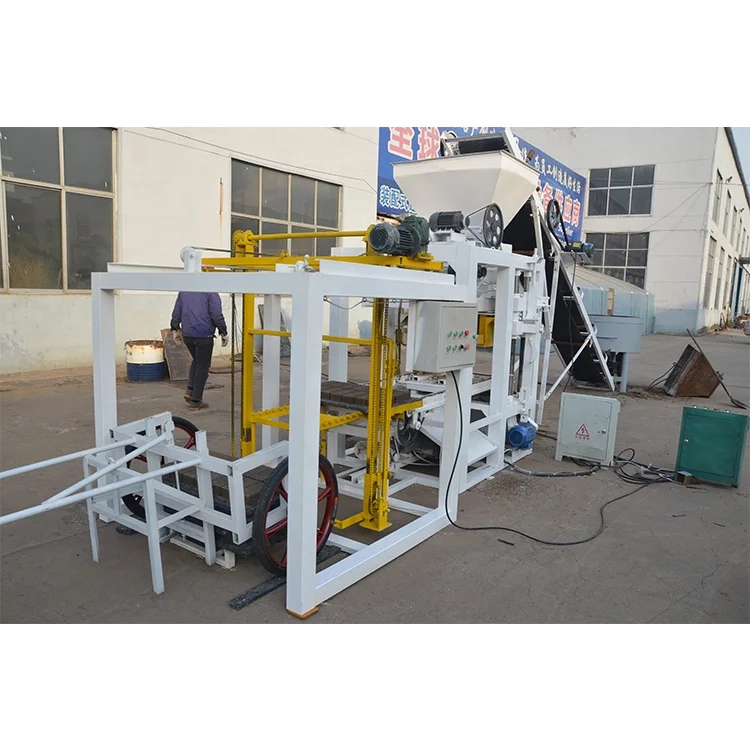
Matched Line Configuration — Every station from the JQ350 pan mixer through the 6m belt conveyor to the optional auto stacker is specified against the press cycle, so the QTJ4-24 block machine production line runs without idle gaps.
Technical Specifications
| Parameter | Value |
|---|---|
| Model | QTJ4-24 |
| Product Type | Semi-Automatic Concrete Block Making Machine |
| Molding Type | Platform Vibration |
| Overall Dimensions (L×W×H) | 3600mm × 1700mm × 2560mm (working state) |
| Total Mass | 1750 kgs |
| Overall Power | 14.25 kW |
| Pallet Size | 850mm × 450mm |
| Mould Format | 390mm × 190mm × 190mm (4 pcs/mould); 240mm × 115mm × 53mm (21 pcs/mould) |
| Vibration System | Lower platform vibration (2 × 3 kW motors); Upper vibration (1.5 kW attached device) |
| Elevating System | Cone-shape motor with JZQ250 speed reducer |
| Delivery Device | Cycloidal pin wheel speed reducer with chain and V-belt drive |
| Control System | Electronic controlling part (PLC / MCC not specified in source) |
| Voltage & Frequency | To be confirmed before commissioning |
| Automation Level | Semi-automatic |
| Mixer (support equipment) | JQ350 pan mixer |
| Conveyor (support equipment) | 6m belt conveyor |
| Optional Equipment | Auto stacker (3–6 layers depending on block height) |
| Included Accessories | Trolley for block transport to curing yard |
| Hydraulic Pressure | Not applicable (mechanical vibration type) |
| Cycle Time | To be confirmed per block format (basis to be confirmed) |
| Output Capacity | To be confirmed per block format and cycle time (basis to be confirmed) |
Application Suitability
| Application | Material or Output |
|---|---|
| Small-scale hollow block plant | Crushed stone, sand, cement and water mix for 390×190×190mm hollow blocks |
| On-site construction block production | Locally sourced aggregate for solid bricks and hollow blocks at building project locations |
| Paving block and kerbstone runs | Fine aggregate and cement blends for 240×115×53mm solid format and similar paver sizes |
| Supplementary secondary line | Format-specific runs alongside an existing primary block production setup |
Why the Mixer Output Matters More Than the Press Cycle Rate
A press that waits for material produces nothing, no matter what the nameplate says.
The QTJ4-24 semi-automatic block making machine with supporting equipment is rated around a mechanical vibration cycle, but that cycle only translates into real daily output when the JQ350 pan mixer discharges fast enough and the 6m belt conveyor delivers continuously to the hopper. I have walked onto sites where the press sat idle for minutes between cycles because the mixer batch was still blending — the operator had no choice but to wait. When you size a block line, the slowest station sets the pace for every station downstream [NEED_CITE: line balancing principles in concrete product manufacturing].
How Each Station Feeds the Next
The QTJ4-24 block machine production line starts with the JQ350 pan mixer, which blends aggregate, cement and water into a consistent batch. The discharge rate of that mixer must align with the press hopper consumption rate. If the batch is too small, the conveyor runs dry before the next mix is ready. If the batch is too large, material sits in the conveyor trough and begins to stiffen. The 6m belt conveyor bridges the gap, carrying mixed material at a steady feed rate into the press hopper so the platform vibration cycle starts on a full charge every time.
Where the Line Breaks Down Without Planning
Most quotations for a semi-automatic block making machine with supporting equipment list the press, the mixer and the conveyor as separate line items without stating how their capacities relate. The result is a line that technically works but chronically underperforms. Pallet handling compounds the problem — if finished blocks are moved to the curing yard by hand using the included trolley, the operator splits attention between feeding the press and clearing pallets. The optional auto stacker, which handles three to six layers depending on block height, removes that bottleneck by mechanising pallet stacking so the press cycle is never interrupted by downstream congestion [NEED_CITE: pallet handling impact on block plant throughput].
Reading the Specifications That Actually Matter
The dual 3 kW lower vibration motors and the 1.5 kW upper vibration device work together to compact the mix from both directions, which matters when the local aggregate is angular or poorly graded — inconsistent compaction shows up as weak blocks that break during transport to the curing area. The 850mm × 450mm pallet size must be checked against the curing rack spacing and the forklift tine width already on site; pallets that do not match existing infrastructure create a second handling step nobody budgeted for. The JZQ250 speed reducer on the elevating system and the cycloidal pin wheel reducer on the delivery device are mechanical components that tolerate dusty conditions better than precision servo drives, which suits open-air block yards where fine cement dust settles on every surface.
What Happens When Line Stations Are Mismatched
When the mixer is undersized for the press cycle, the operator learns to run shorter batches more frequently, which introduces inconsistency in the water-to-cement ratio from batch to batch. When the conveyor is too slow, the press hopper level drops and the vibration cycle compacts a partial charge, producing blocks with uneven density. When pallet handling is entirely manual and the curing yard is far from the press, finished blocks sit on the pallets longer than intended, occupying pallets that the press needs for the next cycle. These are not theoretical failures — they are the everyday reality on sites where the line was assembled from a catalogue rather than configured as a connected system [NEED_CITE: common causes of output shortfall in small block plants].
Why This Line Is Configured Together
Block machinery is our single focus, which means the QTJ4-24 press, JQ350 mixer, 6m conveyor, pallet trolley and optional stacker are specified as one matched system rather than pulled from separate supplier catalogues. The configuration is set against the buyer’s actual mix design, local aggregate and target block format instead of a default setting. Mould design and supply cover the formats the buyer’s market actually sells, including custom drawings when standard formats do not match local demand. The automation level is selectable — a buyer can start with manual pallet handling and add the auto stacker later as volume grows. Installation support includes operator training so the crew understands how each station’s timing affects the next.
Documentation & Verification
- Line layout showing mixer discharge point, conveyor route and press hopper alignment
- Capacity calculation stating the specific block format assumed for output figures
- Machine specification sheet covering vibration motor ratings and reducer types
- Pallet specification with dimensions, material and weight matched to curing rack layout
- Voltage and control language confirmation document signed before production begins
- Factory test record demonstrating press cycle with the configured mould installed
Installation, Commissioning & Support
- Foundation pad sized for 3600mm × 1700mm working footprint with drainage for mixer washdown
- Dedicated power circuit for 14.25 kW total load with voltage and frequency confirmed pre-shipment
- Machine arrives as a stationary platform unit requiring on-site assembly of elevating system and conveyor
- First production run supervised to verify mixer-to-press feed timing and vibration compaction quality
- Operator training covers mould change procedure and electronic control panel operation
- Wear parts list provided for vibration motors, reducers and conveyor belt splicing
Before You Request a Quote
To configure this QTJ4-24 block machine production line accurately, share the block format you plan to produce most often, the aggregate type available locally and the daily output target you need to meet. Confirm the voltage and frequency at the installation site and the display language your operators will use. Let us know whether you already have curing racks and a forklift on site so the 850mm × 450mm pallet specification can be matched to your existing equipment.
Frequently Asked Questions
Q: How is realistic daily output calculated for each block format on the QTJ4-24 line?
A: Output depends on cycle time per format and the number of pieces per mould. For 390×190×190mm hollow blocks at 4 pieces per cycle, the calculation starts from the confirmed cycle time and subtracts mixer reload and pallet change intervals. We provide a written capacity calculation stating the exact format and assumptions before the order is placed.
Q: What happens if the mixer output does not match the press cycle?
A: The JQ350 pan mixer is selected to discharge at a rate that keeps the press hopper charged between cycles. If the line layout shows a gap, we adjust the mixer batch size or add a second mixer to the feed sequence so the QTJ4-24 press never idles waiting for material.
Q: Which supporting equipment is included and which items are optional?
A: The baseline semi-automatic block making machine with supporting equipment includes the JQ350 pan mixer, 6m belt conveyor and pallet transport trolley. The auto stacker for 3–6 layers is optional. Curing racks, forklifts and pallet inventory are typically buyer-supplied and we provide pallet specifications to match.
Q: How do voltage, frequency and control language get confirmed before shipment?
A: We request the site electrical specification during the inquiry stage and issue a voltage and control language confirmation document for the buyer to sign before production starts. This prevents commissioning delays caused by mismatched motor ratings or unreadable control panel labels when the line arrives.
Q: What is the pallet size and how should the curing area be planned around it?
A: The pallet size is 850mm × 450mm. Curing rack shelf spacing must accommodate this dimension with clearance for block height, and the forklift tine width must span the pallet width safely. We provide a rack layout recommendation based on the buyer’s available curing yard area.


