
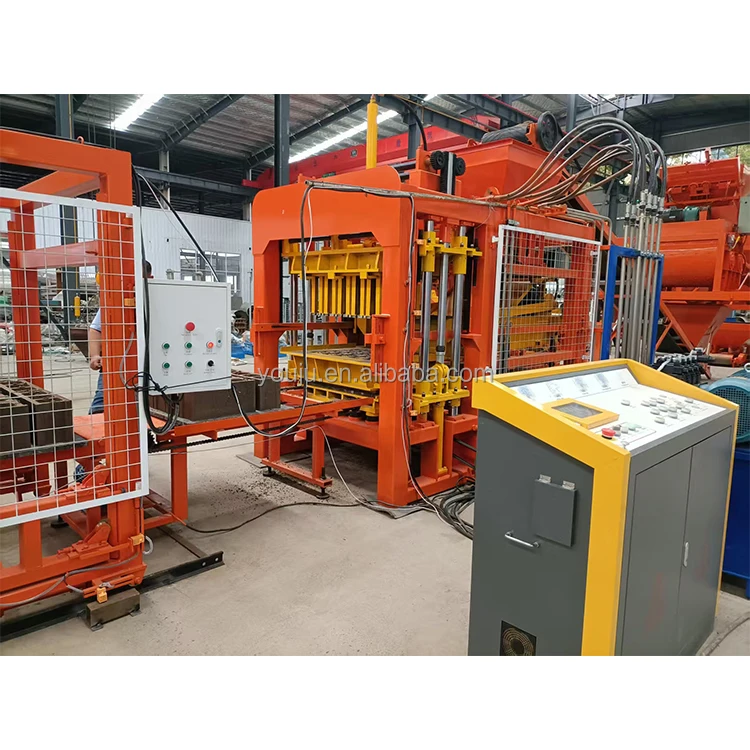
Integrated line pacing — every upstream feeder, mixer, and downstream stacker is sized against the 15–25 s moulding cycle so the QT6-15 press never waits for material or pallets.
Technical Specifications
| Parameter | Value |
|---|---|
| Model | QT6-15 |
| Product Type | Automatic Hydraulic Concrete Block Making Machine |
| Overall Dimensions (L×W×H) | 7100×1500×3000 mm |
| Rated Pressure | 21 MPa |
| Main Vibration Form | Platform vibration |
| Vibration Frequency | 4500–5100 r/min |
| Pallet Size | 880×850 mm |
| Moulding Cycle | 15–25 s |
| Overall Power | 31.25 kW |
| Weight of Machine | 8700 kg |
| Control System | PLC intelligence control |
| Drive Type | Hydraulic |
| Block Strength (Hollow Blocks) | 8–10 MPa |
| Block Strength (Solid Bricks) | 10–20 MPa |
| Raw Material Consumption per Day | 150–190 T (basis not stated in source — confirm block format / material / thickness) |
| Water Consumption per Day | 3%–5% of raw material weight |
| Mix Ratio | Cement 8%–10%, Sand 30%–40%, Stone 50%–60% (approx. 1:4:5) |
| Automation Level | Fully automatic |
| Voltage & Frequency | Configurable to buyer’s local supply (basis to be confirmed) |
Application Suitability
| Application | Material or Output |
|---|---|
| Hollow block production for load-bearing and partition walls | Cement, sand, and crushed stone aggregate (50–60% stone) |
| Solid brick manufacturing for masonry and paving | Cement-sand-stone mix, 10–20 MPa target strength |
| On-site block production for housing or development projects | Local aggregate blended to available sand and stone gradings |
| Format expansion for existing concrete product plants | Interchangeable moulds for multiple block dimensions |
Why the Mixer Bottleneck Silently Kills Your QT6-15 Block Making Machine Production Line Output
The press can only run as fast as the slowest station feeding it.
I once configured a QT6-15 line where the standalone capacity calculation looked excellent on paper. The mixer, however, could not discharge a fresh batch fast enough to match the 15–25 s moulding cycle. The press sat idle for forty seconds per board waiting for material. Over a ten-hour shift that gap compounds into thousands of lost blocks — and the buyer only discovers it after commissioning, when the daily tally falls short of the quoted figure [NEED_CITE: typical batch mixer discharge cycle versus press moulding cycle alignment].
This is the reason the QT6-15 block making machine production line must be specified as a coordinated system. Raw material feeding, mixing, pallet circulation, and stacking all have to match the press tempo, not the other way around.
Matching Every Station to the Press Cycle
The QT6-15 moulding cycle ranges from 15 to 25 seconds depending on block format and mix consistency. A mixer that takes longer than this window to deliver a homogeneous batch forces the press into a holding pattern. When the entire QT6-15 block making machine production line is configured together, the mixer discharge rate, conveyor belt speed, and pallet return loop are all calculated against the same cycle target, eliminating dead time at the hopper.
Pallet Circulation and Curing Area Alignment
The 880×850 mm pallet size governs how many boards are in circulation at any moment. If the curing rack system cannot accept a fresh board as quickly as the press ejects one, the line backs up. Planning the QT6-15 block making machine production line means verifying pallet dimensions against the buyer’s existing forklift fork width, curing rack slot spacing, and available floor area before the first board is ordered [NEED_CITE: pallet handling standards for concrete block curing areas].
From Semi-Automatic Start to Fully Automatic Expansion
A buyer may begin with manual pallet handling and add automatic stacking and cubing later. The PLC intelligence control on the QT6-15 integrates mechanism, electricity, and hydraulic functions into one interface, so additional stations can be brought online without replacing the core controller. This upgrade path keeps the initial investment contained while preserving the option to reduce labour as volume grows.
Reading the Specs That Actually Matter on Site
The 21 MPa rated hydraulic pressure and 4500–5100 r/min platform vibration work together to compact the mix into a dense, consistent block. Higher vibration frequency alone does not guarantee strength if the hydraulic clamp pressure is insufficient to hold the mould rigid during compaction. The 8700 kg machine weight contributes to damping, reducing vibration transmission to the foundation and neighbouring equipment. Block strength outcomes — 8–10 MPa for hollow blocks, 10–20 MPa for solid bricks — depend on the operator matching these machine parameters to the local aggregate grading and cement percentage in the mix.
The overall power draw of 31.25 kW must be supported by a dedicated circuit with the correct voltage and frequency for the destination market. Confirming these electrical parameters before production avoids commissioning delays that can stretch into weeks when a transformer or frequency converter has to be sourced locally.
The Cost of Skipping the Line-Level Audit
When pallet handling, stacking, and curing rack equipment are excluded from the quotation, the buyer is left moving wet blocks by hand at the end of the line. Labour absorbs the shortfall for the first few weeks, then fatigue and breakage erode the daily count. Voltage mismatches discovered after arrival can delay commissioning by the time it takes to ship a compatible motor or drive [NEED_CITE: electrical supply compatibility issues in exported machinery installations]. Moulds specified without reference to the buyer’s actual market formats mean the machine sits idle while replacement tooling is manufactured and shipped.
Why Configure the Whole Line Here
Block machinery is our single focus, so the QT6-15 press, moulds, pallets, and handling equipment are specified as one matched set rather than assembled from separate suppliers. The configuration is built around the buyer’s actual mix design and local aggregate, not a catalogue default. Mould design covers the formats the buyer’s market sells, including custom drawings when standard sizes do not fit. Automation level is selectable, allowing a semi-automatic start with a clear upgrade path to fully automatic stacking and cubing. Installation support includes operator training so the line reaches its intended tempo from the first production day.
Documentation & Verification
- Line layout drawing with capacity calculation stated per block format
- Machine specification sheet covering hydraulic, electrical, and vibration parameters
- Mould drawing and format list for every block type in the quotation
- Pallet specification matched to buyer’s curing rack and forklift dimensions
- Hydraulic and electrical schematic for on-site maintenance reference
- Factory test record run on the buyer’s confirmed block format before dispatch
Installation, Commissioning & Support
- Foundation plan sized for the 7100×1500 mm footprint and 8700 kg static load
- Dedicated power circuit confirmed for 31.25 kW at the buyer’s local voltage and frequency
- Machine dismantled into container-load sections with reassembly sequence documented
- PLC language and display confirmed before the control cabinet leaves the factory
- On-site commissioning with cycle time verification across all line stations
- Operator training covering mould change procedure and daily maintenance checkpoints
What We Need to Configure Your Line
To prepare an accurate line layout, share the block formats your market demands, the target daily output per format, and the raw materials available locally including aggregate grading. We also need your site dimensions, curing area layout, existing forklift specifications, and the local voltage and frequency supply so every station is matched before production begins.
Frequently Asked Questions
Q: How is line capacity calculated and which block format is assumed?
A: Every output figure in our proposal states the exact block format, dimensions, and mix ratio it assumes. A hollow block and a solid brick of different sizes will yield different daily counts from the same QT6-15 press, so the capacity table lists each format separately rather than a single blanket number.
Q: How do upstream feeding and mixing stations match the press cycle time?
A: We calculate the mixer batch size and discharge interval against the 15–25 s moulding cycle so fresh material arrives before the press hopper runs low. Conveyor speed and pallet return timing are verified in the same calculation to prevent any station from becoming a bottleneck.
Q: Is pallet handling, stacking, and curing rack handling included in the line scope?
A: Yes. The quotation covers pallet feeding, wet block stacking, and curing rack handling as part of the QT6-15 block making machine production line. Each station is specified to keep pace with the press, so output does not pile up unhandled at the end of the cycle.
Q: What voltage, frequency, and PLC language options are available?
A: Voltage and frequency are configured to match the buyer’s local grid before the machine enters production. The PLC display language is confirmed at the same stage so the operator can read alarms and parameters in a familiar language from the first day of commissioning.
Q: How is the line footprint planned against the buyer’s site and curing area?
A: We use the buyer’s site dimensions, ceiling height, and curing area layout to position each station. The 880×850 mm pallet size is checked against existing forklift capacity and rack spacing to ensure smooth pallet circulation without requiring additional equipment purchases.


