
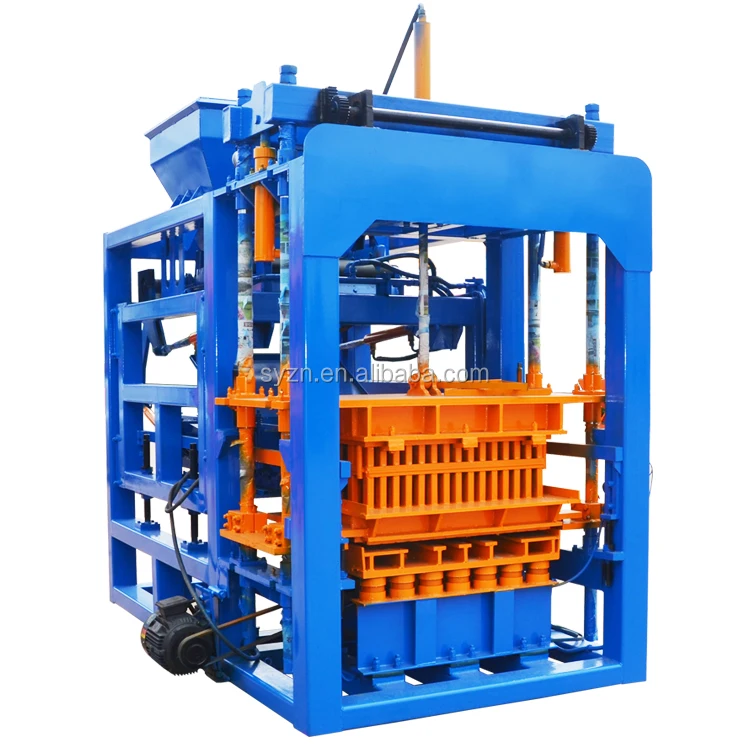
Matched System Sizing — every station from material intake to curing rack is coordinated around the QT6-15 press cycle so the line runs without bottlenecks.
Technical Specifications
| Parameter | Value |
|---|---|
| Model | QT6-15 |
| Product Type | Stationary Hydraulic Block Making Machine |
| Overall Dimensions (L×W×H) | 8200×1700×2950 mm |
| Pallet Size | 880×850 mm |
| Vibration Form | Platform Vibration |
| Vibration Frequency | 0-60 Hz |
| Vibration Force | 45 kN |
| Moulding Mode | Automatic loading, vibration moulding |
| Demolding Method | Hydraulic |
| Molding Cycle | 15-20 s |
| Overall Power | 37 kW |
| Control System | PLC with touch screen, fault diagnosis |
| Total Mass | 7 T |
| Factory Area Required | 1200 m² |
| Block Compressive Strength | >15 MPa |
| Raw Material Adaptability | Waste ash, slag, various aggregates; reduced cement dosage supported |
| Output Capacity (Hollow block 400×200×200 mm) | 1080-1440 pcs/h (basis: stated format) |
| Output Capacity (Hollow block 400×150×200 mm) | 1440-1920 pcs/h (basis: stated format) |
| Output Capacity (Solid brick 240×115×53 mm) | 5760-7680 pcs/h (basis: stated format) |
| Output Capacity (Rectangular paver 200×100×60 mm) | 17280-23040 pcs/8hr (basis: stated format, 20-25 s cycle) |
Application Suitability
| Application | Material or Output |
|---|---|
| Hollow block production | Crushed stone, cement, and waste ash mixes for structural and non-load-bearing walls |
| Solid brick production | Dense aggregate blends for high-compression masonry units |
| Rectangular paving block | Interlocking concrete pavers for driveways, walkways, and parking areas |
| Zigzag interlocking paver | Heavy-duty pavement formats for commercial and industrial yards |
| Project contractor on-site plant | Local aggregate utilization including slag and site waste for housing developments |
Why Pallet Handling Must Be in the Quotation from Day One
A stationary block making machine production line without matched pallet circulation leaves fresh blocks stacked by hand before the cement sets.
Many buyers sign a contract for a QT6-15 press and later discover the quotation covered only the press itself. The result is operators pulling heavy pallets off the discharge end, walking them to a curing yard, and returning empty boards by hand — a rhythm that collapses as soon as daily volume climbs. [NEED_CITE: material handling scope exclusions in block plant contracts]. The pallet size, the curing rack design, and the forklift capacity on site all have to be locked before the press is bolted down.
Line Station Sequencing Around the Press Cycle
The QT6-15 completes a molding cycle every 15 to 20 seconds, which means a loaded pallet leaves the press roughly three to four times per minute. The raw material feeding station, the mixer discharge timing, and the pallet feeder must all be tuned to that rhythm. If the mixer batch takes longer than the press cycle to prepare, the vibration table sits idle and daily output drops. We map each station’s duty time against the press cycle during layout design so no single point starves the next.
Matching the Pallet Board to Your Existing Curing Yard
The 880×850 mm pallet was not chosen arbitrarily. It aligns with standard curing rack widths and fits between uprights on common yard racking systems. If your plant already operates a fleet of three-ton forklifts, the loaded pallet weight — wet block plus board — must stay within fork capacity at maximum lift height. Confirming this before production prevents a scenario where cured cubes cannot be moved to the dispatch area without a second forklift purchase. [NEED_CITE: forklift capacity and pallet load coordination in block plants].
Hydraulic Isolation and Vibration Integrity
The QT6-15 uses an independent integrated hydraulic station mounted away from the main vibration zone. Platform vibration reaches up to 60 Hz with 45 kN of force, and that energy would quickly degrade seals and valve spools if the hydraulic manifold sat on the same frame. Isolating the station means the demolding cylinders receive clean, stable pressure throughout every shift, and the vibration table delivers uniform compaction across the full 880×850 mm mould area. The PLC monitors hydraulic pressure and vibration amplitude together, triggering interlocks if either drifts outside the set window.
What Happens When Line Stations Are Mismatched
I once walked into a plant in West Africa where a QT6-15 had been installed with a manual pallet return system. The press could cycle every 18 seconds, but the operator needed nearly a minute to carry a loaded pallet to the yard and bring an empty one back. The rated capacity was unreachable from the first day, and the buyer blamed the press. A few months later the buyer added an automatic pallet feeder and a chain-type return conveyor; the same QT6-15 then ran at its documented cycle without issue. [NEED_CITE: pallet handling impact on actual versus rated block machine output]. Sizing the stationary block making machine production line as a whole avoids that mismatch.
Why Procure the Full Line from One Source
Block machinery is our single focus, so the QT6-15 press, mould, pallet, and handling equipment are specified as one matched system rather than assembled from separate vendors. We configure the line against your actual mix design and local aggregate, not a catalogue default. Mould design covers the formats your market sells, including custom drawings to your specification. The automation level is selectable — a buyer can start with semi-automatic pallet handling and upgrade to full stacking later without replacing the press. Installation and commissioning support includes operator training on the PLC interface and hydraulic maintenance routines.
Documentation & Verification
- Line layout drawing showing station spacing and pallet flow path for the QT6-15 format
- Capacity calculation sheet stating the block format and cycle time assumed for each figure
- Pallet specification matched to your curing rack dimensions and forklift capacity
- Voltage, frequency, and PLC display language confirmation signed before production
- Hydraulic and electrical schematic with interlock circuit detail
- Factory test record on your selected block format before dispatch
Installation, Commissioning & Support
- Foundation plan sized for the 7 T machine mass and 8200 mm overall length
- Dedicated power circuit for the 37 kW total load with local voltage confirmed beforehand
- Press, hydraulic station, and pallet feeder shipped in dismantled state for container loading
- PLC parameters set on site during first run with your actual mix and aggregate
- Operator training covering mould change procedure, fault diagnosis, and safety interlock logic
- Wear parts list including hydraulic seals and vibration motor bearings with reorder part numbers
What We Need to Size Your Line
Send us your target block format and daily volume requirement so we can calculate cycle times per format. Include your local raw material type and any available gradation data so the mixer and feeder can be configured correctly. Confirm site voltage, frequency, and the PLC language your operators read — that one detail has stalled more commissioning visits than any other mechanical issue.
Frequently Asked Questions
Q: How is line capacity calculated per block format?
A: Each output figure on the QT6-15 is based on a specific block dimension and its corresponding moulding cycle. A 400×200×200 mm hollow block runs a different cycle than a 200×100×60 mm paver. We provide a capacity sheet listing every format you plan to produce alongside its individual cycle time, so daily output expectations are set before the order is placed.
Q: Which supporting stations are included in the quotation?
A: The quotation scope covers raw material feeding, mixing, pallet feeding, stacking, and curing rack handling as a complete stationary block making machine production line. Each station is listed with its model and duty cycle so you can see exactly where the QT6-15 connects to upstream and downstream equipment.
Q: How is pallet size coordinated with our curing area?
A: We ask for your curing rack spacing and forklift load rating before specifying the 880×850 mm pallet board. This ensures loaded pallets fit your existing racks and that forklifts can lift the combined weight of wet blocks and board at full mast height.
Q: Can automation be upgraded after the line is running?
A: Yes. The QT6-15 PLC architecture allows a plant to start with manual pallet handling and add automatic stacking or cubing later. The control cabinet includes reserved I/O points, so the upgrade does not require a new PLC or rewiring of the main press station.
Q: What is the lead time and how is container loading planned?
A: Lead time depends on mould customization and supporting equipment scope. The QT6-15 and its line stations are dismantled for shipment to fit standard containers, and a loading plan is provided before dispatch showing which equipment goes into each container.


