
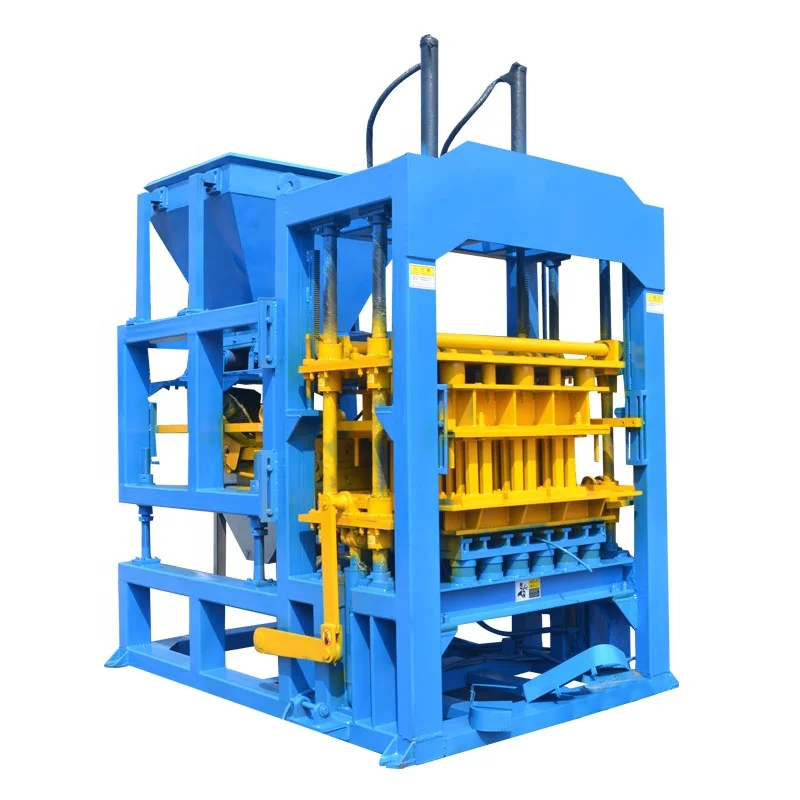
Integrated Line Configuration — the QT5-15 centre press is specified alongside every upstream feeder, mixer and downstream stacker so cycle times align across the full stationary block line.
Technical Specifications
| Parameter | Value |
|---|---|
| Model | QT5-15 |
| Product Type | Stationary Block Making Machine |
| Control System | PLC with fault diagnosis and long-distance controlling |
| Vibration System | Synchronization vibration, frequency adjustable (low frequency for feeding, high frequency for compaction) |
| Feeding System | Particular storage and description material system for feeding accuracy |
| Mould Format (Hollow Block) | 400×200×200 mm / 400×150×200 mm |
| Mould Format (Solid Brick) | 240×115×53 mm |
| Mould Format (Rectangular Paver) | 200×100×60 mm |
| Mould Format (Zigzag Paver) | 225×112.5×60 mm |
| Output Capacity (Hollow Block 400×200×200) | 900–1200 pcs/h (5 pcs/mould, 15–20s cycle) |
| Output Capacity (Hollow Block 400×150×200) | 1080–1440 pcs/h (6 pcs/mould, 15–20s cycle) |
| Output Capacity (Solid Brick 240×115×53) | 5760–7680 pcs/h (32 pcs/mould, 15–20s cycle) |
| Output Capacity (Rectangular Paver 200×100×60) | 3600–4500 pcs/h (25 pcs/mould, 20–25s cycle) |
| Output Capacity (Zigzag Paver 225×112.5×60) | 2304–2880 pcs/h (16 pcs/mould, 20–25s cycle) |
| Pallet Size | (basis to be confirmed) |
| Hydraulic Pressure | (basis to be confirmed) |
| Vibration Force | (basis to be confirmed) |
| Mould Change Time | (basis to be confirmed) |
| Voltage & Frequency | (basis to be confirmed) |
| Overall Dimensions | (basis to be confirmed) |
| Net Weight | (basis to be confirmed) |
Application Suitability
| Application | Material or Output |
|---|---|
| Hollow concrete block production | Crushed stone, cement, sand and fly ash blends for 400×200×200 mm and 400×150×200 mm cavity blocks |
| Solid brick manufacturing | Dense aggregate mixes for 240×115×53 mm standard bricks |
| Rectangular paving block runs | Fine aggregate and pigment blends for 200×100×60 mm pavers |
| Zigzag interlocking paver production | Colour-layered concrete mixes for 225×112.5×60 mm interlocking formats |
What "1,200 Blocks per Hour" Actually Means on the Floor
Quoted cycle rates only translate to real daily output when the mixer discharge, pallet feeder and stacker all keep pace with the press.
A stationary block press rarely runs in isolation. The QT5-15 stationary block making machine production line only reaches its rated rhythm when the batching system delivers a fresh charge within the press cycle, when pallets arrive at the feed station before the mould lifts, and when the stacker clears finished product before the next demould. I once mapped a line where the mixer took 25 seconds per batch while the press cycled every 18 seconds — that gap alone shaved noticeable capacity off the shift. [NEED_CITE: typical block plant cycle-time mismatch causes] Capacity numbers on paper mean little unless the entire upstream and downstream chain is matched to the same beat.
Upstream Stations That Feed the Press on Time
Raw material handling sets the tempo for everything that follows. The QT5-15 stationary block making machine production line uses a dedicated storage and description material system designed to meter each aggregate fraction before the mix enters the pan mixer. When the feeder discharges at a rate that mirrors the press cycle, the hopper above the mould stays topped up without overflow. Variable-frequency drives on the conveyor belts let the plant operator fine-tune feed speed once the local aggregate moisture content shifts between morning and afternoon batches.
Downstream Handling That Clears the Press Without Delay
Once the block leaves the mould, the pallet must travel to the stacker and then to the curing rack before the next empty pallet returns. On the QT5-15 stationary block making machine production line, the pallet return conveyor and the automatic stacking unit are timed to the same PLC clock as the press, so no pallet waits at a junction. If the curing rack handler falls behind, the entire line slows — which is why the rack shuttle speed is specified during the layout phase rather than left to improvisation on site. [NEED_CITE: PLC-synchronized pallet handling in block plants]
Matching Vibration, Pressure and Mix to the Block Format
The QT5-15 uses synchronization vibration with adjustable frequency — low frequency during material feeding to distribute the concrete evenly across the mould cavity, then high frequency during compaction to achieve density. The hydraulic pressure works in concert with that vibration; too little pressure on a lean mix and the hollow block walls crack during demould, too much on a rich mix and the paver surface shows stress marks. Confirming the local aggregate grading and cement ratio before the machine is built lets the vibration force and hydraulic pressure be set to values that actually match the buyer’s recipe. Pallet size must also be checked against the curing area dimensions and the forklift already on site — a mismatch there means blocks are restacked by hand before they even reach the rack.
The Cost of Ignoring Line-Wide Cycle Matching
When the mixer output rate and the press cycle are not reconciled before installation, the press idles while waiting for concrete. I have walked into plants where operators were manually wheeling mix from a mismatched discharge chute to the press hopper because the two pieces of equipment arrived at different heights. That kind of workaround burns labour, introduces batch inconsistency and accelerates wear on the mould because the concrete temperature drops before compaction. [NEED_CITE: manual material transfer effects on block density] These problems are invisible in a quotation that lists only the press.
Why Source the Full Line From One Specification Point
Block machinery is our single focus, so the QT5-15 press, moulds, pallets and handling equipment are specified as one matched system rather than assembled from unrelated suppliers. Every capacity figure we quote states the block format and cycle time it assumes, so buyers can cross-check against their actual target product. Mould design covers the formats the buyer’s market sells, and custom mould drawings are reviewed before production begins. Automation level is selectable — a buyer can start with semi-automatic pallet handling and add a stacker later. Installation support includes operator training that covers the full line, not just the press controls.
Documentation & Verification
- Line layout drawing showing every station from aggregate bin to curing rack
- Capacity calculation sheet stating block format and cycle time for each output figure
- Pallet specification matched to curing area and forklift capacity
- Voltage, frequency and PLC display language confirmation before production
- Factory test record on the buyer’s chosen block format before dispatch
- Hydraulic and electrical schematic for on-site maintenance reference
Installation, Commissioning & Support
- Foundation plan reflecting the QT5-15 overall dimensions and vibration isolation requirements
- Power circuit schedule confirming voltage, frequency and dedicated breaker sizing
- Pallet feeder alignment checked against press infeed height during assembly
- PLC fault-diagnosis system calibrated and language verified on first start-up
- Mould change procedure trained on-site with the buyer’s selected block formats
- Wear parts list covering vibration springs, hydraulic seals and mould liners
Preparing Your Line Inquiry
To size the QT5-15 stationary block making machine production line correctly, share your target block format, the local aggregate types available, and the daily output you need in a single shift. Include your workshop length, width and ceiling height so the curing rack system can be laid out around existing columns. Confirm the site voltage and frequency, the PLC language your operators read, and whether you already have a mixer or forklift that must tie into the new line.
Frequently Asked Questions
Q: How is the quoted output of the QT5-15 verified for my specific block format?
A: Every capacity figure we provide states the exact block format, mould cavity count and cycle time it assumes. For a 400×200×200 mm hollow block the QT5-15 produces 5 pieces per mould at a 15–20 second cycle. We cross-check that number against your target daily volume in a written calculation before the order is placed.
Q: Which upstream and downstream stations are included in the line quotation?
A: The quotation explicitly lists each station — batching, mixing, pallet feeding, stacking and curing rack handling — and marks any item the buyer will supply. Cycle times for every included station are matched to the press so the QT5-15 is never left waiting for material or pallets.
Q: How are pallet size and curing rack dimensions confirmed against my site?
A: We ask for your curing area floor plan and forklift capacity before the pallet specification is finalised. The pallet length, width and material are then chosen to fit both the QT5-15 mould table and the rack slots, avoiding double-handling when blocks move to the curing zone.
Q: What electrical and language details are confirmed before shipment?
A: Voltage, frequency and PLC display language are written into the production order. The PLC fault-diagnosis interface and long-distance controlling module are set to those parameters, and a confirmation document is shared before the QT5-15 leaves the factory.
Q: What does installation and operator training cover on a complete line?
A: Our team supervises foundation work, aligns every station from the mixer discharge to the curing rack shuttle, and runs test cycles in the buyer’s chosen block format. Training covers PLC operation, mould change procedure, daily maintenance intervals and wear-part replacement on the QT5-15 and all connected handling equipment.


