
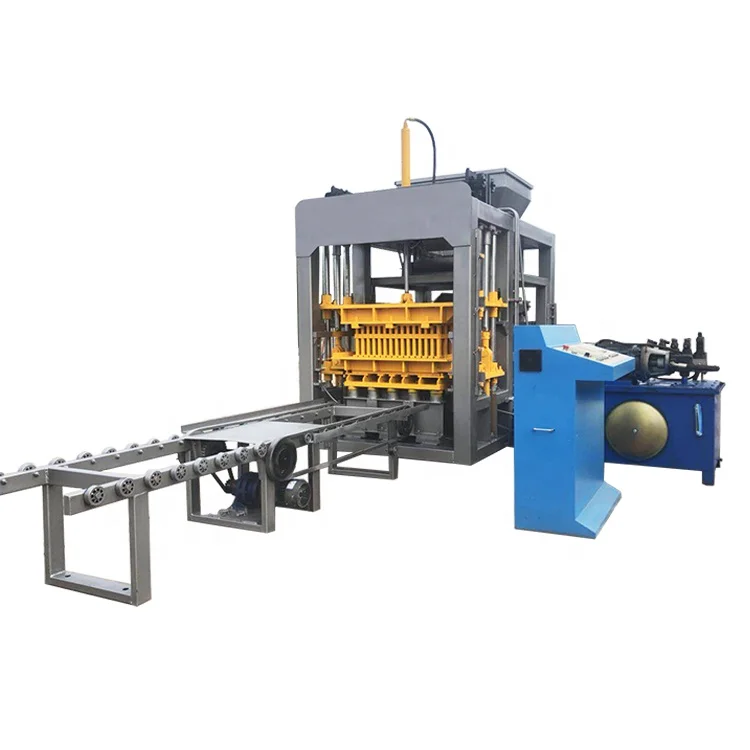
Balanced Line Flow — Every station upstream and downstream of the QT5-15 is timed against its 15–20 second press cycle so no pallet queues or gaps appear during continuous production.
Technical Specifications
| Parameter | Value |
|---|---|
| Model | QT5-15 |
| Product Type | Stationary Automatic Concrete Block Making Machine |
| Overall Dimensions (L×W×H) | 7400 × 1950 × 2800 mm |
| Rated Pressure | 21 MPa |
| Main Vibration Form | Hydraulic platform vibration |
| Vibrating Frequency | 2800–4500 rolls/min |
| Cycle Time | 15–20 seconds |
| Motors Power | 26.5 kW |
| Pallet Size | 1100 × 550 mm |
| Net Weight | 6 T |
| Voltage | Configurable to buyer requirement |
| Control System | PLC with fault diagnosis and long-distance controlling system |
| Output Capacity (Solid Brick) | 23,040–28,800 pcs/8h (basis: 240×115×90 mm) |
| Output Capacity (Paver/Brick) | 61,440–70,400 pcs/8h (basis: 400×115×53 mm) |
| Output Capacity (Hollow Block) | 7,200–9,600 pcs/8h (basis: 400×200×200 mm) |
| Automation Level | Full automatic |
| Assembly State | Stationary |
| Standard | CE |
Application Suitability
| Application | Material or Output |
|---|---|
| Hollow block production for building walls | Crushed stone, cement, sand aggregate mixes |
| Paving brick manufacturing for walkways and yards | Fine aggregate with pigment-loaded face mix |
| Solid brick output for load-bearing masonry | Standard cement-sand blends at high compaction |
| Multicellular brick for partition walls | Lightweight aggregate or fly ash blends |
Why the Rest of the Line Decides Your Real Output
A stationary block making machine production line only reaches its rated cycle when every upstream and downstream station matches the press timing exactly.
When I was doing line commissioning in the workshop, a buyer in West Africa installed the QT5-15 press and saw it run perfectly during factory acceptance. Once on site, the mixer discharged batches slower than the hopper consumed them, and the pallet return conveyor could not keep pace with the stacking station. The press sat idle for several seconds every cycle. The whole stationary block making machine production line lost noticeable throughput each shift because nobody had calculated the interval between stations before shipping. [NEED_CITE:]
Timing Every Station Against the Press Cycle
The QT5-15 completes one moulding cycle in 15–20 seconds depending on the block format being produced. The raw material feeder, mixer discharge, pallet feeder, and stacking unit must each finish their task within that same window. If the mixer takes longer to discharge a full batch, the press waits. We calculate each station interval from the target block format and write it into the stationary block making machine production line layout before any steel is cut.
Pallet Circulation and Curing Rack Alignment
The 1100 × 550 mm pallet leaves the press carrying wet blocks and travels through the stacking station before returning empty. If the curing rack spacing does not match this pallet dimension, workers handle every pallet by hand at the rack entrance. We confirm rack bay width, forklift tine spacing, and pallet material against the buyer’s existing infrastructure so the pallet loop closes without manual intervention. [NEED_CITE:]
Reading the Vibration and Pressure Data Together
The hydraulic platform vibration operates between 2800 and 4500 rolls/min while the system holds 21 MPa rated pressure. Vibration frequency determines how thoroughly the mix settles into thin-web hollow blocks, and hydraulic pressure sets the final compaction density. A low frequency with high pressure leaves air pockets in tall hollow blocks; high frequency with low pressure produces pavers that chip at the edges during demoulding. Matching both values to the buyer’s specific aggregate gradation and cement ratio is part of the configuration we confirm before the machine enters production.
The 26.5 kW motor package drives the hydraulic pump, vibration motor, and conveyor drives simultaneously. When the mixer and pallet return conveyor share the same electrical panel, peak current draw must be calculated across all motors starting in sequence to avoid tripping the main breaker during continuous operation.
What Happens When Stations Are Specified Separately
When a buyer sources the press from one supplier and the supporting equipment from another, nobody owns the cycle time mismatch. The press vendor points to the 15–20 second cycle as proof the machine performs, and the conveyor vendor points to belt speed as proof their equipment runs. The gap between those two numbers shows up as pallets piling on the transfer frame and workers clearing jams every few hours. [NEED_CITE:]
Why Configuration Is Verified Before Fabrication
The QT5-15 is specified as part of a matched system where raw material feeding, mixing, pallet circulation, stacking, and curing rack handling are each sized against the press cycle. Voltage and frequency are confirmed in writing against the buyer’s site supply. PLC display language is set before the control panel is wired. The line layout drawing shows every station with its calculated interval so the buyer can verify flow before the machine is built.
Documentation & Verification
- Line layout drawing with cycle time at each station for your block format
- Capacity calculation sheet stating the exact block dimensions assumed
- Pallet specification matched to your curing rack bay and forklift capacity
- Voltage, frequency, and PLC language confirmation signed before production
- Factory test record run on your target block format before dispatch
- CE declaration covering the complete line where applicable
Installation, Commissioning & Support
- Foundation plan sized to the 7400 × 1950 mm footprint and 6 T operating weight
- Dedicated circuit calculated for the 26.5 kW total motor load at confirmed voltage
- Machine arrives in dismantled states with reassembly sequence documented
- First production run supervised until cycle time stabilises at target format
- Operator training covers PLC fault diagnosis screens and remote monitoring access
- Wear parts list identifies hydraulic seals and mould liners with reorder codes
What We Need to Configure Your Line
Send the block format you sell most, your target daily output per format, and the aggregate materials available within hauling distance of your plant. Include your current curing area dimensions, forklift model, and the voltage and frequency at the site transformer. If you already run a mixer or pallet return system, share the model and cycle rate so we can confirm whether they match the press interval or need replacement.
Frequently Asked Questions
Q: How is the daily output of 7,200–9,600 pieces verified and which block format does it assume?
A: That figure assumes continuous production of 400×200×200 mm hollow blocks over an eight-hour shift with the press cycling at 15–20 seconds per mould. Real output depends on the mixer keeping up and the stacking station clearing pallets within that same window. We calculate throughput per format and show it on the line layout drawing before the order is confirmed.
Q: Which supporting equipment stations are included in the quotation and which are optional?
A: The quotation covers raw material feeding, mixing, pallet feeding, the QT5-15 press, stacking, and curing rack handling as one line. Stations like the cubing unit or additional curing racks can be added or removed. Each station appears on the layout drawing so the buyer sees exactly which equipment ships and which is deferred.
Q: How do we ensure the pallet size matches our existing curing racks and forklift?
A: We ask for your curing rack bay width and forklift tine spacing before confirming the 1100 × 550 mm pallet. If your existing racks are narrower, we adjust the pallet dimension and reconfigure the press mould area accordingly. The pallet material and thickness are also matched to the load weight of your heaviest block format.
Q: What voltage, frequency, and PLC language options are confirmed before shipment?
A: Voltage and frequency are set to match the buyer’s site transformer supply and confirmed in writing before the electrical panel is wired. The PLC display language is selected from available options at the same stage. This prevents commissioning delays caused by mismatched power or an interface the operator cannot read.


