
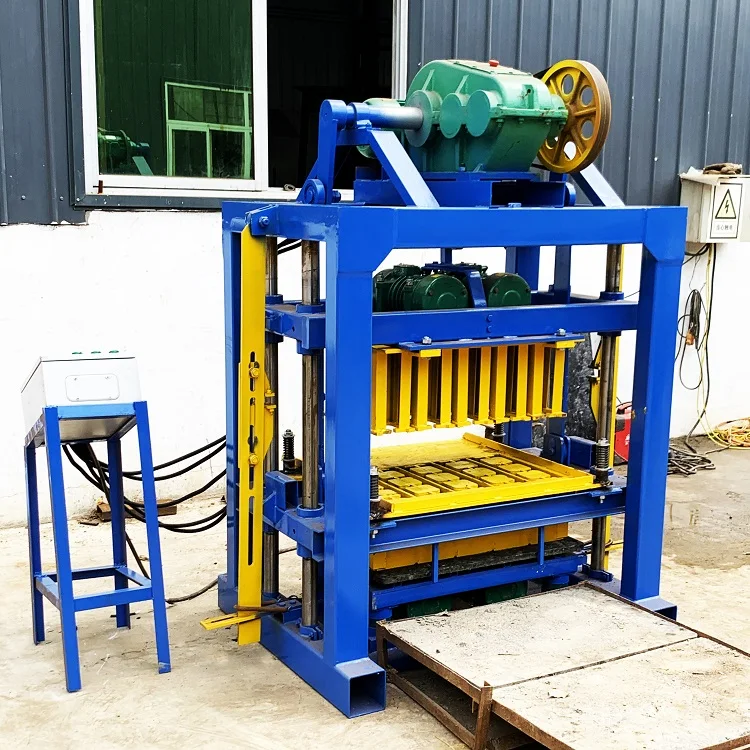
Line-Matched Output — the QTJ4-40 manual block making machine production line is configured around your curing rack spacing and pallet return path, not assembled from catalogue defaults.
Technical Specifications
| Parameter | Value |
|---|---|
| Model | QTJ4-40 / QT4-40 |
| Product Type | Manual Concrete Block Making Machine |
| Main Vibration Form | Platform Vibration |
| Vibration Frequency | 2800 r/min |
| Pallet Size | 850 × 450 mm |
| Overall Dimensions | 1350 × 1460 × 1800 mm |
| Machine Weight | 1 T |
| Factory Area Required | 200 m² |
| Labor Requirement | 1–3 people |
| Automation Level | Manual (top die push-pull with automatic scraper) |
| Capacity — 400×200×200 mm Hollow Block | 2880 pcs / 8 hours (4 pcs per mould) |
| Capacity — 400×150×200 mm Hollow Block | 4000 pcs / 8 hours (5 pcs per mould) |
| Capacity — 225×112.5×60 mm Paver Block | 7200 pcs / 8 hours (9 pcs per mould) |
| Raw Materials | Concrete, cement, fly ash, crushed stone, sand, dust, gravel, slag |
| Raw Material Ratio (approx.) | Cement 8–10%, sand 30–40%, stone 50–60% |
| Mould Options | 4 pcs (400×200×200), 5 pcs (400×150×200), 9 pcs (225×112.5×60) |
| Applied Products | Hollow blocks, solid blocks, pavers, interlocking blocks, curbstone, colored pavers |
| Key Features | CE referenced, platform vibration, top die push-pull with automatic scraper, multiple mould options |
Application Suitability
| Application | Material or Output |
|---|---|
| Small-scale hollow block plant | Crushed stone, sand, cement producing 400×200×200 mm or 400×150×200 mm hollow blocks |
| On-site construction block manufacturing | Concrete mixed locally for building contractors needing wall blocks on a project site |
| Interlocking paver production | Cement, sand, and dust forming 225×112.5×60 mm interlocking and paving blocks |
| First-time block plant startup | Low-investment line for entrepreneurs entering the concrete block market with limited capital |
| Distributor format expansion | Building material distributors adding solid or colored paver blocks to existing inventory |
Why a Manual Block Making Machine Production Line Stalls Before the Press Does
The press is rarely the bottleneck — it is the station before or after it that starves the cycle.
When a mixer finishes a batch in eight minutes but the QTJ4-40 consumes that batch in five, the operator stands idle for three minutes every cycle. Over an eight-hour shift that adds up to hours of lost output with no mechanical fault to blame. I saw this first-hand on a job in West Africa last year: the line looked fine on paper, but the upstream feeder timing was off, and the crew spent half the day waiting on material [NEED_CITE: station cycle matching in small block lines]. The manual block making machine production line only reaches its rated capacity when every station — batching, mixing, pallet supply, and curing removal — is paced to the press.
Pacing the Mixer to the Press Cycle
The QTJ4-40 draws raw mix through each mould cycle in a rhythm that depends on block format and operator speed. A mixer that batches too slowly forces the press to wait; a mixer that batches too fast causes material to sit and begin setting before it reaches the mould. Sizing the mixer drum volume and batch time to the press consumption rate is the single most important decision in a manual block making machine production line. Get this wrong and no amount of press tuning will recover the lost output.
Pallet Circulation Defines Your Real Daily Output
With a pallet size of 850 × 450 mm, every cured block leaves the press on one of these boards and does not return until the block is stripped. The number of pallets in circulation must cover the full curing duration plus press-side buffer stock. If the curing cycle runs twenty-four hours and the press consumes pallets faster than they come back, the line stops — not because the machine failed, but because the pallet loop was undersized [NEED_CITE: pallet inventory calculation for block curing]. Planning the curing rack count and forklift schedule around the 850 × 450 mm pallet dimension keeps the press fed continuously.
Reading the Specs That Actually Govern Line Flow
Platform vibration at 2800 r/min sets the compaction rhythm. This frequency must suit the buyer’s local aggregate gradation — coarse crushed stone responds differently than fine sand-dust blends, and density consistency across the shift depends on that match. The 850 × 450 mm pallet size is not just a press parameter; it locks in the curing rack shelf width, the forklift tine spacing, and the pallet stack height for the entire site. The 200 m² factory area requirement defines the minimum footprint that must accommodate the mixing station, the press, wet block staging, and the curing racks without creating a traffic bottleneck between stations.
What Happens When One Station Falls Behind
A line is only as fast as its slowest station. If the curing area runs out of rack space because blocks were not stripped on schedule, the press operator has nowhere to send the next pallet. If the raw material feeder delivers an inconsistent mix, the vibration cannot compact uniformly and block density drops across the batch. These are not machine faults — they are line design gaps. I have watched crews blame the press when the real problem was a batching ratio that shifted every time a different operator scooped the aggregate [NEED_CITE: batch consistency in manual block production].
Why Configure the Line Here
Block machinery is the single focus of this operation, so the press, moulds, pallets, and handling equipment are specified as one matched system rather than sourced separately. Each manual block making machine production line is configured against the buyer’s actual mix design and local aggregate, not a catalogue default. Mould design covers the formats the buyer’s market actually sells, including custom drawings. The automation level is selectable — a buyer can start with the QTJ4-40 manual setup and add semi-automatic pallet handling later without replacing the press. Installation support includes operator training so the crew understands how each station’s timing affects the next.
Documentation & Verification
- Line layout drawing showing station positions, material flow, and pallet circulation path for the 200 m² site
- Capacity calculation per block format so each upstream and downstream station is sized correctly
- Mould drawing and format list confirming the 4, 5, or 9 cavity options
- Pallet specification matched to curing rack dimensions and existing forklift
- Voltage and frequency confirmation before production to avoid commissioning delays
- Factory test record on the buyer’s target block format before dispatch
Installation, Commissioning & Support
- Site preparation for the 1350 × 1460 × 1800 mm machine footprint within the 200 m² layout
- Electrical supply verification for voltage and frequency before the QTJ4-40 is energized
- Pallet inventory count calculated to match curing cycle duration and press consumption rate
- First-shift operator training covering mould change, scraper adjustment, and platform vibration checks
- Wear parts list for vibration components and scraper blades with reorder intervals
- Daily maintenance schedule tied to the 2800 r/min vibration assembly and moving joints
Before You Send an Inquiry
To size a manual block making machine production line properly, share your target block format and the daily volume you need from a single shift. Tell us the raw materials available locally — the sand, stone, and cement sources — along with their gradation if you have lab data. Confirm your site dimensions, existing forklift capacity, and the curing space you can allocate. Finally, state your local voltage and frequency so the electrical configuration is settled before production starts.
Frequently Asked Questions
Q: How do I verify daily output by block format and size each station to match?
A: Each capacity figure for the QTJ4-40 is tied to a specific block size and cavity count — for example, 2880 hollow blocks per eight-hour shift is based on the 400×200×200 mm format at four pieces per mould. Your mixer, pallet supply, and curing rack count must each be sized against that same format so no station creates idle time.
Q: How many pallets do I need to keep the press running through a full curing cycle?
A: The 850 × 450 mm pallet must cover the press consumption rate for the entire curing duration plus a buffer. If curing takes twenty-four hours, you need enough pallets to fill every rack position plus the ones in active press rotation. Running short means the line stops regardless of machine condition.
Q: What mixer capacity and batch time does the QTJ4-40 require?
A: The mixer drum must deliver a full batch in less time than the press takes to consume the previous batch. If the press uses one batch in five minutes, the mixer should finish within four to five minutes including loading and discharge. Any gap forces the operator to wait.
Q: How should a 200 m² site be laid out to avoid bottlenecks?
A: The 200 m² must fit the mixing station, the press, wet block staging, curing racks, and pallet return paths without stations blocking each other. Material should flow in one direction from batching through curing, and the forklift route must not cross the operator’s pallet-handling zone.
Q: What happens when one station is slower than the press cycle?
A: The press sits idle and daily output drops below the rated figure for that block format. Identifying the slow station before ordering — whether it is the mixer, pallet return, or curing strip — lets you adjust that station’s capacity so the line runs at the pace the press can sustain.


