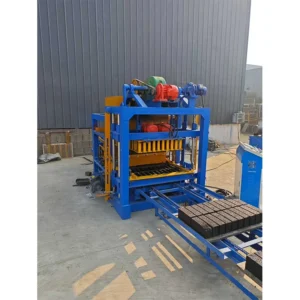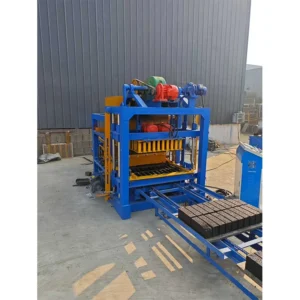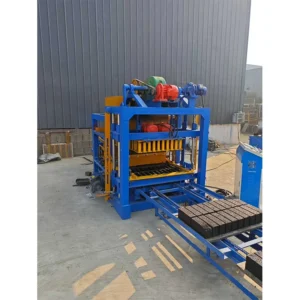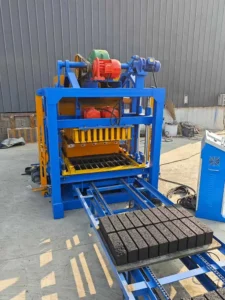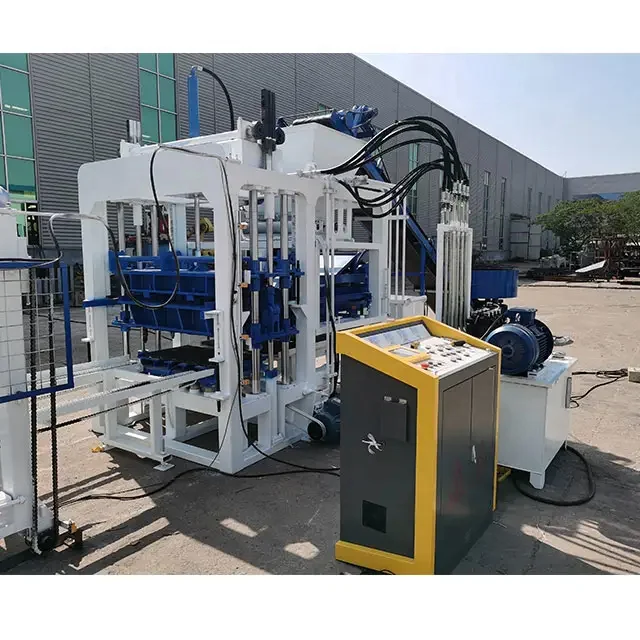
Matched System Sizing — every station around the QT4-18 is specified as one timed sequence, so the press never waits for the mixer or pallet return.
Technical Specifications
| Parameter | Value |
|---|---|
| Model | QT4-18 |
| Product Type | Automatic Concrete Block Making Machine |
| Overall Dimensions (L×W×H) | 2500×1750×2200 mm |
| Rated Pressure | 16 MPa |
| Vibration Form | Platform Vibration |
| Pallet Size | 950×550 mm |
| Molding Cycle | 18–25 s (basis not stated in source — confirm block format, material and thickness) |
| Overall Power | 27.5 kW |
| Control System | PLC with frequency converter and human-machine interface |
| Electrical Components | Schneider internationally renowned brand |
| Mould Lifting Mechanism | Double-sided synchronous gears |
| Automation Level | Automatic with hydro-cylinder pallet feeder, automatic demould and product push |
| Material Feeder System | Hopper, feeding box, feeding platform, conveyor with distribution belt hopper |
| Block Receiver | Frame, conveyor system, idler wheels, motor and reducer with triangle belt |
| Supporting Equipment Available | JQ500 pan mixer, 8 m belt conveyor (6 m optional), stacker, block clamper, extra moulds, trolley, cement silo, batching plant |
| Mould Change Method | Manual bolt release using M24 bolts |
Application Suitability
| Application | Material or Output |
|---|---|
| Hollow block production for building walls | Crushed stone, river sand, cement and water |
| Solid brick production for load-bearing structures | Local aggregate blends with cement binder |
| On-site block production for housing projects | Site-sourced sand and gravel with portable mixer |
| Format expansion for existing product plants | Multiple mould formats on a single pallet size |
Why the Molding Cycle Figure Alone Misleads Buyers
The cycle number only holds when every upstream and downstream station keeps pace.
A press that molds in 18 to 25 seconds sounds productive on paper. Yet many automatic block machine production line projects stall because the mixer cannot batch fast enough, the belt conveyor drops material unevenly, or the pallet feeder returns slower than the press expects. I once watched a line in West Africa where the press sat idle for nearly a third of each shift simply because the pallet return stroke was two seconds longer than the mold close time. The buyer had selected each station from a different supplier, and nobody had checked the timing chain end to end. That is why the turnkey block making equipment approach here treats every station as one sequence [NEED_CITE: line timing coordination in concrete block plants].
How Each Station Connects Around the Press
The JQ500 pan mixer feeds the distribution belt hopper through the 8 m belt conveyor. The hopper meters material into the feeding box so that each mold cavity receives a consistent charge before the vibration cycle starts. When the press completes its 18–25 second mold sequence, the hydro-cylinder pallet feeder pushes the finished product onto the block receiver while loading the next empty pallet in the same stroke. This overlapping motion is what keeps the automatic block machine production line running at its stated rhythm rather than losing beats between stations.
Where the Timing Chain Breaks Down
The PLC with frequency converter coordinates the pallet feeder, material feeder and block receiver as a single timed sequence. If any station drifts — a worn conveyor belt slipping on the idler wheels, a mixer gate that sticks, a pallet that warps and jams the feeder rails — the press waits. In my experience configuring lines for African and Southeast Asian markets, the most common timing failure is not the press itself but the belt conveyor speed set too low for the mixer discharge rate. We verify each station cycle against the others during factory testing so that the turnkey block making equipment arrives with a timing map, not just a parts list [NEED_CITE: factory sequence testing for block production lines].
Reading the Specifications That Matter
The 16 MPa rated pressure works together with platform vibration to compact the concrete mix into the mold cavity. Higher pressure alone will not produce a dense block if the vibration frequency does not match the aggregate particle size — fine sand needs shorter, sharper vibration while coarse crushed stone benefits from longer dwell time. The 950×550 mm pallet size determines how many blocks fit per cycle and must match the curing yard rack spacing and the forklift tine width the buyer already operates. Double-sided synchronous gears on the mould lifting mechanism keep the upper and lower mold halves aligned during the change, reducing the manual adjustment needed after each M24 bolt release. The 27.5 kW overall power draw covers the press, pallet feeder and block receiver; the mixer and conveyor draw additional power from separate circuits.
The Cost of Skipping Line-Level Specification
When a buyer orders the press alone and sources the mixer, conveyor and stacker locally, the stations rarely share the same timing reference. The result is a line that runs below its expected daily output, with operators manually clearing pallet jams or waiting for the mixer to catch up. I have seen contractors add a second shift just to meet a project deadline because the line bottleneck was never identified before installation. Mismatched pallet sizes force the curing yard to be rearranged or new racks to be fabricated. Unconfirmed voltage and frequency delay commissioning for weeks while transformers or variable-frequency drives are sourced on site [NEED_CITE: common commissioning delays in exported block machinery].
Why Sourcing the Full Line Here Reduces Integration Risk
Block machinery is our single focus, so the QT4-18 press, mould, pallet and handling equipment are specified as one matched system rather than assembled from separate catalogs. We set the configuration against the buyer’s actual mix design, local aggregate sample and target block format instead of quoting a default package. Mould design covers the formats the buyer’s market actually sells, including custom drawings when standard formats do not match local building codes. The automation level is selectable — a buyer can start with manual pallet handling and add automatic stacking and cubing later without replacing the press. Installation includes on-site commissioning and operator training so that the timing chain is verified under real production conditions, not just on the factory floor.
Documentation & Verification
- Line layout showing station spacing and pallet flow path for the 950×550 mm pallet size
- Capacity calculation stating which block format the 18–25 s cycle assumes
- Voltage, frequency and PLC display language confirmation signed before production
- Factory test record covering the full line sequence from mixer discharge to block receiver
- Hydraulic and electrical schematic matching the as-built 27.5 kW power configuration
Installation, Commissioning & Support
- Foundation plan accounting for the 2500×1750×2200 mm machine footprint and vibration isolation
- Dedicated power circuit sized for the 27.5 kW press load plus mixer and conveyor draws
- Machine dismantled into press, feeder and receiver sections for container loading and reassembled on site
- First-run timing verification across mixer, belt conveyor, pallet feeder and block receiver stations
- Operator training on PLC interface, mould change procedure using M24 bolts and daily lubrication points
- Wear parts list covering hydraulic seals, vibration springs and conveyor belt splices
What to Include in Your Inquiry
Send us your target block format and daily output requirement so we can calculate the line capacity on that specific product. Provide a sample or lab report of your local aggregate — sand source, maximum particle size and clay content — so the vibration and pressure settings are matched before the machine ships. Confirm your site voltage, frequency and preferred PLC display language to avoid commissioning delays. If you already have a curing yard and forklift, share the rack dimensions and tine width so the pallet specification aligns with your existing handling equipment.
Frequently Asked Questions
Q: How is the line capacity calculated and which block format is the 18–25 s cycle based on?
A: The molding cycle varies with block format, wall thickness and aggregate density. We calculate capacity by running the specific mould the buyer intends to use, timing the full sequence from pallet feed to product push, and reporting pieces per hour for that exact format. No single cycle figure applies across all block types.
Q: How do the mixer, conveyor and stacker cycles match the press to avoid bottlenecks?
A: Each station is timed against the press molding cycle during factory testing. The JQ500 mixer batch size, belt conveyor speed and stacker lift interval are all set so that no station forces the press to wait. The PLC frequency converter fine-tunes feeder speed on site if aggregate flow characteristics differ from test conditions.
Q: What supporting equipment is included and what must the buyer source locally?
A: The quotation covers the press, pallet feeder, block receiver, mixer, belt conveyor and available stacker. The buyer typically provides the curing yard, water supply, cement storage silo and forklift. We confirm the pallet size against the buyer’s existing racks and forklift before production starts.
Q: Can the line start semi-automatic and upgrade to full automatic stacking later?
A: Yes. The press and PLC control remain the same; the upgrade adds an automatic stacker and cubing station downstream. The block receiver and pallet feeder are already configured to interface with the stacker, so the changeover does not require press modification or extended downtime.