
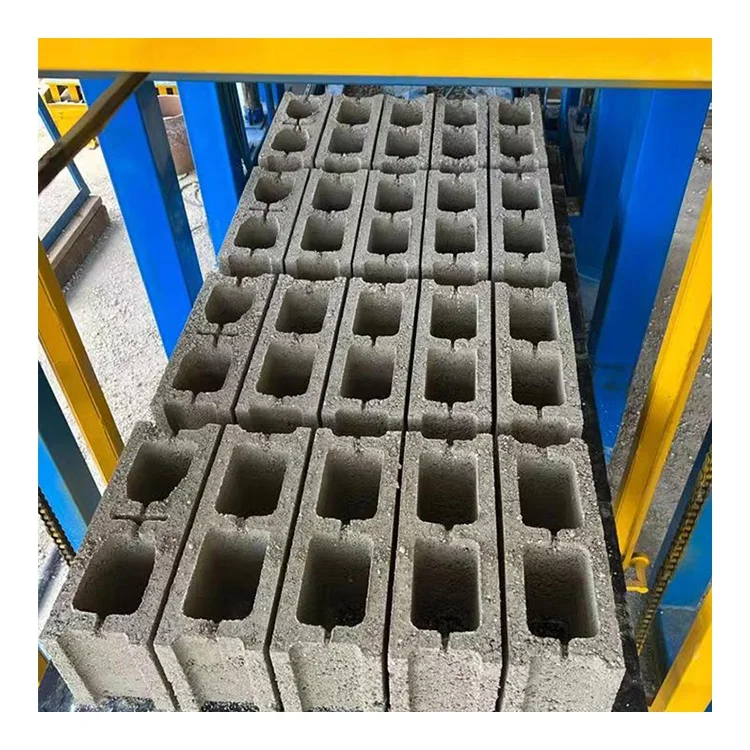
Matched Line Engineering — every station from the JS500 mixer through to pallet handling is specified as one coordinated system so the press never waits between cycles.
Technical Specifications
| Parameter | Value |
|---|---|
| Model | QT4-15 |
| Product Type | Stationary Concrete Block Making Machine |
| Host Machine Power | 27.5 kW |
| Moulding Cycle | 15 s (basis not stated in source — confirm block format / material / thickness) |
| Overall Dimensions (L×W×H) | 7100 × 1600 × 2610 mm |
| Pallet Size | 1020 × 570 mm |
| Net Weight | 5 T |
| Vibration Force | 40 kN |
| Mixer Model | JS500 |
| Voltage | 380 V (frequency not stated in source — confirm target market) |
| Water Consumption | 4 T per day |
| Required Workers | 3–4 |
| Workshop Area | 150 m² |
| Control System | Computer controlled directional vibration, photoelectric material control |
| Motor Brand | Siemens |
| Feeding System | Hopper with swing-type cutting device for uniform material distribution |
| Vibration Method | Table and mould vibrating together, low-frequency feeding and high-frequency vibrating |
| Automation Level | Automatic (exact PLC brand / language not stated in source — confirm) |
| Assembly State | Skid-mounted, requires on-site utility connection |
| Key Features | Photoelectric material control, directional vibration, swing-type feed hopper |
Application Suitability
| Application | Material or Output |
|---|---|
| Hollow block production | Crushed stone, cement, sand, water — standard walling formats |
| Multicellular brick production | Lightweight aggregate or standard concrete mix for partition bricks |
| Paving brick production | High-density concrete mix with fine aggregate for interlocking pavers |
| Standard solid brick production | Cement and sand mix for load-bearing or infill masonry units |
| Small-scale stationary block plant | Complete line from raw material batching through to stacking |
| On-site housing project production | Portable setup for development contractors producing locally |
What a "15-Second Cycle" Actually Means for Your Daily Output
The cycle time printed on the nameplate assumes one specific block format — and your daily throughput changes with every mould you install.
When a quotation lists a single cycle figure without naming the block format, mix design, and compaction pressure behind it, the real output on your shop floor can fall noticeably short of expectation. I have seen lines where the press was rated for a fast cycle on a thin paving brick, but the buyer’s main product was a deep hollow block requiring longer vibration and higher pressure. The result was a press that spent most of each shift waiting for the mixer to catch up, or producing blocks that cracked during curing because the cycle had been rushed. [NEED_CITE: block cycle time verification by format and material]
A stationary concrete block making machine production line only delivers its rated output when every station — batching, mixing, feeding, pressing, pallet transfer, and stacking — is timed to the same beat. That is where line-level engineering matters more than press specifications alone.
Line Synchronization Between Mixer and Press
The JS500 mixer paired with this line must deliver a fresh batch to the hopper before the swing-type feeding device completes its current distribution sweep. If the mixer discharge lags even a few seconds behind the press demand, the hopper runs light and the next cycle starts with an incomplete feed. Over a full shift, those short feeds accumulate into a noticeable gap between theoretical and actual output. Setting the mixer discharge timing and conveyor speed to match the press cycle is the single most impactful adjustment during commissioning.
Pallet Flow and Curing Zone Coordination
Every pressed block leaves the station on a 1020 × 570 mm pallet, and those pallets must move to the curing area at the same rate the press produces them. If the curing rack spacing, forklift capacity, or yard layout cannot absorb that flow, pallets pile up at the press exit and the operator is forced to pause the machine. Before the line ships, confirming that your existing forklift can handle the loaded pallet weight and that your curing racks accept the pallet dimensions prevents a bottleneck that no amount of press speed can overcome.
How Vibration and Pressure Shape Block Density
The 40 kN vibration force works in combination with table-and-mould vibrating to compact the concrete mix from two directions simultaneously. Low-frequency feeding settles the material into the mould cavity before high-frequency vibration drives compaction. This two-stage approach matters because a single-frequency system tends to leave density variation between the top and bottom of taller blocks. For hollow blocks with thin webs, consistent density through the full depth is what prevents corner cracking during handling. [NEED_CITE: vibration method and block density relationship in concrete masonry]
Reading the Specifications That Matter Most
The 27.5 kW host machine power must cover vibration motors, hydraulic pump, and feed system simultaneously during the peak draw of each cycle. Undersizing any upstream breaker or cable run causes voltage sag that shortens motor life. The 380 V supply requires confirmation of frequency — 50 Hz and 60 Hz markets need different motor windings and pump calibrations, and shipping a machine wound for the wrong frequency is a commissioning delay that can stretch into weeks. [NEED_CITE: voltage and frequency standards by export market]
The 150 m² workshop area is the minimum footprint that accommodates raw material staging, the press station, pallet return path, and a curing zone with adequate airflow. Planning the layout before the equipment arrives avoids relocating the mixer or rerouting the pallet conveyor after installation.
The computer-controlled directional vibration system with photoelectric material control removes guesswork from the feed stage. The photoelectric sensor confirms material level before each cycle starts, reducing the chance of a short feed that would produce an undersized or underweight block.
The Hidden Cost of Mismatched Line Stations
Quotations that cover only the press and omit pallet handling, stacking, and curing transfer leave the buyer to move wet blocks by hand. On a line running continuous cycles, manual pallet handling pulls workers away from quality checks and mould changes. I have visited plants where two workers spent every shift just carrying pallets from the press exit to the curing racks — labor that was never budgeted because the quotation line item did not exist. [NEED_CITE: hidden costs of incomplete block production line quotations]
When the pallet size is chosen without checking the buyer’s existing curing rack dimensions, the racks must be rebuilt or replaced. That cost appears after the machine arrives, not during the quotation stage.
Why Buyers Source This Line Here
Block machinery is the single focus of the production facility, so the QT4-15 press, JS500 mixer, pallet feeder, and handling equipment are specified as one matched system rather than assembled from unrelated suppliers. Configuration starts from the buyer’s actual mix design, local aggregate gradation, and target block format instead of a catalogue default. Mould design covers the formats the buyer’s market actually sells, including custom drawings when standard formats do not match local building codes.
The automation level is selectable station by station — a buyer can begin with semi-automatic pallet handling and add automatic stacking later as volume grows. Installation and commissioning include operator training so the crew understands cycle timing, mould change procedure, and daily maintenance before the first production run. Documentation arrives with the machine: line layout with capacity calculation per block format, hydraulic and electrical schematics, and a factory test record showing the press running the buyer’s specified mould.
Documentation & Verification
- Line layout drawing with capacity calculation stated per block format and mix design
- Machine specification sheet confirming motor brand, vibration force, and pallet size
- Mould drawing and format list matching the buyer’s local block standards
- Hydraulic and electrical schematic with voltage and frequency confirmation
- Factory test record showing cycle time on the buyer’s selected block format before dispatch
- Operation and maintenance manual covering daily checks and mould change procedure
Installation, Commissioning & Support
- Foundation pad sized for the 7100 × 1600 mm machine footprint with level tolerance specified
- Dedicated 27.5 kW circuit with correct breaker rating for the 380 V three-phase supply
- Skid-mounted delivery with on-site utility connection for water, power, and compressed air
- First-run commissioning with cycle timing adjusted to the confirmed block format and mix
- Operator training covering mould change, photoelectric sensor calibration, and daily lubrication
- Wear parts list identifying hydraulic seals, vibration motor brushes, and mould liner replacement intervals
What to Share with Your Inquiry
To size the supporting stations correctly around this stationary concrete block making machine production line, the most useful details are the block formats your market sells, the daily output target per format, and the raw materials available locally. Confirming your site voltage and frequency, existing forklift capacity, and curing area dimensions lets the line layout match your facility before the equipment is built. If you are replacing a press within an existing line, the upstream mixer model and downstream pallet conveyor type help determine which stations need adaptation.
Frequently Asked Questions
Q: How is the 15-second moulding cycle verified per block format?
A: The 15-second figure applies to a specific block format, mix, and thickness that must be confirmed before the cycle time can be guaranteed. A deep hollow block typically requires longer vibration than a thin paving brick. During factory testing, the press runs the buyer’s selected mould and the actual cycle is recorded and shared before dispatch.
Q: What supporting equipment is included in the line?
A: The line covers the JS500 mixer, feed hopper with swing-type cutting device, pallet feeder, the QT4-15 press, and pallet return system. Each station is specified so handoff points between mixing, feeding, pressing, and pallet transfer are timed to prevent the press from waiting. Stacking and curing rack handling can be added based on automation level chosen.
Q: How must pallet size align with the curing area?
A: The 1020 × 570 mm pallet dictates curing rack shelf spacing, forklift tine width, and yard aisle dimensions. If the buyer’s existing racks or forklift were sized for a different pallet, modifications are needed before the line can run continuously. Confirming these dimensions during the quotation stage avoids costly rework after arrival.
Q: Can individual stations be upgraded later?
A: Yes. A buyer can start with manual pallet handling at the press exit and add automatic stacking or cubing as production volume grows. The control system and pallet conveyor interface are designed to accept additional stations without replacing the press or modifying the foundation layout.
Q: What voltage and language details must be confirmed before shipping?
A: The 380 V supply must be matched to the destination country’s frequency — either 50 Hz or 60 Hz — because motor windings and pump calibration differ. The control system display language is confirmed at the order stage so operators can read alarms and cycle parameters in their working language from the first day of production.


