
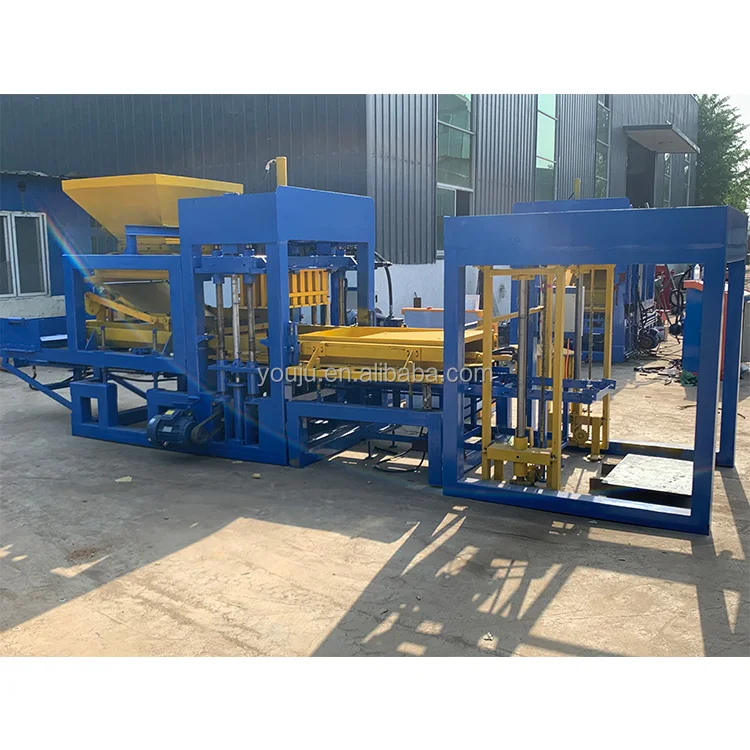
Matched System Design — Raw material feeding, mixing, pallet circulation and stacking are specified as one line around the QT4-15 press so cycle times align at every station.
Technical Specifications
| Parameter | Value |
|---|---|
| Model | QT4-15 |
| Product Type | Hydraulic Interlocking Brick Making Machine |
| Molding Cycle | 15–30s (basis not stated in source) |
| Pallet Size | 900 × 500 mm |
| Vibration Type | Platform vibration |
| Vibration Frequency | 50–70 Hz |
| Product Height Range | 50–220 mm |
| Overall Power | 24.5 kW |
| Demolding Method | Hydraulic |
| Control System | PLC |
| Automation Level | Automatic (pallet feeding, material feeding, vibrating, demoulding) |
| Output Capacity (400×200×200mm hollow block) | 900–1,200 pcs/hour, 7,200–9,600 pcs/8hr |
| Output Capacity (400×150×200mm hollow block) | 1,080–1,440 pcs/hour, 8,640–11,520 pcs/8hr |
| Output Capacity (400×100×200mm hollow block) | 1,440–1,920 pcs/hour, 11,520–15,360 pcs/8hr |
| Output Capacity (200×100×60mm paver) | 2,880–3,840 pcs/hour, 23,040–30,720 pcs/8hr |
| Output Capacity (240×115×53mm solid brick) | 5,930–6,720 pcs/hour, 47,400–53,700 pcs/8hr |
| Block Compressive Strength | More than 15 MPa |
| Raw Materials | Flyash, slag, gangue, sand, water, crushed stone, cement |
| Mould Change | Supported (hollow block, paver, solid brick) |
| Voltage & Frequency | (basis not stated in source — confirm target market voltage) |
| Overall Dimensions | (basis not stated in source) |
| Net Weight | (basis not stated in source) |
| Standards | CE (certificate availability to be confirmed) |
Application Suitability
| Application | Material or Output |
|---|---|
| Hollow block production for wall construction | Crushed stone, sand, cement, flyash blends |
| Paver brick for walkways and yards | Sand, cement, fine aggregate mixes |
| Solid brick for load-bearing structures | Cement, gangue, slag, sand combinations |
| Interlocking brick for low-cost housing | Local aggregate with cement binder |
| Industrial residue block manufacturing | Flyash, slag, gangue mixed with cement |
What the QT4-15 Block Machine Production Line Must Solve Before the Press Starts Running
A press is only as productive as the slowest station around it.
I once watched a block plant in West Africa where the host press cycled perfectly every 20 seconds, yet the mixer discharged a batch only every 90 seconds. The operator spent most of the shift waiting. Downstream, two workers stacked wet blocks by hand because no pallet return conveyor was budgeted. That plant ran at a fraction of its nameplate capacity every single day. The QT4-15 block machine production line avoids this trap by sizing the feeder, mixer, pallet loop and stacker to the same 15–30 second window the press demands [NEED_CITE: block plant line balancing principles for stationary equipment].
Matching Every Station to the Press Cycle
The QT4-15 block machine production line starts with raw material feeding configured to the buyer’s actual mix design. When local aggregate is coarse crushed stone rather than fine sand, the feeder gate and belt width must deliver a heavier charge within the press window. A mismatched feeder forces the mixer to run longer batches, and the press sits idle between charges.
The PLC-controlled sequence ties pallet feeding, material discharge, platform vibration and hydraulic demoulding into one continuous loop. Because the automation level covers all four stages, no manual intervention breaks the cycle. This matters most when the line runs the 400×100×200mm hollow block format at the shorter end of the molding cycle — the upstream mixer and downstream pallet return must clear and reset within that same window.
Pallet Circulation Defines the Real Daily Output
Every pallet that leaves the press must travel through the curing rack, dry, and return before the next cycle can begin. With a 900×500mm pallet, the curing rack spacing, forklift fork width and stacker magazine must all accept that dimension. When a buyer installs racks built for a different pallet size, the line stalls at the curing stage regardless of how fast the press cycles.
The pallet material also affects vibration transfer. Bamboo pallets absorb some of the 50–70 Hz platform vibration before it reaches the mould cavity, while steel pallets transmit it fully. Choosing pallet material without testing against the buyer’s aggregate can leave block density below the 15 MPa target. Line specification must therefore lock pallet type before the press is commissioned [NEED_CITE: pallet material effect on vibration transmission in block presses].
Reading the Specs That Actually Matter
The vibration frequency range of 50–70 Hz pairs with hydraulic demoulding to control block density. At the lower end of the frequency band, the platform delivers longer, gentler oscillation suited to hollow blocks with thin webs. Higher frequency compacts paver mixes more aggressively, producing the denser structure needed for pedestrian traffic. Without this adjustable range, a single line cannot produce both formats at acceptable strength.
The 24.5 kW overall power figure covers the press motor, hydraulic pump and vibration motor running simultaneously. Buyers often compare motor nameplate ratings without checking whether the quoted power includes the full press assembly. A lower headline power sometimes means the hydraulic pump is undersized, resulting in slower demoulding and longer cycle times.
Product height range of 50–220 mm determines which moulds the line can accept. A mould for a 250 mm kerbstone falls outside this envelope, so buyers planning to add kerbstones later must confirm whether a different press station is needed rather than assuming one machine covers every format.
The Cost of Leaving Stations Out of the Quotation
When a quotation covers only the press and omits the pallet return conveyor, stacking unit and curing rack handling, the buyer must source these separately. Mismatched conveyor speeds and incompatible pallet dimensions then surface during installation, adding weeks to commissioning. Buyers who budget the complete QT4-15 block machine production line upfront avoid this procurement gap and keep the project timeline intact [NEED_CITE: hidden costs of partial block line quotations].
Why Specify the Full Line Here
Block machinery is our single focus, so the QT4-15 is never quoted as a standalone press. Machine, mould, pallet and handling equipment are configured together against the buyer’s local aggregate and target block format. Mould design covers the hollow block, paver and solid brick formats the buyer’s market actually sells, including custom drawings when standard formats do not match. Automation level is selectable — a buyer can start with the automatic sequence shown here and add a cubing stacker later as volume grows. Installation support includes operator training on the PLC interface, and wear parts lists are provided so the first mould or hydraulic seal replacement does not halt production.
Documentation & Verification
- Line layout and capacity calculation stating the block format assumed for each output figure
- Machine specification sheet covering the 24.5 kW power assembly and hydraulic circuit
- Mould drawing and format list for hollow block, paver and solid brick cavities
- Pallet specification matched to 900×500mm size and selected material
- Voltage and control language confirmation document before production begins
- Factory test record on the buyer’s target block format before dispatch
Installation, Commissioning & Support
- Foundation plan sized to the 24.5 kW overall power and vibration load of the press station
- Dedicated electrical circuit confirmed for local voltage and frequency before the control panel is wired
- Press and pallet feeder arrive in separated modules for container loading and on-site assembly
- PLC parameters tuned to the buyer’s mix design and selected block format during first run
- Operator training covers the automatic pallet feeding, material feeding and hydraulic demoulding sequence
- Wear parts list identifies hydraulic seals and mould liners for the first scheduled replacement
Before You Request a Quotation
Provide the block formats your market sells, the daily volume you need for each format, and the local aggregate available at your site. Confirm the voltage and frequency at your plant, the PLC display language your operators require, and whether existing curing racks or forklifts must be reused. If you already operate a mixer or pallet system upstream, share those specifications so the QT4-15 block machine production line can be matched to your current equipment rather than replacing it.
Frequently Asked Questions
Q: How do the feeding, mixing and pallet stations keep pace with the QT4-15 press cycle?
A: Each station is sized to clear its task within the 15–30 second molding window. The mixer batch volume, feeder belt speed and pallet return conveyor rate are calculated from the target block format. When the press runs at the shorter cycle end, upstream and downstream equipment must reset faster, and the line layout reflects that timing.
Q: What pallet size does the line use and how does it match existing curing racks?
A: The standard pallet is 900×500mm. Before the line ships, we confirm that your curing rack slots and forklift forks accept this dimension. If your existing racks use a different size, the pallet specification is adjusted and the press mould layout is reviewed to ensure the block arrangement still fits the new pallet footprint.
Q: Which block formats are covered in the capacity calculation?
A: The capacity table lists 400×200×200mm, 400×150×200mm and 400×100×200mm hollow blocks, plus 200×100×60mm pavers and 240×115×53mm solid bricks. Each figure states the format assumed. If your primary product is a different size, we calculate a separate output estimate based on that mould cavity count and cycle time.
Q: How is the raw material feed configured for my local aggregate?
A: The feeder and mixer are set against your actual mix design and the aggregate available on site. Coarse crushed stone requires a wider feeder gate and longer mix time than fine sand. We request a sample sieve analysis before finalizing the feed configuration so the press receives a consistent charge every cycle.


