
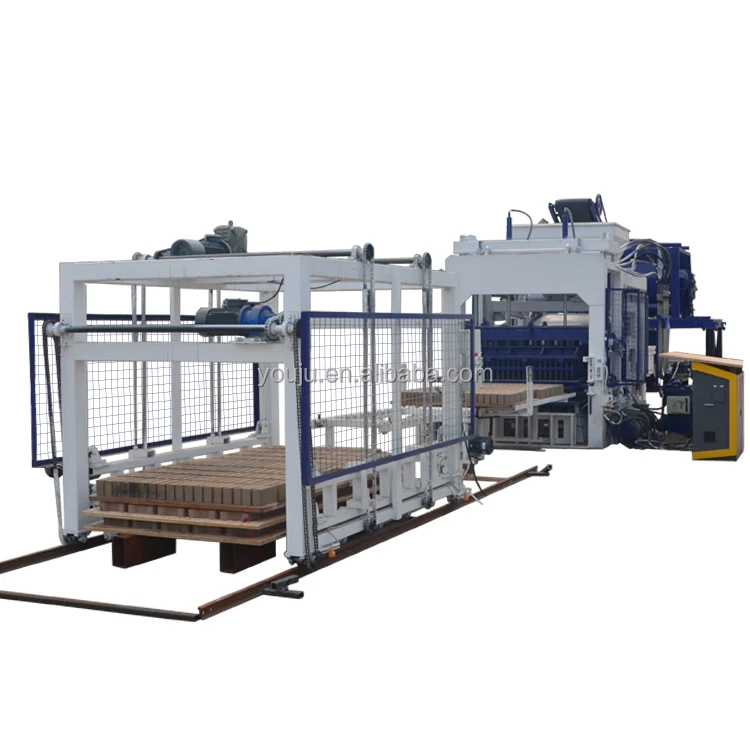
Configured As One System — the QT12-15 is never quoted alone; raw material feeding, mixing, pallet handling, stacking, and curing rack systems are matched so upstream and downstream cycle times align with the press.
Technical Specifications
| Parameter | Value |
|---|---|
| Model | QT12-15 |
| Product Type | Stationary Concrete Block Making Machine |
| Overall Dimensions (L×W×H) | 7500×2500×3020 mm |
| Pallet Size | 1220×900 mm |
| Vibration Form | Platform Vibration |
| Vibration Frequency | 0-60 Hz |
| Vibration Force | 100 kN |
| Moulding Mode | Automatic loading, vibration moulding |
| Demolding Method | Hydraulic |
| Molding Cycle | 15-20 s |
| Hydraulic System | Computer-controlled flow pressure |
| Feeding System | Semi-closed screen reticular rotational forced feeding unit |
| Control System | PLC with human-machine interface dialogue system |
| Overall Power | 53 kW |
| Total Mass | 12 T |
| General Water Consumption | 12 T/Day |
| Factory Area | 1200 m² |
| Output Capacity (Hollow Bricks 400×200×200 mm) | 12 pcs/mould, 1728-2160 pcs/h, cycle 20-25 s |
| Output Capacity (Porous Bricks 240×115×90 mm) | 27 pcs/mould, 4860-6480 pcs/h, cycle 15-20 s |
| Output Capacity (Standard Bricks 240×115×53 mm) | 62 pcs/mould, 12700-14400 pcs/h, cycle 15-17 s |
| Automation Level | Fully automatic |
| Warranty | 1 year for the whole machine (excluding spare parts) |
Application Suitability
| Application | Material or Output |
|---|---|
| High-capacity hollow block production | Crushed stone, sand, cement, fly ash, gravel, slag |
| Solid and porous brick manufacturing | Sand, cement, dust, crushed stone |
| Paver and interlocking block production | Colored aggregates, cement, fine sand |
| Curbstone and kerbstone manufacturing | Coarse aggregate, cement, high-strength mix |
| On-site contractor block plants | Local aggregate, cement, project-specific formats |
Why "14,400 Bricks Per Hour" Means Nothing Without the Rest of the Line
A press rated for 14,400 standard bricks per hour will produce far fewer if the mixer cannot deliver material within its 15-17 second cycle.
I once configured a stationary block machine for a project in West Africa where the host press was capable of strong daily numbers on paper. The buyer sourced a smaller pan mixer locally to save cost. The result was the host press idling through most of each cycle, waiting for the next batch of mix. The actual daily output dropped to roughly half of what the capacity table suggested. With the QT12-15 concrete block machine production line, every station upstream and downstream is calculated against the press cycle, not quoted independently. [NEED_CITE: matching upstream and downstream station cycle times in block production]
Matching Every Station Around the Press
The QT12-15 concrete block machine production line is specified starting from the press cycle, then working outward. The feeding system, mixer discharge rate, pallet feeding speed, and stacking station are each timed so the press is never the bottleneck waiting on another station. A 15-second cycle on standard bricks means the mixer must deliver a fresh batch, the forced feeding unit must distribute it across the mould, and the pallet conveyor must remove the finished product — all within that window.
How Line Layout Prevents Idle Time
When a block line is assembled from separate suppliers, each vendor quotes their own machine in isolation. The mixer vendor does not know the press demands a new batch every 15 seconds. The stacker vendor does not know the pallet conveyor delivers at a specific rate. The QT12-15 line layout addresses this by calculating each station’s throughput against the host press, so material flow is continuous. [NEED_CITE: block production line integration standards]
Reading the Capacity Table Honestly
The output figures above are tied to specific block formats and cycle times. The hollow brick number assumes a 400×200×200 mm format at 20-25 seconds per cycle. The porous brick number assumes 240×115×90 mm at 15-20 seconds. Switching between formats changes the daily output, which is why our capacity calculation document states the assumed format behind every figure.
Vibration, Pressure, and What They Mean for Block Density
The platform vibration system operates at 0-60 Hz with 100 kN of vibration force, working alongside computer-controlled hydraulic flow pressure. Vibration consolidates the mix into the mould cavity, while hydraulic pressure determines how tightly the material is compressed before demolding. Together, they set the block’s compressive strength. If the buyer’s local aggregate is coarser or the cement ratio differs, the vibration frequency and pressure settings must be adjusted to maintain target strength.
What Happens When Line Stations Are Mismatched
Buyers who select the host press based on its standalone cycle time and then source supporting equipment separately often discover the gap only after installation. The mixer runs slower than expected. The pallet feeder cannot keep pace. The curing rack system backs up, forcing operators to stack wet blocks by hand. Each of these mismatches erodes the daily output the buyer originally planned around. [NEED_CITE: common block line commissioning delays from station mismatch]
Why Buyers Choose This Line Configuration
The line is specified against the buyer’s actual mix design and local aggregate, not a generic catalogue default. Pallet size at 1220×900 mm is confirmed against the buyer’s existing curing racks and forklift before production begins. Voltage, frequency, and PLC display language are locked in during the order stage, not discovered at commissioning. The semi-closed screen reticular rotational forced feeding unit is calibrated for the buyer’s material characteristics. Mould design covers the formats the buyer’s market actually sells, with custom drawings available.
Documentation & Verification
- Line layout and capacity calculation stating the block format behind each output figure
- Machine specification sheet with 7500×2500×3020 mm dimensions and 53 kW power rating
- Hydraulic and electrical schematic for site utility integration
- Pallet specification matched to curing rack system and forklift
- Voltage, frequency, and PLC display language confirmation document
- Factory test record before dispatch
Installation, Commissioning & Support
- Foundation plan based on 12 T total mass and 7500 mm line length
- Power supply requirement confirmed for 53 kW overall draw and local voltage
- Machine shipped in dismantled state for container loading, reassembled on site
- PLC human-machine interface configured in buyer’s language before arrival
- Operator training on mould change procedure and cycle time adjustment
- Wear parts list and hydraulic component schedule for first replacement cycle
What We Need From You to Configure the Line
To size the QT12-15 concrete block machine production line correctly, we need your target block format and daily output target, the local raw materials available (aggregate type, sand gradation, cement grade), your site dimensions and curing area layout, the voltage and frequency standard in your region, and details of any existing equipment the line must connect to.
Frequently Asked Questions
Q: How is daily output calculated, and which block format does each capacity figure assume?
A: Every output figure in our capacity table is tied to a specific block format and cycle time. For example, 12,700-14,400 pieces per hour applies to 240×115×53 mm standard bricks at a 15-17 second cycle. We provide a capacity calculation document that states the format behind each number so daily planning is realistic.
Q: How do upstream and downstream stations match the press cycle time?
A: Each station — mixer, feeder, pallet conveyor, stacker, curing rack handler — is selected so its throughput aligns with the host press cycle. For the QT12-15, a 15-20 second moulding cycle means the mixer must deliver a fresh batch and the pallet system must clear the finished product within that window.
Q: What pallet size is specified, and how does it relate to my curing area?
A: The standard pallet size is 1220×900 mm. Before production, we confirm this matches your curing rack dimensions and forklift capacity. A mismatch here causes delays and damage during block handling after demolding.
Q: What voltage and PLC language will the machine be configured for?
A: Voltage, frequency, and PLC display language are confirmed during the order stage based on your local power grid and operator requirements. This prevents commissioning delays that occur when these details are left until the machine arrives on site.
Q: What site area and utilities does the complete line require?
A: The host press and supporting stations need approximately 1200 m² of factory area, around 12 tonnes of water per day, and a 53 kW power supply. Exact requirements depend on your line configuration and the curing system layout you choose.


