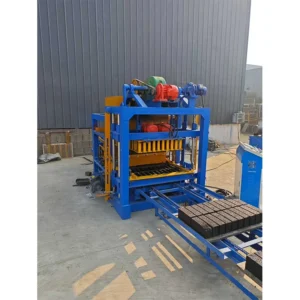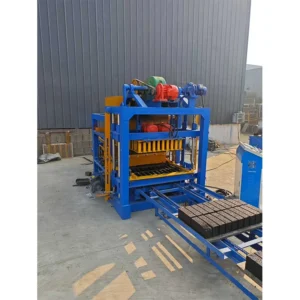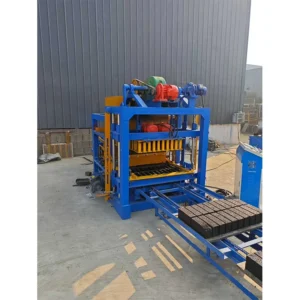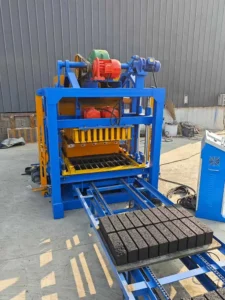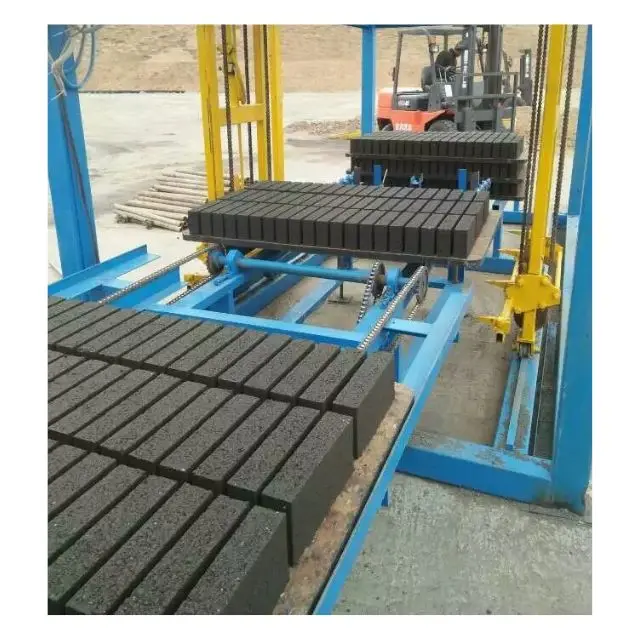
Matched line rhythm — Every station from the JS750 mixer to the stacking unit is timed against the 15–25 s molding cycle so the QT10-15 press never waits for a pallet or mix delivery.
Technical Specifications
| Parameter | Value |
|---|---|
| Product Type | Fully Automatic Concrete Block Making Machine |
| Model | QT10-15 |
| Overall Dimensions (L×W×H) | 9350×2320×2950 mm |
| Moulding Area | 1025×810 mm |
| Pallet Size | 1100×900 mm |
| Forming Height Range | 40–250 mm |
| Rated Pressure | 21 MPa |
| Main Vibration Form | Platform vibration |
| Vibration Frequency | 4500–5100 r/min |
| Molding Cycle | 15–25 s |
| Overall Power | 44 kW |
| Mixer Model | JS750 |
| General Water Consumption | 12 T/day |
| Control System | PLC (Mitsubishi) |
| Hydraulic Unit | Taiwan Jiugang |
| Switch Components | Omron |
| Electrical Elements | Schneider |
| Host & Mixer Motor | Siemens |
| Mould Treatment | High temperature carburizing heat treatment |
| Output (Hollow Block 400×200×200 mm) | 10 pcs/mould, 1800–2400 pcs/h, 14400–19200 pcs/8h |
| Output (Hollow Block 400×150×200 mm) | 12 pcs/mould, 2160–2880 pcs/h, 17280–23040 pcs/8h |
| Output (Solid Brick 240×115×90 mm) | 52 pcs/mould, 9360–12480 pcs/h, 74880–99840 pcs/8h |
| Voltage | Customized to local request (basis to be confirmed) |
| Standards | CE standard motors; full machine CE declaration to be verified |
Application Suitability
| Application | Material or Output |
|---|---|
| Hollow block production for load-bearing and partition walls | Crushed stone, sand, cement, fly ash blends |
| Solid brick manufacturing for masonry and infill | Local aggregate with cement binder |
| Paving block and interlocking brick runs | High-density concrete mixes with fine aggregate |
| Kerbstone and heavy-format concrete units | Coarse aggregate mixes within 40–250 mm forming height |
| Fly ash brick production for regional markets | Fly ash, lime, gypsum, and sand formulations |
What "Fully Automatic" Actually Covers in a Block Line
A press is only as fast as the slowest station feeding or clearing it.
Many quotations list the automatic block machine production line as a headline, then leave raw material batching, pallet return, stacking, and curing rack handling as buyer-supplied items. The result is a high-speed press that spends half a shift idle because the operator is still moving wet blocks by hand. I have walked onto sites where a capable press was bottlenecked entirely by pallet logistics, and the daily output looked nothing like the brochure promised [NEED_CITE: common gaps in block line quotation scope]. The line must be quoted as a connected sequence of stations, each with a cycle time that matches the press rhythm.
Synchronizing Every Station Around the Press Cycle
The QT10-15 completes a molding cycle in 15–25 seconds, which means the pallet feeder must deliver a fresh board, the mixer must discharge a measured batch, and the stacker must clear the finished board within that same window. When the automatic block machine production line is specified as a whole, the PLC coordinates these movements as a single timed sequence rather than independent stations running on separate timers.
Where the Line Breaks Down If Pallet Handling Is Underspecified
A 1100×900 mm pallet loaded with wet blocks weighs considerably more than an empty one, and the return conveyor must move both reliably across the curing area. If the forklift on site cannot handle the loaded pallet dimensions or the curing racks do not accept the board spacing, the stacker backs up and the press halts. I have seen plant owners discover this mismatch on the first day of production, when the theoretical cycle time meets physical floor space [NEED_CITE: pallet and curing area planning for block plants].
Reading the Core Specifications in Production Terms
The 21 MPa rated pressure working alongside 4500–5100 r/min platform vibration determines how densely the concrete is compacted into the mould. Higher vibration frequency alone does not guarantee block strength — the hydraulic pressure must hold the mould closed firmly enough for the vibration to consolidate the mix rather than just shake it. The 1025×810 mm moulding area on a 1100×900 mm pallet gives enough border for reliable handling without wasting board surface. A JS750 mixer integrated upstream ensures the mix reaches the hopper at a consistent moisture level, which matters because even small water variations shift cycle behavior and block density noticeably. The 44 kW overall power draw covers the press, mixer, and conveyors running together, so electrical planning must account for the full line load rather than the press motor alone.
The Cost of Skipping Downstream Stations
When a buyer purchases the press and mixer but defers the automatic stacker and curing rack handler, the line operates at the speed of the manual pallet crew. During an eight-hour shift that gap compounds into significant lost output, and block damage from hand stacking adds rejection costs that never appear in the original budget. The automation level should be decided before the order is placed, not retrofitted after the first month of production reveals the bottleneck [NEED_CITE: manual versus automatic stacking impact on block breakage rates].
Why the Whole Line Should Come from One Specification Source
The configuration is built around the buyer’s actual mix design and local aggregate, not a catalogue default — the vibration and pressure settings are matched to what the plant will actually pour. Moulds for the block formats the buyer’s market demands are designed and supplied together with the press, including custom drawings when standard formats do not fit. Pallet size and material are chosen against the curing area dimensions and forklift capacity already on site. Voltage, frequency, and PLC display language are confirmed in writing before production starts, preventing commissioning delays when the line arrives. Installation support covers the full connected line, so operator training addresses every station from batching through stacking, not the press in isolation.
Documentation & Verification
- Line layout drawing with capacity calculation stated per block format
- Pallet specification matched to curing area and forklift capacity
- Voltage, frequency, and PLC display language confirmation before production
- Hydraulic and electrical schematics covering press, mixer, and all conveyors
- Factory test record on the buyer’s target block format
- Operation and maintenance manual covering every line station
Installation, Commissioning & Support
- Foundation plan sized to the 9350×2320 mm press footprint plus conveyor runs
- Dedicated electrical circuit for the 44 kW total line load at confirmed voltage
- Press, mixer, and conveyors shipped in labeled sections for on-site assembly
- Full line commissioning with cycle timing verified across every station
- Operator training on PLC controls, mould change, and daily maintenance routines
- Wear parts list with mould and hydraulic component replacement intervals
What to Prepare Before Requesting a Quotation
Share the block formats your market actually sells, the daily output target per format, and the raw materials available locally including aggregate type and gradation. Confirm the voltage and frequency at your site, the language needed on the PLC display, and whether you already have forklifts and curing racks that the pallet specification must match.
Frequently Asked Questions
Q: How is line capacity calculated and which block format is assumed?
A: Every output figure on this page states the exact block dimensions it assumes — for instance, 1800–2400 hollow blocks per hour is based on 400×200×200 mm format at 10 pieces per mould. When you request a proposal, the capacity calculation document will list your target format and the corresponding cycle time, so the daily output expectation is grounded in your actual product, not a generic number.
Q: How are cycle times matched so the press never waits for pallets or mix?
A: The PLC coordinates the pallet feeder, mixer discharge, and stacker as one timed sequence against the 15–25 second molding cycle. Each station’s motor and sensor are wired into the same control logic, so a delay at any point pauses the line in a controlled way rather than causing a jam or a dry cycle with no material.
Q: What pallet size is specified and how does it match my curing area?
A: The standard pallet for this line is 1100×900 mm, but the material and thickness are confirmed against your curing rack spacing and forklift capacity before production. A pallet that is too heavy for your existing forklift or too wide for your rack slots will create a bottleneck that no press speed can overcome.
Q: What supporting equipment is included and what must I source separately?
A: The quotation covers raw material feeding, the JS750 mixer, pallet feeder, press, stacker, and curing rack handler as a connected line. Items typically sourced by the buyer include the curing room structure, external water supply plumbing, and the forklift for moving cured racks — these are identified clearly in the line layout document so there are no surprises at installation.