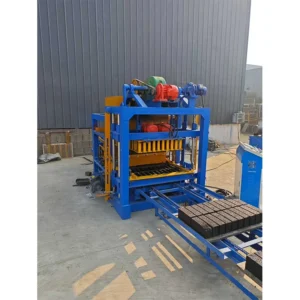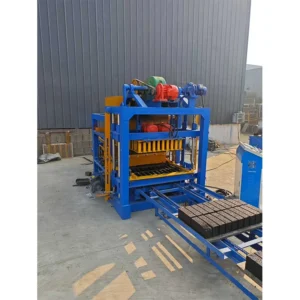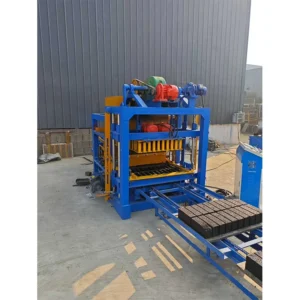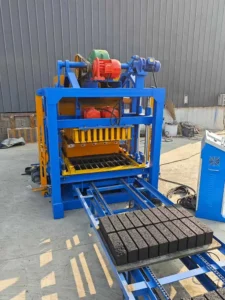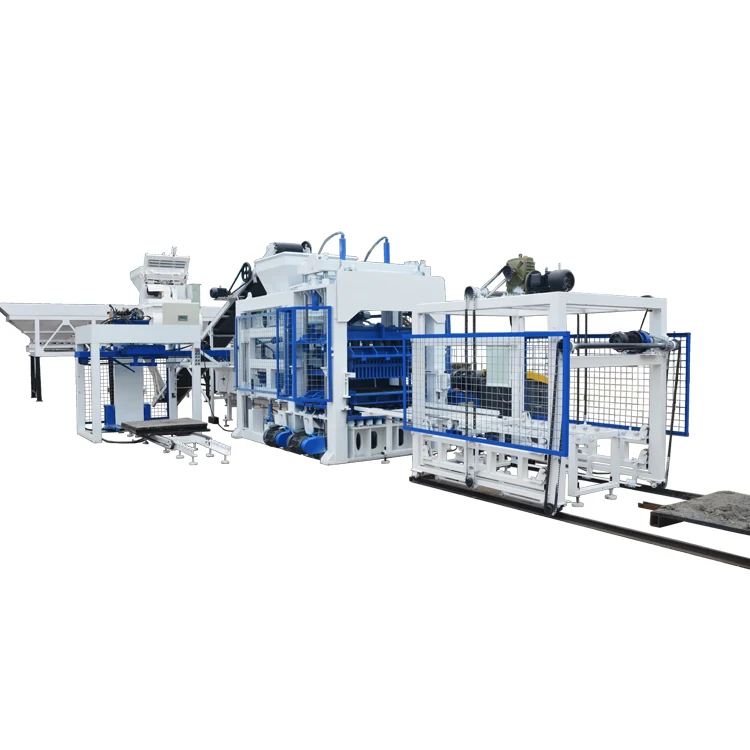
Matched System Integration — every station from raw material feeding to cubing is timed against the QT10-15 press cycle so no single point throttles your daily throughput.
Technical Specifications
| Parameter | Value |
|---|---|
| Model | QT10-15 |
| Product Type | Automatic Block Making Machine |
| Automation Level | Automatic (Industry 4.0 European version) |
| Vibration Acceleration | 20g |
| Vibration Technology | Dynamic and static table with frequency conversion, four-axis vibration |
| Material Feeding System | Press-in arch breaker with 360° rotation |
| Cloth Platform | Replaceable wear-resistant plate |
| Vibration Damping | Flexible pressure head reduction + adjustable pressure air bag in mold box |
| Mould Adaptability | Hollow blocks, solid blocks, interlocking bricks, pavement bricks, slope protection bricks, porous bricks |
| Control System | PLC (brand/model to be confirmed) |
| Output Capacity | Based on block format and mix design (basis to be confirmed) |
| Cycle Time | Varies by block format (basis to be confirmed) |
| Hydraulic Pressure | To be confirmed per configuration |
| Pallet Size | Matched to line layout and curing area (basis to be confirmed) |
| Voltage & Frequency | Configurable to site requirement (basis to be confirmed) |
| Certification | CE declaration where applicable |
Application Suitability
| Application | Material or Output |
|---|---|
| High-volume hollow block production | Crushed stone, sand, cement, fly ash aggregates |
| Solid block and interlocking brick runs | Local aggregate blends with cementitious binder |
| Pavement brick and kerbstone forming | Fine aggregate and pigment-loaded concrete mixes |
| Slope protection and porous brick output | Permeable aggregate gradations with controlled water-cement ratio |
| Multi-format plant expansion | Quick mould change across standard and custom block geometries |
What "Rated Output" Means When the Rest of the Line Is Missing
A press is only as fast as the slowest station feeding it or clearing it.
I spent three weeks on a site in Southeast Asia where a buyer had ordered a high-capacity automatic block making machine production line press by itself. The mixer discharged faster than the pallet feeder could index, and the stacker at the far end could not keep up with the press ejection rate. The machine sat idle for seconds every cycle while operators hand-stacked wet blocks off the press table. The rated output existed only on paper because the surrounding stations had never been matched to the press cycle [NEED_CITE: line synchronization losses in block production]. This is why the QT10-15 is quoted as part of a complete line, with each station’s cycle verified against the press timing before the layout drawing is signed off.
How Every Station Connects Around the Press
Raw material feeding starts the sequence. The 360° rotating press-in arch breaker on the QT10-15 ensures consistent material distribution into the mould cavity, which means the mixer upstream must deliver a fresh batch at the exact moment the feeder completes its rotation. If the mixer cycle is even a few seconds longer than the press cycle, the entire automatic block making machine production line slows to match the mixer, not the press.
Pallet feeding is the next choke point. Pallets must arrive at the press table synchronized with the vibration and hydraulic press sequence. A pallet feeder sized for a slower press will starve the QT10-15, while one sized too large wastes floor space and complicates the return loop. The pallet size is confirmed against the buyer’s existing curing racks and forklift before the feeder is built.
Stacking, Curing, and Cubing: The End of the Line That Buyers Forget
After forming, wet blocks on pallets travel to the stacking station. The automatic stacker must index at a rate matched to the press ejection speed, and the curing rack handler must move full racks out and empty racks in without creating a queue. If the cubing station at the end cannot bundle cured product fast enough, racks back up into the curing area and eventually into the press hall [NEED_CITE: curing area bottleneck in block plants]. The QT10-15 line specification includes every station from raw material in to cubed product out, with each cycle time stated in the layout drawing so the buyer can see where time is spent.
Reading the Specs That Actually Affect Your Line
Vibration acceleration at 20g with four-axis vibration and frequency conversion determines how quickly and uniformly the concrete mix compacts in the mould. Higher acceleration with controlled frequency allows shorter cycle times across different block formats, from thin pavement bricks to tall hollow blocks. The dynamic and static table arrangement ensures that vibration energy reaches the full mould depth rather than concentrating at the base.
The adjustable pressure air bag vibration damping inside the mould box absorbs shock that would otherwise transfer into the machine frame and surrounding structure. This extends component service life and reduces noise in the press hall, which matters when the line runs multiple shifts. The replaceable wear-resistant plate on the cloth platform means that when abrasion inevitably wears the feed surface, maintenance crews swap a single plate rather than rebuilding the entire feeder assembly.
The Cost of Specifying the Press Without the Line
When supporting stations are left out of the quotation, buyers often discover the gap only after the press is bolted to the floor. Pallets pile up at the press exit because no stacker was included. The mixer runs at half capacity because its discharge gate was never matched to the feeder intake rate. Voltage and PLC language arrive unconfirmed, and commissioning stalls while the electrician sources a transformer and the operator tries to navigate a control screen in an unfamiliar language [NEED_CITE: commissioning delays from unconfirmed electrical specifications]. These are not equipment failures — they are specification failures, and they cost weeks of lost production on top of the capital already spent.
Why Procuring the Full Line from One Source Matters
Block machinery is our single focus, so the QT10-15 press, its moulds, pallets, and every handling station are specified as one matched system rather than assembled from separate suppliers who have never communicated with each other. Configuration is set against your actual mix design and local aggregate, not a catalogue default, which means vibration force and hydraulic pressure are chosen for the material you will actually run.
Mould design covers the formats your market sells, including custom drawings when standard moulds do not match local demand. The automation level is selectable — a buyer can start with semi-automatic pallet handling and add automatic stacking later as production volume justifies the investment. Installation support includes operator training on the full line, not just the press, so your crew understands how a timing change at the mixer propagates through every downstream station.
Documentation & Verification
- Line layout drawing with capacity calculation stated per block format
- Machine specification sheet covering press and all supporting stations
- Mould drawing and format list for every block type in your order
- Pallet specification matched to your curing rack dimensions and forklift capacity
- Hydraulic and electrical schematic for the complete line, not the press alone
- Factory test record on your specified block format before dispatch
Installation, Commissioning & Support
- Foundation plan with load points and vibration isolation requirements for the QT10-15 frame
- Voltage, frequency, and dedicated circuit confirmation for every motor and PLC on the line
- Machine dismantling schedule for container loading and reassembly sequence on site
- Commissioning run with cycle timing verification across all stations from mixer to cuber
- Operator training covering mould change, pallet feed adjustment, and PLC fault diagnosis
- Wear parts list including cloth platform plates and hydraulic seals with reorder intervals
What to Prepare Before Requesting a Line Quotation
Share your target block formats with dimensions, the daily output you need for each format, and the local aggregate and cement you plan to use. Provide your curing area dimensions, existing forklift capacity, and the pallet size you already stock if any. Confirm your site voltage and frequency, and specify the PLC display language your operators will work with.
Frequently Asked Questions
Q: How is daily line output calculated, and which block format is the capacity based on?
A: Daily output is calculated by multiplying the press cycle time for a specific block format by the number of production hours, then adjusted for the actual throughput of every supporting station. The capacity figure in any quotation must state the block format, dimensions, and mix design it assumes. Without that basis, the number is not comparable across suppliers.
Q: How are pallet feeding, stacking, and cubing stations timed to the press cycle?
A: Each station’s cycle is measured against the QT10-15 press ejection rate during line design. The pallet feeder must index faster than the press cycle, the stacker must clear pallets before the next batch arrives, and the cuber must bundle cured product before racks back up. Timing values are stated on the line layout drawing before production begins.
Q: What pallet size and material does the line assume, and can it match my existing curing racks?
A: Pallet size is confirmed during the proposal stage based on your curing rack dimensions and forklift capacity. The line can be built around bamboo, steel, or composite pallets depending on your curing environment and budget. The pallet feeder and return conveyor are then configured to handle the specific pallet weight and thickness you choose.
Q: Which supporting stations are included in the quotation and which are optional?
A: The quotation covers raw material feeding, mixing, pallet feeding, the QT10-15 press, stacking, curing rack handling, and cubing as a complete sequence. Stations such as colour pigment dosing or secondary shot-blast finishing are listed separately so you can see exactly what is included and what can be added later as production requirements grow.
Q: How do I confirm voltage, frequency, and PLC language for every station on the line before shipment?
A: A voltage and control confirmation sheet is sent for your signature before production starts. This document lists the motor voltage and frequency for every station, the PLC brand and display language, and the electrical standard the panels are built to. Signing this sheet prevents commissioning delays caused by mismatched electrical specifications on arrival.