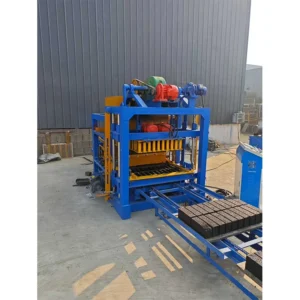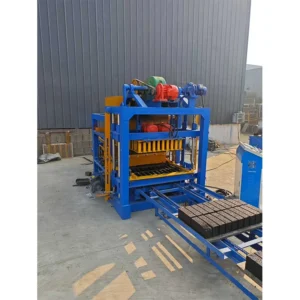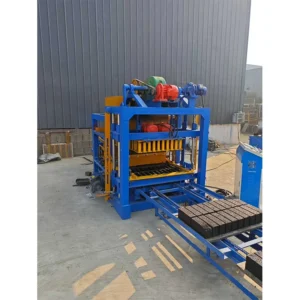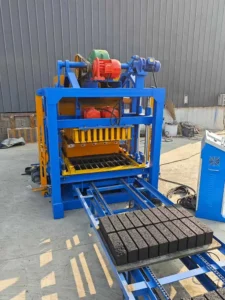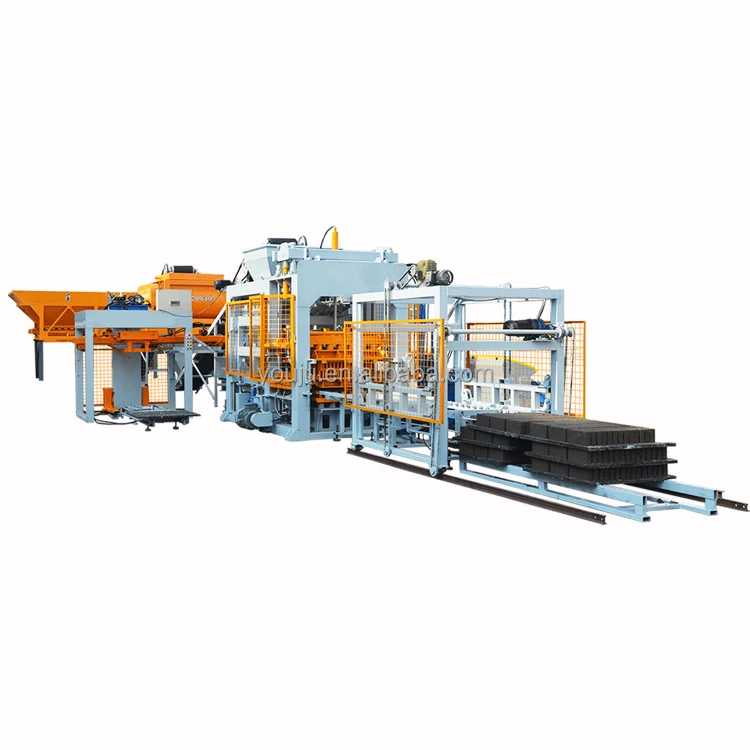
Integrated Line Synchronization — every station around the QT 8-15 press is timed against its 15–25 second moulding cycle so mixers, pallet feeders and stackers sustain continuous output without bottlenecking.
Technical Specifications
| Parameter | Value |
|---|---|
| Model | QT 8-15 |
| Product Type | Fully Automatic Concrete Block Making Machine |
| Overall Dimensions (L×W×H) | 8300 x 1860 x 3000 mm |
| Rated Power | 37 kW |
| Vibration Form | Platform Vibration |
| Vibration Frequency | 2800-4500 RPM |
| Pallet Size | 950 x 900 mm |
| Moulding Cycle | 15 – 25s (basis not stated in source — confirm block format / material / thickness) |
| Brick Height Range | 50-200 mm |
| Control System | PLC with touch screen interface |
| Hydraulic System | Independent integrated hydraulic station |
| Block Formats Supported | Hollow block, porous block, standard solid block, paving block, curbstone, grass block, slope-protecting block, ring-tree block |
| Raw Materials | Fly ash, slag, gangue, industrial waste, river sand, gravel, cement |
| Compressive Strength | Up to 15 MPa |
| Output Capacity (400 x 200 x 200 mm hollow block) | 1912 pcs/hour, 15300 pcs/day (8 hours) |
| Output Capacity (400 x 150 x 200 mm hollow block) | 2875 pcs/hour, 23000 pcs/day (8 hours) |
| Output Capacity (240 x 115 x 90 mm porous block) | 4320 pcs/hour, 34560 pcs/day (8 hours) |
| Output Capacity (240 x 115 x 53 mm standard solid block) | 9360 pcs/hour, 74880 pcs/day (8 hours) |
| Output Capacity (225 x 112.5 x 60 mm paving block) | 3000 pcs/hour, 24000 pcs/day (8 hours) |
| Output Capacity (200 x 100 x 60 mm paving block) | 4625 pcs/hour, 37000 pcs/day (8 hours) |
| Moulds per Format (400x200x200) | 8 pcs/mould |
| Moulds per Format (400x150x200) | 12 pcs/mould |
| Moulds per Format (240x115x90) | 18 pcs/mould |
| Moulds per Format (240x115x53) | 39 pcs/mould |
| Moulds per Format (225×112.5×60) | 18 pcs/mould |
| Moulds per Format (200x100x60) | 28 pcs/mould |
| Automation Level | Fully automatic |
| Color Paving Capability | Yes, with optional color feeding machine |
| Line Equipment Listed | Cement silo, host block machine, mixer, batching machine, stacker, forklift |
| Block Machine Components | Pallet feed machine, block molding machine, storage hopper, conveyor, hydraulic unit, PLC control cabinet |
Application Suitability
| Application | Material or Output |
|---|---|
| Hollow block production plants | Fly ash, slag, river sand and cement mixes forming 400x200x200 mm or 400x150x200 mm cavity blocks |
| Paving block manufacturing | Crushed stone, gravel and cement producing 225×112.5×60 mm or 200x100x60 mm interlocking pavers |
| Porous and solid brick lines | Gangue, industrial waste and cement for 240x115x90 mm porous or 240x115x53 mm standard bricks |
| On-site contractor production | Local aggregate and cement for curbstone, grass block and slope-protecting formats at project locations |
Why "Pieces per Hour" Means Nothing Without Line Context
A block press rated at thousands of pieces per hour only reaches that figure when upstream mixing and downstream pallet handling sustain the same cadence.
When I first started configuring lines, I watched a plant owner invest heavily in a high-cycle host machine only to discover the mixer could not deliver a fresh batch fast enough. The press sat idle forty seconds every cycle waiting for material, and daily output fell far below the quoted number. The automatic block making machine production line only delivers its stated capacity when the batching machine, mixer, conveyor, pallet feeder and stacker are all calculated against the same moulding cycle. [NEED_CITE: line synchronization principles in concrete block manufacturing]
Matching the Mixer to the Moulding Cycle
The QT 8-15 completes a moulding cycle in 15 to 25 seconds depending on block format and material thickness. The mixer upstream must discharge a fully blended batch into the storage hopper within that same window, otherwise the press waits and the automatic block making machine production line loses throughput. A batching machine feeding the mixer must also meter raw materials — fly ash, sand, cement — accurately enough that each batch reaches the target compressive strength of up to 15 MPa without manual adjustment.
Pallet Flow as the Hidden Bottleneck
Every moulded block rides a 950 x 900 mm pallet from the press to the curing area. The pallet feed machine must deliver a fresh pallet under the press within seconds of the previous one departing. Downstream, the stacker must lift and place loaded pallets onto curing racks at the same rate. If the stacker cycle is slower than the press cycle, pallets queue on the conveyor and the operator ends up pulling them off by hand — exactly the situation the automatic configuration was meant to prevent. [NEED_CITE: pallet handling integration in block production lines]
Reading the Specification Sheet Honestly
Platform vibration at 2800–4500 RPM works with the independent hydraulic station to compact the mix inside the mould. The vibration frequency range allows the operator to dial in the right setting for lightweight fly ash mixes or denser gravel-based paver mixes. The PLC touch screen controls the press cycle, pallet feed and stacking sequence from one interface, so timing adjustments propagate across the line rather than requiring separate changes at each station. The 37 kW rated power covers the host machine; the full line draws additional power for the mixer, batching machine, conveyor and stacker, which must be calculated before the site electrical supply is committed.
The Cost of a Mismatched Line
A buyer who specifies the press alone and sources the mixer, conveyor and stacker separately often discovers the stations arrive with incompatible control signals or mismatched cycle times. The PLC cannot coordinate a stacker it was never programmed to communicate with, and the result is a semi-automatic line sold at a fully automatic price. Pallet dimensions compound the problem: if the 950 x 900 mm pallet does not match the curing rack spacing or the forklift fork width already on site, the entire curing workflow requires rework before the first block is sold. [NEED_CITE: integration failures in multi-supplier block lines]
Why This Line Configuration Works
Block machinery is the single focus here, so the QT 8-15 press, moulds, pallets and handling equipment are specified as one matched system rather than assembled from separate suppliers. The line is configured against the buyer’s actual mix design and local aggregate, not a catalogue default, so vibration frequency and hydraulic pressure are set to produce blocks at the target strength from day one. Automation level is selectable, allowing a buyer to start with semi-automatic pallet handling and upgrade the stacker later without replacing the press. Mould design covers the formats the buyer’s market actually sells, and custom mould drawings are available when standard formats do not match local demand. Installation support includes operator training so the crew understands how to adjust cycle times across all stations, not just the press.
Documentation & Verification
- Line layout drawing showing station spacing and pallet flow path for the QT 8-15 configuration
- Capacity calculation stating the exact block format and cycle time used for throughput figures
- Pallet specification sheet confirming 950 x 900 mm dimensions and material grade
- Hydraulic and electrical schematic for the independent integrated station and PLC cabinet
- Factory test record showing press cycle time, vibration frequency and hydraulic pressure on the buyer’s mix
- Voltage, frequency and PLC display language confirmation document signed before production
Installation, Commissioning & Support
- Foundation plan sized to the 8300 x 1860 mm machine footprint with vibration isolation requirements
- Dedicated electrical circuit rated for the 37 kW host machine plus upstream and downstream equipment
- Pallet feed machine and stacker aligned to the 950 x 900 mm pallet during on-site commissioning
- PLC touch screen language set and cycle parameters loaded for the buyer’s target block format before first run
- Operator training covering mould change procedure and vibration frequency adjustment for different mixes
- Wear parts list identifying hydraulic seals and vibration components with recommended replacement intervals
What to Include in Your Inquiry
To configure the automatic block making machine production line around the QT 8-15, provide the target block format and daily output requirement so the capacity calculation reflects your actual product. Share your local raw material sources and any existing curing rack dimensions or forklift specifications so the pallet size and handling equipment are matched to your site. Confirm the local voltage, frequency and preferred PLC display language so the electrical and control systems are correct before the line ships.
Frequently Asked Questions
Q: How do I verify the real daily output of the line?
A: Daily output depends on the block format being produced. The capacity table lists figures for specific formats — for example, 15300 pieces per 8-hour day is rated at 400x200x200 mm hollow blocks at 8 pieces per mould. Ask for a capacity calculation that names the exact format and cycle time assumed, not a single headline number.
Q: Which upstream equipment must match the press cycle?
A: The batching machine, mixer and conveyor must deliver a fresh batch into the storage hopper within the QT 8-15 moulding cycle of 15 to 25 seconds. If any upstream station is slower, the press waits and daily output drops proportionally.
Q: Is pallet handling and stacking included in the quotation?
A: The line equipment list includes a pallet feed machine and stacker alongside the host block machine. Confirm that these stations are quoted together with the press and that the PLC is programmed to coordinate all three, otherwise you receive a press that runs automatically but still requires manual pallet handling.
Q: How is pallet size matched to my curing area?
A: The standard pallet is 950 x 900 mm. Before the line is finalized, share your curing rack dimensions and forklift fork width so the pallet size is confirmed compatible. A mismatch means racks must be rebuilt or a forklift replaced before production starts.
Q: What electrical and control details must be confirmed before shipping?
A: Voltage, frequency and PLC display language must be confirmed before the QT 8-15 enters production. The 37 kW host machine plus the mixer, conveyor and stacker require a site electrical supply sized for the full line, not the press alone.