
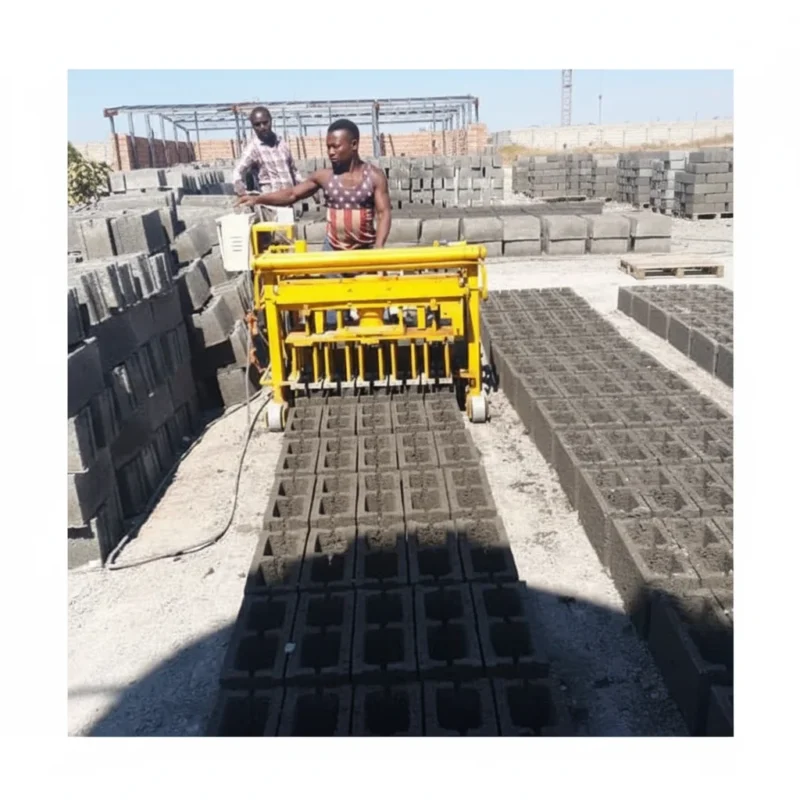
Matched Vibration to Your Local Aggregate — The QMY4-30 mobile egg-laying block making equipment is specified around the mix design and aggregate available on your site, not a catalogue default, so block density remains consistent from the first mold to the last.
Technical Specifications
| Parameter | Value |
|---|---|
| Product Type | Mobile Egg-Laying Concrete Block Making Machine |
| Model | QMY4-30 |
| Overall Dimensions (L×W×H) | 1300 × 1500 × 1000 mm |
| Net Weight | 950 – 1000 kg |
| Vibration Method | Mold Vibration |
| Vibration Force | 28.6 kN |
| Excitation Frequency | 4500 r/min |
| Total Power | 5.95 kW |
| Output Capacity | 3000 pcs/day (basis not stated in source — confirm block format, material, thickness) |
| Raw Materials | Concrete, fly ash, cinder, coal gangue, river sand, gravel, cement, industrial waste residue |
| Automation Level | Manual operation with mold vibration |
| Assembly State | Mobile / egg-laying (no fixed pallet required) |
| Pallet Size | N/A — blocks laid directly on ground |
| Stacking Method | Manual |
Application Suitability
| Application | Material or Output |
|---|---|
| On-site hollow block production for building contractors | Crushed stone, river sand, and cement mixes |
| Solid block manufacturing for housing projects | Fly ash, cinder, and local aggregate blends |
| Small-scale paving block runs for entrepreneurs | Gravel, coal gangue, and cement combinations |
| Remote-site block production without fixed plant infrastructure | Industrial waste residue and cement mixes |
What the "3000 Pieces per Day" Figure Leaves Out for a Mobile Block Machine Production Line
A capacity number without a block format attached is a guess, not a guarantee.
I once watched a West African contractor run a QMY-class egg-laying machine on site. The blocks came out fine, but the mixer feeding it was undersized. Every cycle, the press sat idle for over forty seconds waiting for the next batch of concrete. By the end of the shift, daily output dropped well below what the brochure promised. The mobile block machine production line only performs when every upstream station — mixer, feeder, water supply — is timed to the press cycle. [NEED_CITE: block machine line balancing principles for mobile egg-laying equipment]
How the Press Fits Inside a Lean Block Line
A mobile block machine production line starts long before the press itself. Raw material must arrive at the hopper at a rate that matches the mold cycle, which means the mixer capacity and discharge speed must be calculated against the QMY4-30’s vibration and molding time. When the mixer is too small or the feed belt too slow, the press idles — and idle time is lost output you cannot recover later in the shift. Sizing the mixer, feeder, and water dosing system to the press cycle is the first step in line design, not an afterthought.
Curing Area Planning Around the Egg-Laying Path
Because the QMY4-30 lays blocks directly on the ground, the curing zone must be a flat, compacted surface long enough to hold a full day’s output without congestion. Forklifts or hand carts need clear aisles between block rows for watering and later collection. If the curing area is too short, fresh blocks crowd together before they gain initial strength, leading to edge damage and waste. Planning the curing footprint as part of the mobile block machine production line layout prevents bottlenecks that no amount of press speed can fix. [NEED_CITE: ground preparation standards for egg-laying block machines]
Reading the Specs That Actually Shape Block Quality
The 28.6 kN vibration force and 4500 r/min excitation frequency work together to compact the concrete inside the mold. Higher vibration force drives aggregate particles into a tighter arrangement, but only if the mix moisture and cement ratio allow it — a dry mix with insufficient water will not consolidate even under strong vibration. The 5.95 kW total power keeps the machine runnable on sites with limited generator capacity, which matters when a fixed plant is not an option. At 950–1000 kg net weight, the unit is heavy enough to resist walking during vibration yet light enough to relocate with a small loader or forklift as the building footprint shifts. The egg-laying design eliminates pallet costs entirely, which changes the economics of the curing zone compared to stationary lines.
The Hidden Cost of Undersized Upstream Equipment
When the mixer discharges slower than the press cycles, the operator either waits — losing output — or forces a short cycle, producing under-compacted blocks that fail strength tests on site. I have seen projects where the contractor blamed the block machine for low output, but the root cause was a mixer that could only deliver half the volume the press needed per cycle. The mobile block machine production line only reaches its stated capacity when material supply is continuous. Fixing the upstream mismatch after commissioning means buying a larger mixer and re-pouring feed foundations, which costs far more than sizing correctly at the inquiry stage. [NEED_CITE: common causes of output shortfall in mobile block production lines]
Why Buyers Source the Complete Line Here
Block machinery is our single focus, so the QMY4-30 is specified as part of a matched system — mixer, feeder, curing layout — rather than sold as a standalone press. We configure the line against your actual mix design and local aggregate, not a default recipe, because vibration force only produces strong blocks when the material responds to it. Mould formats are selected for the products your market actually buys, and custom mould drawings are available when standard formats do not fit. Automation level is selectable, so you can start with manual egg-laying operation and plan an upgrade path as demand grows. Installation support includes line layout, operator training, and a wear parts list so replacements are on hand before the first mold change is due.
Documentation & Verification
- Line layout showing mixer, feeder, and curing zone sized to QMY4-30 cycle time
- Capacity calculation stating the exact block format behind the daily output figure
- Voltage and frequency confirmation sheet before production begins
- Factory test record on your specified mix and block format prior to dispatch
- Wear parts and mold list with part numbers for reordering
Installation, Commissioning & Support
- Ground preparation guide specifying flatness tolerance for the 1300 × 1500 mm machine footprint
- Power supply checklist matching the 5.95 kW total load to your site voltage and frequency
- On-site assembly support for the mobile unit, including vibration motor alignment check
- First-run commissioning with mold vibration tuning matched to your aggregate and mix design
- Operator training covering cycle sequence, mold change procedure, and daily maintenance points
- Spare mold and hydraulic wear parts list provided at delivery for uninterrupted production
What to Share Before Requesting a Quote
To size the QMY4-30 and its upstream stations accurately, provide your target block format and dimensions, the local aggregate and cement type you plan to use, and your site power supply voltage and frequency. If you already have a mixer or feeding equipment, share those specifications so the line can be balanced around what you own. Let us know whether your curing area is paved or compacted earth and how much flat ground is available, since this determines daily output flow.
Frequently Asked Questions
Q: How is the daily output of the QMY4-30 verified, and which block format does it assume?
A: The 3000 pcs/day figure requires confirmation of block format, wall thickness, and mix design before it can be treated as a reliable target. Different hollow block sizes and solid block dimensions change the volume of concrete per mold and the vibration time needed, shifting actual output. We provide a capacity calculation tied to your specific block format during the proposal stage.
Q: What upstream equipment must be matched to the QMY4-30 so the press does not wait for material?
A: The mixer discharge rate and raw material feeder speed must deliver a fresh batch before each mold cycle completes. If the mixer is undersized, the press idles between cycles and daily output drops. We calculate mixer capacity and feed belt speed against the QMY4-30 cycle time so material flow stays continuous throughout the shift.
Q: What site preparation does an egg-laying machine require compared to a fixed-plant line?
A: An egg-laying machine needs a flat, compacted ground surface large enough to hold a full day’s production with walking aisles for curing and collection. Unlike a fixed plant with pallet racks, there is no pallet investment, but the ground must be level to prevent block deformation. We include curing area dimensions in the line layout based on your target output.
Q: Can the QMY4-30 be upgraded later into a semi-automatic or automatic line?
A: The QMY4-30 operates as a standalone mobile unit, and upgrading to a semi-automatic or automatic stationary line typically means replacing the press rather than retrofitting it. However, the supporting equipment — mixer, feeder, curing layout — can be designed from the start to accommodate a future stationary press, protecting your initial line investment.
Q: How do vibration force and local aggregate type affect block strength?
A: The 28.6 kN vibration force compacts aggregate particles into a dense matrix, but the result depends on your mix moisture, cement ratio, and aggregate gradation. A poorly graded sand with too many fines may not consolidate well even under strong vibration. We adjust mold vibration parameters and recommend mix adjustments based on samples of your local raw materials.


