
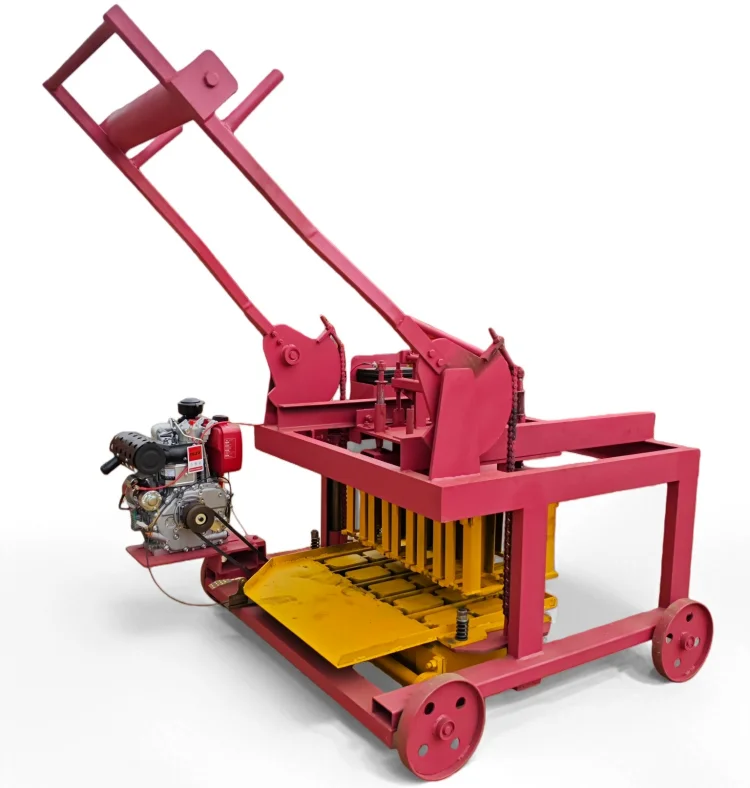
Matched System Lineup — the QMR4-45 mobile block machine is specified alongside its diesel mixer and trolley so the press never waits for material at the molding station.
Technical Specifications
| Parameter | Value |
|---|---|
| Model | QMR4-45 |
| Product Type | Mobile Diesel Block Making Machine |
| Molding Cycle | 45s (basis not stated in source — confirm block format / material / thickness) |
| Power Source | Diesel |
| Engine Power | 8 hp |
| Molding Form | Vibration and Pressure |
| Vibration Force | 60 KN |
| Total Weight | 800 kg |
| Overall Dimensions | 2420 × 1320 × 1650 mm |
| Pallet Requirement | No pallet required |
| Block Formats | Paver brick, hollow block, concrete block, solid brick, fly ash brick |
| Included Equipment | JZC350 or JQ350 Diesel Concrete Mixer with Electric Generating Unit; Trolley |
| Mobility | Mobile, easy to relocate |
Application Suitability
| Application | Material or Output |
|---|---|
| On-site construction block production | Crushed stone, sand, and cement mixes for hollow and solid blocks |
| Housing project supply without fixed plant | Fly ash and cement blends for standard concrete blocks |
| Remote site paver manufacturing | Aggregate and cement for interlocking and paving bricks |
| Small-scale contractor production | Local sand and gravel for load-bearing solid bricks |
What "45 Seconds per Cycle" Actually Means on Site
Cycle time only translates to daily output when the block format, mix consistency, and material feed are all confirmed together.
Many mobile block machine buyers see a 45-second cycle and mentally multiply it into a shift output, only to find that the number assumed a specific hollow block size with an ideal mix that their local aggregate cannot replicate. When the mixer cannot keep pace or the trolley arrives late, the press sits idle and the real throughput drops well below expectation [NEED_CITE: common capacity overestimation in mobile block production]. The mobile block machine production line only delivers its rated rhythm when every station — mixing, transport, molding — is balanced to the same beat.
How the Mixer and Press Stay in Sync
The QMR4-45 ships with either a JZC350 or JQ350 diesel concrete mixer, both driven by an integrated electric generating unit. This pairing means the mixing station does not depend on grid power, which matters on remote construction sites where electricity is unreliable or absent. The mixer batch size and discharge rate are chosen to feed the press continuously, preventing the common bottleneck where the block machine waits for the next batch while the crew stands around. A mobile block machine production line is only as fast as its slowest handoff, and this configuration addresses the first critical handoff point.
No-Pallet Operation and What It Removes from the Workflow
Traditional stationary block machines require pallets to carry freshly molded blocks to the curing area, adding pallet purchase cost, storage space, and a return loop to the daily routine. The QMR4-45 molds blocks directly onto the ground surface, eliminating that entire material handling layer. For a contractor producing blocks beside a building foundation, this means fewer items to track and a smaller site footprint [NEED_CITE: pallet-free mobile block production advantages]. The trade-off is that the ground must be level and firm enough to accept blocks without deformation, a condition that should be verified before the first production run.
Reading the Vibration and Pressure Numbers
The 60 KN vibration force works together with mechanical pressure to compact the concrete mix inside the mold cavity. In mobile egg-laying machines, vibration is the primary densification mechanism because hydraulic pressure is limited compared to stationary presses. A 60 KN rating places this unit in a range suitable for standard hollow blocks and solid bricks made from typical crushed stone and cement mixes. If the local aggregate is unusually angular or the mix is lean on fines, the effective compaction may differ from what the same force achieves with well-graded sand [NEED_CITE: vibration force requirements for different aggregate shapes]. Matching the vibration force to the buyer’s actual mix design is essential for consistent block strength across every batch.
The Cost of Skipping the Line-Level View
Buying the QMR4-45 as a standalone press without confirming mixer output, trolley capacity, and curing area layout leads to predictable disappointments. A mixer that batches too slowly forces the press operator to pause between cycles, turning a 45-second rhythm into a 90-second reality. A curing area that is too small or too uneven causes freshly laid blocks to crack or tilt before they gain initial set strength. These are not machine defects but line design gaps [NEED_CITE: mobile block line coordination failures], and they surface only after the equipment has been paid for and shipped to site.
Why Procure the Complete Setup Here
Block machinery is the single focus of this factory, so the QMR4-45, its diesel mixer, and trolley are specified as one matched system rather than assembled from separate suppliers. Configuration is set against the buyer’s actual mix design and target block format, not a catalog default. Mould options cover the formats the buyer’s market sells, and custom mold drawings are available when standard formats do not match local demand. Automation level is selectable, allowing a buyer to start with this mobile unit and add stations later. Installation support includes on-site commissioning guidance and operator training specific to the no-pallet workflow.
Documentation & Verification
- Machine specification sheet confirming vibration force and engine power matched to your block format
- Line layout showing mixer, trolley, and press positioning with capacity stated per block type
- Voltage and control language confirmation for the electric generating unit before production
- Factory test record on your target block format before dispatch
- Operation and maintenance manual covering diesel engine servicing and mold change procedure
- Packing photographs and customs documentation support for export shipment
Installation, Commissioning & Support
- Level and compacted ground area of at least 20 meters by 10 meters required for the 2420 × 1320 mm press footprint and curing zone
- Diesel fuel supply and storage planned for the 8 hp engine and mixer generating unit
- Machine arrives assembled; trolley and mixer are loaded separately for container loading
- First-run parameter setting covers vibration duration and molding cycle adjusted to your mix
- Operator training on no-pallet ground preparation and block spacing for consistent curing
- Wear parts list including mold liners and vibration motor brushes with recommended stock quantities
- Daily maintenance checklist covering diesel engine oil, vibration motor bolts, and mold surface cleaning
What to Share Before Requesting a Quote
To configure the mobile block machine production line around your project, provide the block formats you intend to produce and the daily volume you need to sustain. Include details on local aggregate type, cement grade, and whether fly ash is available, as these affect mix design and mold selection. Confirm the site ground conditions and available curing area dimensions so the no-pallet workflow can be validated before shipment.
Frequently Asked Questions
Q: How is the 45-second molding cycle verified and which block format does it assume?
A: The 45-second figure is measured under specific conditions that depend on block size, wall thickness, and mix workability. Before quoting, we confirm which format was used as the basis and recalculate cycle time for your actual product. If your hollow block is larger or your mix is stiffer, the cycle may extend, and the daily output is adjusted accordingly.
Q: What supporting equipment is included so the press is not left waiting?
A: The standard package includes a JZC350 or JQ350 diesel concrete mixer with an electric generating unit and a transport trolley. These are sized to match the QMR4-45 press throughput, ensuring a continuous material supply. The mixer batch volume and discharge speed are selected to keep pace with the molding cycle.
Q: How do the diesel mixer and trolley connect to the press for continuous flow?
A: The mixer discharges into the trolley, which is wheeled to the press loading hopper. The operator tips the trolley to feed the mold box. This manual handoff is the simplest arrangement for mobile operation and keeps the line free of conveyors that would reduce relocation flexibility on a construction site.
Q: What site conditions are needed for no-pallet mobile operation?
A: The ground must be level, firm, and free of loose debris so that freshly molded blocks hold their shape upon release. A compacted soil or concrete slab surface works well. Adequate curing area must be available adjacent to the production path, protected from direct sun and rain during the initial set period.
Q: Can the line be upgraded with additional stations as production scales?
A: Yes. Buyers who start with the QMR4-45 mobile setup can later add pallet-based stationary machines, automatic stacking, or curing rack systems as volume grows. The mold formats and block specifications established during the mobile phase carry over, maintaining product consistency across the expanded operation.


