
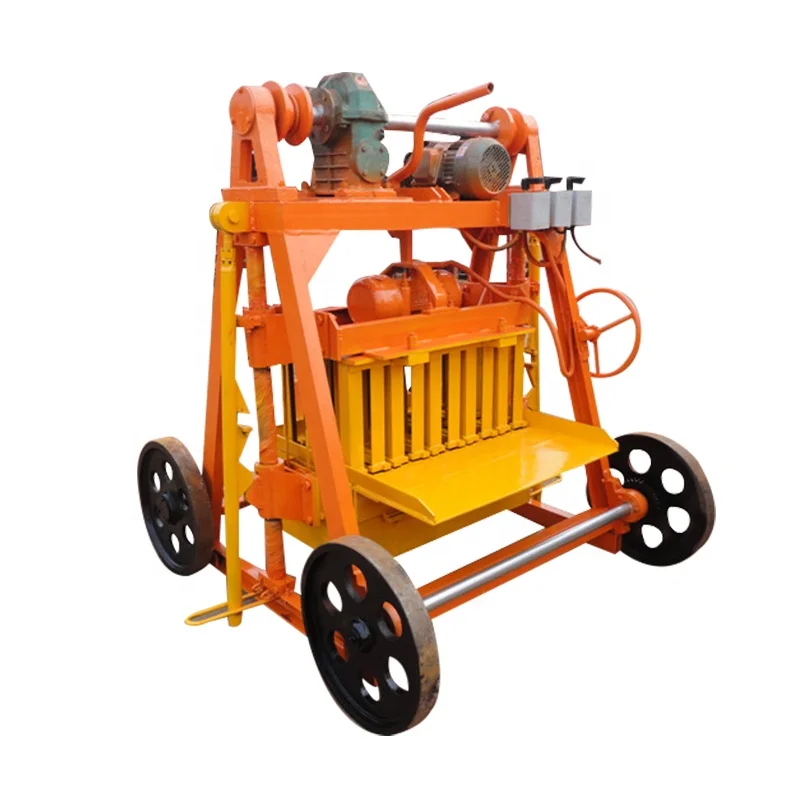
Complete Block Line Configuration — The QMJ4-45 mobile egg laying block machine production line integrates feeding, mixing, and curing handling as one matched system, preventing the press from waiting on upstream stations.
Technical Specifications
| Parameter | Value |
|---|---|
| Model | QMJ4-45 |
| Product Type | Mobile Egg Laying Block Making Machine |
| Mould Capacity | 4 pcs/mould (400×200×200mm hollow block) |
| Vibration Frequency | 2400 r/min |
| Moulding Cycle | 40–45 s |
| Output Capacity | 3000 pcs/day (basis: 400×200×200mm hollow block, 8-hour shift) |
| Output Capacity | 3500 pcs/day (basis: 400×150×200mm hollow block, 8-hour shift) |
| Output Capacity | 4500 pcs/day (basis: 400×120×200mm hollow block, 8-hour shift) |
| Moulding Method | Mold vibration |
| Demould Method | Manual |
| Turning Method | Manual |
| Total Power | 6 kW |
| Power Source | Diesel / Petrol engine |
| Automation Level | Manual operation, egg-laying |
| Pallet Requirement | None (blocks laid directly on ground) |
| Mould Format Options | 400×200×200mm / 400×150×200mm / 400×120×200mm hollow block |
| Control System | Manual mechanical operation |
| Warranty | One year |
Application Suitability
| Application | Material or Output |
|---|---|
| On-site hollow block production | Crushed stone, river sand, cement mix |
| Housing project temporary plants | Local aggregate with cement binder |
| Contractor self-supply block yards | Standard concrete hollow blocks |
| Rural block entrepreneurship | Cement, sand, and coarse aggregate blends |
Why "Daily Output" Figures Fail Without Line Context
A mobile block machine only produces as fast as the slowest upstream station allows.
Quoted daily capacity for the QMJ4-45 mobile egg laying block machine production line assumes continuous material feed, consistent mix arrival, and clear curing ground ahead of the machine. When the mixer cannot keep pace or the raw material pile runs dry mid-shift, actual throughput drops well below the stated figures. [NEED_CITE: production line bottleneck theory in small-scale block manufacturing] Buyers who treat the press as a standalone unit regularly discover that their real output reflects the weakest link in the entire workflow, not the cycle time printed on the spec sheet.
Feeding and Mixing Stations That Match the Press Cycle
The QMJ4-45 completes a moulding cycle every 40–45 seconds, meaning the mixer must deliver a fresh batch within that same window to avoid idle press time. A pan mixer or small drum mixer positioned within a wheelbarrow run of the machine keeps material flowing without overstocking wet mix that begins to set before moulding. This mobile egg laying block machine production line approach treats material delivery as part of the cycle, not an afterthought.
Curing Area Layout and Ground Preparation
Because the egg-laying method places blocks directly on the ground, the curing area must be level, compacted cement or hard-packed earth extending in rows that allow the machine to traverse and return without turning sharply. Each production run leaves blocks in a linear pattern, and the curing layout must account for the 400×200×200mm footprint plus walking space between rows. [NEED_CITE: curing ground preparation standards for egg-laying block machines] Without planned row spacing, blocks crowd together and forklift or hand-cart access becomes impossible during the collection phase.
Vibration Force and Mould Density Interaction
The 2400 r/min vibration frequency acts on the mould cavity to consolidate the mix around aggregate particles, and the twice-vibration molding core upgrade delivers a second compaction pulse that improves block density uniformity. On coarse volcanic aggregate or low-moisture mixes, the vibration duration may need extension to achieve full compaction. Matching vibration behaviour to the buyer’s actual mix design prevents weak blocks that crack during handling or fail compressive strength tests on site.
What Happens When Supporting Equipment Gets Left Out
Quotations that cover only the press leave buyers scrambling for mixers, wheelbarrows, and curing covers after arrival. Hand-mixing cannot sustain the 40–45 second cycle consistently, so the machine sits idle while workers prepare the next batch. Curing without ground sheets or water-spraying equipment leads to surface cracking in hot climates, producing blocks that must be discarded before sale. [NEED_CITE: common causes of block rejection in mobile production setups] These gaps turn a mobile egg laying block machine production line into a collection of disconnected tasks rather than a coordinated workflow.
Why the Line Matters More Than the Press Alone
The QMJ4-45 is specified alongside the mixer capacity, raw material feed method, and curing ground dimensions so that every station keeps pace with the press. Configuration is set against the buyer’s local aggregate and target block format rather than a catalogue default, ensuring vibration settings and cycle adjustments reflect real material behaviour. Mould design covers the hollow block sizes the buyer’s market actually purchases, and the manual operation level allows scaling to semi-automatic feeding as volume grows. Supporting equipment within the block line — from material feeding through curing rack handling — arrives as part of one matched system instead of separate purchases assembled on site. Installation includes operator training on mix consistency and cycle pacing so the crew understands how each station affects the next.
Documentation & Verification
- Line layout drawing showing mixer position, feed path, and curing row spacing for the QMJ4-45
- Capacity calculation sheet stating which hollow block format each daily output figure assumes
- Mould drawing and format list confirming included 400×200×200mm and optional sizes
- Operation and maintenance manual covering engine service intervals and vibration adjustment
- Factory test record on buyer’s specified aggregate before dispatch
- Wear parts list identifying mould liner and vibration components with part numbers
Installation, Commissioning & Support
- Level cement ground required for curing area with minimum dimensions based on daily row count
- Diesel or petrol engine eliminates grid dependency; fuel supply and storage planned on site
- Machine arrives assembled; operator checks vibration frequency and mould alignment before first run
- First-day production supervised to confirm mix consistency matches the 40–45 second cycle
- Mould change procedure trained for each hollow block format the buyer will produce
- Spare mould liners and vibration motor brushes included in the initial wear parts package
What We Need to Configure Your Line
To size the supporting stations around the QMJ4-45 mobile egg laying block machine production line, share your target hollow block format, the daily volume you plan to sustain, and a sample or description of your local aggregate. Let us know whether your site has existing mixing equipment and how much flat curing ground is available. This information determines mixer capacity, feed method, and curing layout so the line arrives balanced rather than improvised.
Frequently Asked Questions
Q: How is the daily output of 3000–4500 pcs verified, and which block format does each figure assume?
A: Each output figure ties to a specific hollow block size and an eight-hour shift. The 3000 pcs/day rating assumes 400×200×200mm blocks, 3500 assumes 400×150×200mm, and 4500 assumes 400×120×200mm. These figures hold when the mixer keeps pace and curing ground remains clear ahead of the machine.
Q: What supporting equipment is needed to complete the line around the QMJ4-45?
A: A pan or drum mixer sized to deliver fresh batch every 40–45 seconds, wheelbarrows or a belt conveyor for mix transport, and level cement curing ground with planned row spacing. Water-spraying equipment for curing and hand carts for block collection complete the workflow around the press.
Q: How does the egg-laying method affect curing area layout and block handling workflow?
A: Blocks are placed directly on the ground in linear rows as the machine moves forward. The curing area must extend in straight lines with walking space between rows for later collection. This eliminates pallet costs but demands more flat ground than pallet-based systems.
Q: Can the QMJ4-45 be upgraded with semi-automatic feeding as production scales?
A: The manual feed arrangement can be supplemented with a small belt conveyor or hopper feed system that delivers mix to the mould box without hand shovelling. This reduces cycle variation and operator fatigue while keeping the egg-laying and engine-driven design unchanged.
Q: What mould formats are available, and how long does a mould change take on this manual machine?
A: Standard formats include 400×200×200mm, 400×150×200mm, and 400×120×200mm hollow blocks. Mould change involves unbolting the current mould box, lifting it clear, and seating the replacement — a task completed within one shift once the operator is trained on the bolt pattern.


