
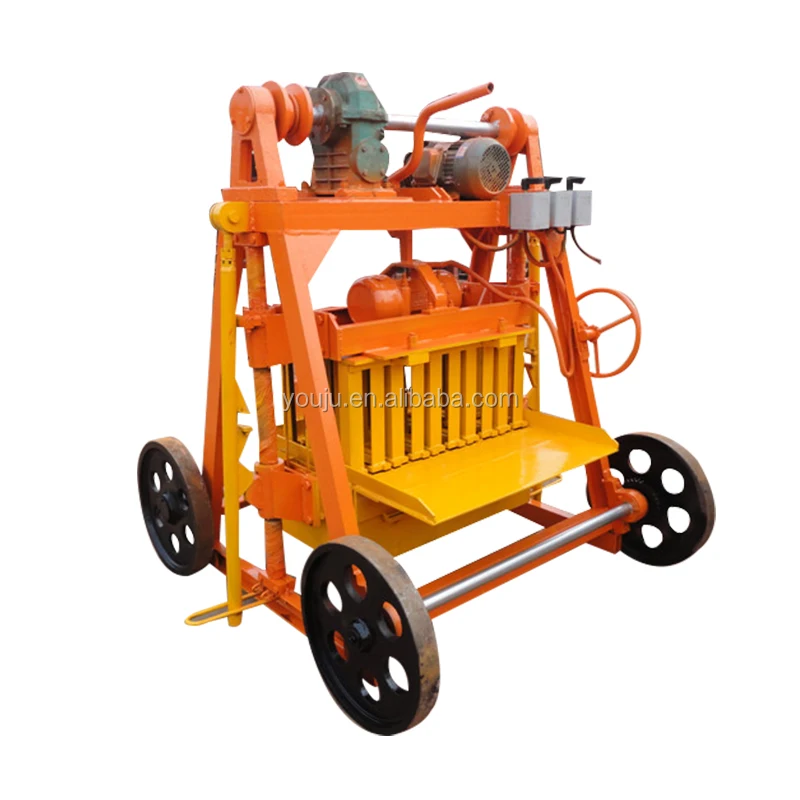
Single-Focus Block Line Design — every supporting station from mixer to curing area is sized around the QMJ4-45 egg-laying block machine so the press never waits for material or space.
Technical Specifications
| Parameter | Value |
|---|---|
| Product Type | Mobile Egg-Laying Block Making Machine |
| Model | QMJ4-45 |
| Molding Capacity | 4 pcs/mold (basis: 400×200×200mm hollow block) |
| Molding Cycle | 40–45 s (basis not stated in source — confirm block format / material / thickness) |
| Productivity (400×200×200mm hollow block) | 3,000 pcs/day (8-hour shift) |
| Productivity (400×150×200mm hollow block) | 3,500 pcs/day (8-hour shift, 5 pcs/mould) |
| Productivity (400×120×200mm hollow block) | 4,500 pcs/day (8-hour shift, 6 pcs/mould) |
| Vibration Frequency | 2,400 r/min |
| Vibration Method | Mold vibration |
| Demold Method | Manual |
| Turning Method | Manual |
| Total Power | 6 kW |
| Power Source | Diesel / Petrol engine |
| Pallet Requirement | None (egg-laying type — blocks laid directly on ground) |
| Automation Level | Manual operation |
| Block Density Feature | Twice-vibration molding core |
| Warranty | One year |
Application Suitability
| Application | Material or Output |
|---|---|
| On-site hollow block production for housing projects | Crushed stone, sand, cement, water |
| Remote development sites without grid power | Diesel-powered operation, no fixed plant needed |
| First-time block production with minimal infrastructure | Hollow blocks, multicellular bricks, standard bricks |
| Paving brick production on existing cement yards | Cement-aggregate mix, ground-level curing |
What a Mobile Block Machine Production Line Actually Requires on Site
The press itself is the easiest part — keeping material flowing to it and space available behind it is where most on-site lines stall.
When a contractor brings a mobile egg-laying machine to a housing project, the expectation is simple: produce blocks where they will be used, skip the fixed plant investment, and keep the masons supplied. What often happens instead is the mixer cannot keep up with the press cycle, the curing ground is too small so fresh blocks get stepped on, and the diesel engine sits idling while workers shovel aggregate by hand. The daily number then falls far below what was quoted. [NEED_CITE: typical material handling bottlenecks in mobile block production]
How the Egg-Laying Design Changes the Line Layout
An egg-laying block machine produces directly on the ground, which removes the pallet feeding station, pallet return conveyor, and pallet storage rack from the mobile block machine production line entirely. This simplification cuts the footprint and the number of components that can break down on a remote site. What it adds instead is a need for a large, flat, clean curing area directly behind the machine’s walking path. The operator lays a row, the machine moves forward, and the next row follows — so the curing ground must be long enough for a full shift of output before blocks can be moved.
Matching the Mixer to the Press Cycle
The QMJ4-45 completes a molding cycle every 40 to 45 seconds when producing the reference 400×200×200mm hollow block format. That means the upstream mixer must deliver a fresh batch of concrete to the hopper at least every few cycles, or the press sits idle. In the African field case I mentioned, the contractor paired the machine with a hand-fed drum mixer that took far longer per batch than the press consumed. The result was a machine spending half its shift waiting. A pan mixer or a larger-capacity drum mixer positioned within a few meters of the press, fed by a small loader or conveyor belt, keeps the cycle unbroken. [NEED_CITE: material feed rate requirements for continuous mobile block production]
Reading the Vibration and Power Specs for Real Output
The twice-vibration molding core applies two vibration phases per cycle, which compresses the aggregate mix more evenly than a single-vibration pass. At 2,400 r/min mold vibration, the frequency is adequate for hollow blocks in the 400mm length range, but the actual block density depends on how well the mix design matches the vibration force — too wet a mix collapses, too dry a mix leaves voids. The 6 kW total power rating driven by a diesel or petrol engine means the machine operates independently of grid supply, but fuel consumption and engine maintenance intervals must be factored into daily running cost. The manual demold and manual turning keep the machine mechanically simple, which matters when the nearest service workshop is hours away.
The Cost of Undersizing the Supporting Equipment
When the egg-laying block machine supporting equipment is not planned as a system, the consequences show up within the first week. A mixer that is too small forces the press into stop-start operation, doubling the shift time needed for the same output. A curing area that is too short means workers have to move blocks before they have set, causing corner damage and breakage. No ground leveling before production leads to uneven block bases, which masons reject on site. These are not machine faults — they are line planning gaps that turn a quoted capacity into a frustrating shortfall. [NEED_CITE: on-site curing area planning for egg-laying block machines]
Why Procurement Through a Line-Focused Supplier Matters
Block machinery as a single focus means the QMJ4-45 is specified alongside the mixer capacity, the curing ground dimensions, and the material feed method rather than sold as a standalone press. Configuration is set against the buyer’s actual mix design and local aggregate, not a catalogue default — the vibration force and mix moisture must work together for consistent block strength. Mould design and supply cover the hollow block formats the buyer’s market actually sells, including custom dimensions beyond the standard 400×200×200mm. Documentation includes a line layout with capacity calculation stated per block format, so the buyer sees the 3,000-piece figure tied to the 400×200×200mm assumption and the 8-hour shift, not a generic daily number. Automation level is selectable, so a buyer starting with manual operation can plan an upgrade path as volume grows.
Documentation & Verification
- Line layout drawing showing mixer position, press path, and curing area sized for your chosen block format
- Capacity calculation sheet stating output per block format with 8-hour shift assumption
- Mould drawing and format list confirming which hollow block dimensions the machine accepts
- Hydraulic and electrical schematic for on-site troubleshooting
- Engine specification sheet with fuel type, consumption rate, and service intervals
- Factory test record on your specified block format before dispatch
Installation, Commissioning & Support
- Flat, compacted ground area prepared to length based on daily output and block format chosen
- Diesel or petrol engine commissioned with local fuel type and ambient temperature confirmed
- Mixer positioned within reach of the QMJ4-45 hopper to maintain the 40–45 second cycle rhythm
- First-run block samples tested for density and compressive strength against project specification
- Operator training on manual demold, mold change, and daily vibration assembly inspection
- Wear parts list covering mold liners, vibration springs, and engine consumables for first-year stock
What to Include in Your Inquiry
To configure the mobile block machine production line around your site, share the hollow block dimensions your market requires, the daily volume you need to sustain, and whether grid power is available or diesel operation is mandatory. Provide the local aggregate type and cement grade so the mix design can be matched to the vibration settings. If you already own a mixer or loader, include its model and capacity so the upstream feed rate can be checked against the press cycle.
Frequently Asked Questions
Q: How is daily output calculated per block format, and what shift length is assumed?
A: The QMJ4-45 produces 3,000 pieces per 8-hour shift when making 400×200×200mm hollow blocks at 4 pieces per mold. For the 400×150×200mm format at 5 pieces per mold, the figure is 3,500 pieces, and for 400×120×200mm at 6 pieces per mold, it reaches 4,500 pieces. Each figure assumes an unbroken cycle with material always available.
Q: What curing area layout is needed when blocks are laid directly on the ground?
A: Because the egg-laying machine lays blocks in continuous rows on the ground, the curing area must be long enough to hold a full shift of output before blocks are moved. Ground must be flat, compacted, and clean. A typical layout leaves rows spaced for walking access during watering and curing over several days.
Q: How does the diesel or petrol engine option affect daily fuel cost and maintenance?
A: The 6 kW total power driven by a combustion engine removes the need for grid electricity, which suits remote sites. Fuel consumption depends on engine type and load cycle. Engine oil, air filter, and fuel filter follow standard small-engine service intervals, and spare filters should be stocked on site before the first production run.
Q: What upstream mixing and material feeding equipment keeps the machine running without idle time?
A: The press cycles every 40–45 seconds on the reference format, so the mixer must deliver a fresh batch within that window. A pan mixer or adequately sized drum mixer, fed by a small loader or belt conveyor, prevents the stop-start pattern that cuts real output in half on poorly planned sites.


