
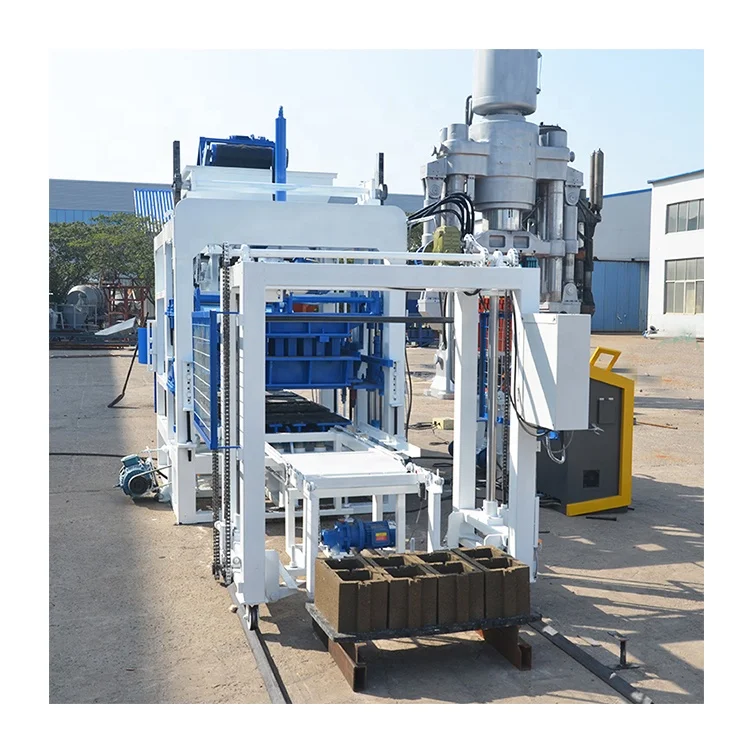
Matched Line Configuration — Every station from raw material feeding to cubed block exit is sized against the QT4-18 press cycle, so the press never idles waiting for upstream or downstream equipment.
Technical Specifications
| Parameter | Value |
|---|---|
| Model | QT4-18 |
| Product Type | Automatic Concrete Block Making Machine |
| Machine Power | 27.5 kW |
| Molding Cycle | 15-25 seconds |
| Hydraulic Pressure | 20 MPa |
| Machine Weight | 5800 kg |
| Overall Dimensions | 7100 × 1600 × 2610 mm |
| Main Vibration Form | Platform Vibration |
| Frame Construction | Welded thick steel rectangle section |
| Mould Treatment | Precise line cutting and carburizing heat treatment |
| Output Capacity | 5760-7680 pcs/day based on 400×200×200mm hollow block, 15-20s cycle |
| Output Capacity | 25200-33600 pcs/day based on 240×115×90mm porous block, 15-20s cycle |
| Output Capacity | 59300-67200 pcs/day based on 240×115×53mm standard block, 15-17s cycle |
| Voltage | Configured to buyer’s local voltage (basis not stated in source — confirm voltage/frequency) |
| Automation Level | Full automatic (confirm PLC model and stacking configuration) |
Application Suitability
| Application | Material or Output |
|---|---|
| Concrete hollow block production for masonry construction | Cement, crushed stone, sand, and water mix |
| Solid and porous brick production for building walls | Fly ash, slag, or natural sand blends |
| Paving brick and interlocking block for roads and landscapes | High-strength aggregate with color-face layering |
| Curb stone and hydraulic block for civil engineering | Coarse aggregate with high cement content |
| Color-face layered brick for architectural finishes | Dual-layer material feed with pigment dosing |
Why "Full Automatic" Means Nothing If the Line Stops at the Press
A stationary block making machine production line is only as fast as its slowest supporting station.
I once configured a block line where the press cycled every 18 seconds but the pallet feeder delivered every 24 seconds. The press spent six seconds per cycle waiting for a pallet. Over an eight-hour shift, that gap cost the buyer roughly 1,200 blocks of output they had budgeted for [NEED_CITE: typical output loss from unmatched station cycle times]. The quotation had listed a headline daily capacity without naming the format or explaining which stations were included. When the buyer received only the press with manual pallet handling, the real throughput fell far short of expectation. A complete stationary block making machine production line must specify every station — feeder, mixer, pallet return, stacker, and curing rack handler — with cycle times that interlock rather than overlap.
Station Synchronization Around the 15-25 Second Press Cycle
The QT4-18 molding cycle ranges from 15 to 25 seconds depending on block format and mix design. Upstream, the mixer batch size and discharge rate must deliver a fresh batch within this window so the hopper never runs dry mid-cycle. Downstream, the pallet feeder must index a new pallet into position before the press completes its compaction sequence. When the stationary block making machine production line is designed as one system, these intervals are calculated together rather than sourced from separate suppliers who each optimize for their own equipment.
Pallet Handling and Curing Rack Integration
Block output leaves the press on pallets that must travel through curing before the blocks can be stripped and the pallets returned. The pallet size chosen for this line must match both the press platen dimensions and the buyer’s existing curing area layout and forklift capacity [NEED_CITE: pallet standardization across block plant stations]. A pallet that is too wide for the curing racks forces the buyer to rebuild the rack system. A pallet material that warps under moisture exposure shortens pallet life and introduces block dimension drift. The pallet return conveyor and curing rack handler complete the loop so pallets cycle back to the press without manual intervention.
Reading the Specifications Beyond the Headline
The 20 MPa hydraulic pressure works in tandem with platform vibration to compact the mix into dense, dimensionally stable blocks. If the batching system delivers a mix that is too wet or too lean, neither pressure nor vibration can compensate, and block strength drops below specification. The welded thick steel rectangle frame absorbs vibration forces cycle after cycle; a lighter frame would transmit vibration into the foundation, accelerating wear on adjacent stations. Mould formats — from 400×200×200mm hollow blocks at four pieces per mould to 240×115×53mm standard blocks at 28 pieces per mould — determine not only daily output but also the pallet size, stacker gripper width, and curing rack slot spacing. Each format change ripples through the entire stationary block making machine production line, which is why the line must be configured for the specific formats the buyer’s market demands rather than a catalogue default.
The Cost of Treating the Press as a Standalone Purchase
When a buyer purchases only the press and sources supporting equipment locally, the interfaces become the problem. Pallet dimensions may not match the press platen, forcing custom adapter plates. The local mixer may batch too slowly, leaving the press idle between cycles. Voltage and frequency mismatches between the press motor and locally sourced conveyors can trip breakers during simultaneous startup [NEED_CITE: electrical load coordination in multi-station block lines]. These integration failures do not appear in any single supplier’s quotation but surface during commissioning, when the line fails to reach the output the buyer planned for.
Why Sourcing the Full Line from One Supplier Matters Here
Block machinery is the single focus of this supply operation, which means the press, mould, pallet, and handling equipment are specified as one matched system. The configuration is set against the buyer’s actual mix design and local aggregate, not a generic catalogue default. Mould design covers the formats the buyer’s market sells, including custom drawings for non-standard shapes. Automation level is selectable, so a buyer can start with semi-automatic pallet return and upgrade to full stacking and cubing without replacing the press. Installation support includes operator training so the crew understands how each station’s cycle time affects the next [NEED_CITE: block plant commissioning and operator training scope].
Documentation & Verification
- Line layout drawing showing every station with cycle time stated per block format
- Capacity calculation naming the exact block format assumed for daily output
- Pallet specification sheet matched to buyer’s curing area and forklift capacity
- Voltage, frequency, and PLC display language confirmation before production
- Factory test record on buyer’s target block format before dispatch
- Hydraulic and electrical schematic for local maintenance reference
Installation, Commissioning & Support
- Foundation plan sized for 5800 kg machine weight and 7100 × 1600 × 2610 mm footprint
- Dedicated power circuit for 27.5 kW total machine power at confirmed local voltage
- Pallet feeder and stacker aligned to press platen height during on-site assembly
- First-run molding cycle verification across all three mould formats
- Operator training on PLC controls with display language confirmed pre-production
- Wear parts list covering hydraulic seals and mould wear components for initial stock
What to Include in Your Line Inquiry
To configure a stationary block making machine production line around the QT4-18 press, provide the target block format and daily output, the local aggregate type and available cement grade, and the dimensions of your curing area. Confirm your site voltage, frequency, and preferred PLC display language. If you already own pallets or forklifts, send the pallet dimensions and forklift load capacity so the line is designed around your existing equipment rather than forcing a replacement.
Frequently Asked Questions
Q: What stations sit between raw material infeed and cured block exit on this line?
A: The line includes aggregate batching, mixing, material feeding to the press hopper, pallet feeding into the press, the QT4-18 compaction station, green block conveying, stacking or cubing, and curing rack loading. Each station’s cycle time is calculated against the 15-25 second press cycle so no station becomes a bottleneck. The layout drawing shows every station with its individual timing.
Q: How is pallet size chosen for this line?
A: Pallet size is matched to the press platen, the buyer’s curing rack slot dimensions, and the forklift fork width and load rating already on site. The material — typically bamboo, PVC, or steel — is selected based on local humidity and expected pallet lifespan. This avoids the common failure where pallets fit the press but cannot enter the curing racks.
Q: How does the mixer batch size align with the QT4-18 molding cycle?
A: The mixer is sized so one complete batch discharges into the press hopper within the 15-25 second press cycle window. If the mix design requires longer blending for the buyer’s local aggregate, a larger mixer or twin-shaft configuration is specified so the press never waits for material. Batch timing is confirmed during line commissioning.
Q: Can I start semi-automatic and upgrade the stacking station later?
A: Yes. The QT4-18 press interface remains the same whether pallets are returned manually or by automatic conveyor. The stacking and cubing station can be added later without modifying the press frame or hydraulic system. The initial line layout reserves floor space and electrical capacity for the future upgrade.
Q: What documentation confirms the daily output figure for my block format?
A: The capacity calculation document names the exact block format — for example, 400×200×200mm hollow blocks at four pieces per mould with a 15-20 second cycle — and states the resulting daily output. This prevents the common discrepancy where a headline output figure assumes a format the buyer does not produce.


