
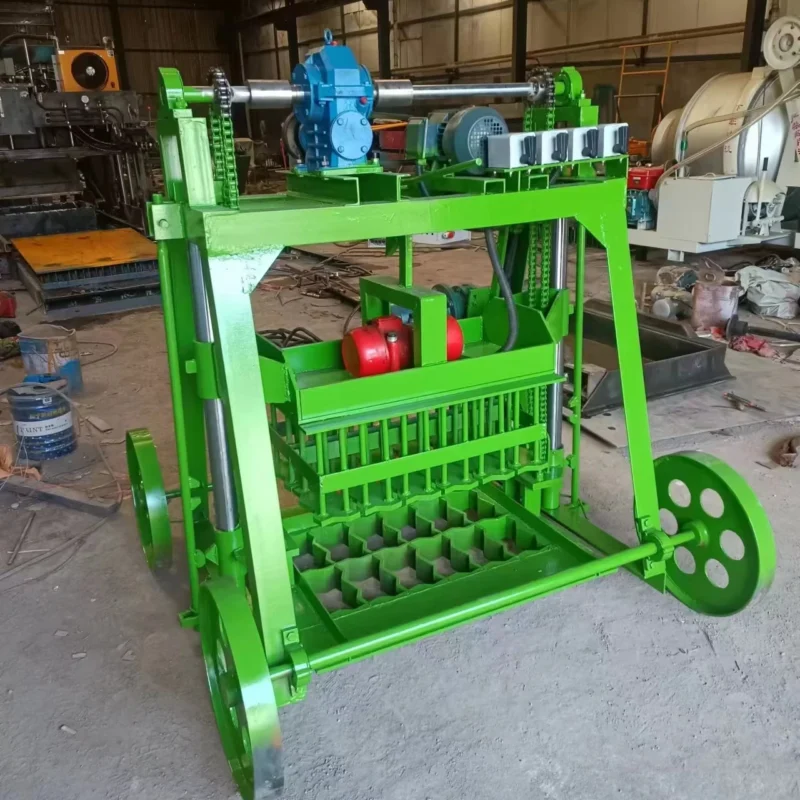
Press-to-line cycle matching — the QMJ4-45 mobile block machine is specified alongside its mixer, feeder and curing-area layout so no station idles while another catches up.
Technical Specifications
| Parameter | Value |
|---|---|
| Product Type | Hydraulic Mobile Block Making Machine |
| Model | QMJ4-45 |
| Machine Power | 7.4 kW |
| Molding Cycle | 45 s (basis not stated in source — confirm block format / material / thickness) |
| Output Capacity | 2,400 pcs / 8 h (based on 400×200×200 mm hollow block, 4 pcs/mould) |
| Output Capacity | 3,200 pcs / 8 h (based on 400×150×200 mm block, 5 pcs/mould) |
| Raw Materials | Concrete, sand, cement, fly ash, lime, gypsum |
| Machine Weight | 1 T (source value — verify against manufacturer catalog) |
| Overall Dimensions (L×W×H) | 1550 × 1335 × 1580 mm |
| Pallet Size | No pallets required (egg-laying type) |
| Voltage | Configured to buyer’s local voltage |
| Control System | Manual force control with jog control |
| Orientation Mechanism | Four-pole guided with extended orientation bearing |
| Automation Level | Semi-automatic |
| Block Formats Supported | Road blocks, curb stones, hollow bricks (via mould change) |
Application Suitability
| Application | Material or Output |
|---|---|
| On-site hollow block production for housing projects | Crushed stone, sand and cement fed from a pan mixer |
| Road block and kerbstone runs for municipal contractors | Local aggregate blended with fly ash or lime |
| First block plant for entrepreneurs with limited capital | Semi-automatic workflow from mixer to ground curing area |
| Format expansion for existing distributors | Mould change on the press matched to upstream batch adjustments |
What the Mixer Must Deliver Before the Press Cycles Again
A 45-second press cycle is only real if the upstream station can feed it without pause.
Buyers often see a mobile block making machine production line quoted at a single output number, only to discover on site that the mixer empties slower than the press consumes. I remember a job where a client paired a mobile block maker with an undersized pan mixer. The press sat idle for long stretches every hour, waiting for the next batch of concrete. Actual daily output fell well short of the quoted figure because the feeding station had not been matched to the press cycle. [NEED_CITE: mixer throughput matching press cycle time in concrete block production]
How the QMJ4-45 Sits Inside a Compact Line
The QMJ4-45 operates as the press station within a mobile block making machine production line that begins at raw material storage and ends at the curing ground. Because the machine lays blocks directly onto the ground — the egg-laying design — there is no pallet return loop to plan around. That removes an entire conveyor circuit and lets the line fit into a smaller site footprint.
The mixing station must deliver a fresh batch within the 45-second mould cycle so the press never waits. A correctly sized pan mixer placed within a short wheel-loader run keeps material flowing. The curing area must be levelled and marked in advance so the operator can move the machine forward after each drop without repositioning delays.
Matching Every Station to the Same Rhythm
Line planning means treating the mixer output rate, the press cycle and the curing-area turnover as one continuous chain. If any single station runs slower, the entire mobile block making machine production line slows to that pace. We calculate each station’s throughput against the block format the buyer actually intends to produce, not a catalogue peak.
Capacity for a 400×200×200 mm hollow block sits at 2,400 pieces per 8-hour shift, while a 400×150×200 mm format reaches 3,200 pieces per shift. Both figures assume the mixer keeps up and the curing ground is ready. When a buyer switches formats mid-shift, the mould change at the press and the mix adjustment upstream must happen together, or the line stalls again. [NEED_CITE: impact of format change on line throughput in mobile block production]
Reading the Specs That Shape Daily Output
The 7.4 kW motor rating sets the upper limit for vibration force and hydraulic pressure at the mould head. These two forces work together: vibration compacts the mix into the mould cavity while hydraulic pressure locks the density from above. If the local aggregate is coarser than the default assumption, the operator may need to adjust cycle timing to reach full compaction.
The four-pole guided orientation with extended bearings keeps the mould head aligned through every stroke. On an egg-laying machine that moves across a curing yard, consistent alignment means each block drops square and avoids corner damage that would otherwise increase scrap at the curing area.
Jog control keeps the operator count low at the press station itself. One person steers the machine while others handle mixing and stacking downstream. Because no pallets are involved, the labour that would normally manage pallet feeding and return is free to work at the mixer or curing ground.
Voltage must be confirmed before the line ships. A machine wired for one frequency running on another will cycle at the wrong speed, throwing off every timing assumption in the line layout.
The Cost of Skipping Line-Level Planning
When a buyer purchases the press alone and sources the mixer locally without checking batch delivery time, the line bottleneck shifts upstream. The press may be rated for a given output, but the actual count at the end of the day reflects the slowest station. Mould wear accelerates when the mix sits too long in the cavity before the next stroke, and inconsistent block density leads to rejections the curing crew discovers too late. [NEED_CITE: consequences of mismatched station cycle times in block production lines]
Why the Line Conversation Starts Here
Block machinery is our single focus, which means the QMJ4-45 is never quoted as a standalone press — it is specified as part of a matched system where mixer capacity, feeding rate and curing-area handling are verified before the order is placed. Configuration is set against the buyer’s actual mix design and local aggregate, not a catalogue default, so the output figures hold up on site.
Mould design covers every format the buyer’s market sells, with custom drawings available when standard shapes do not match local demand. The semi-automatic level lets a buyer start with minimal capital and add batching or stacking automation later without replacing the press. Installation support includes operator training at the buyer’s site so the crew understands how each station’s pace affects the whole line.
Documentation & Verification
- Line layout drawing showing mixer, feeder and QMJ4-45 press station with matched cycle times
- Capacity calculation sheet stating the block format assumed for each output figure
- Mould drawing and format list for every block type planned, including custom shapes
- Voltage, frequency and control language confirmation documented before shipment
- Factory test record on the buyer’s specified block format before dispatch
- Operation and maintenance manual covering jog control and four-pole bearing service
Installation, Commissioning & Support
- Levelled and compacted ground required across the curing area before the QMJ4-45 arrives on site
- Dedicated power circuit matching confirmed voltage and frequency for the 7.4 kW motor
- Machine shipped assembled; on-site setup limited to electrical connection and test run
- First-shift commissioning with cycle timing verified against the installed mixer batch rate
- Operator training on jog control, mould change procedure and four-pole alignment checks
- Wear parts list covering mould liners and hydraulic seals with recommended reorder intervals
What We Need to Scope Your Line
Share the block formats your market demands, the daily volume you need to hit and the raw materials available locally. Let us know your site’s voltage and frequency, the curing area you can allocate and whether you already have a mixer on site. With that information we can lay out each station and confirm that every part of the line keeps pace with the press.
Frequently Asked Questions
Q: How is output capacity verified per block format, and what happens when the format changes?
A: Each output figure is tied to a specific block size and mould cavity count. A 400×200×200 mm hollow block yields 2,400 pieces per 8-hour shift, while a 400×150×200 mm format yields 3,200. When you switch formats mid-shift, the mould change and the upstream mix adjustment must happen together to maintain line rhythm.
Q: Which supporting stations must match the press cycle so the line runs without bottlenecks?
A: The pan mixer is the most critical upstream station. It must deliver a full batch within the press mould cycle so the operator never waits. Downstream, the curing ground must be prepared in advance so the machine moves forward without delay after each drop.
Q: The QMJ4-45 requires no pallets — what does that mean for site layout?
A: The egg-laying design eliminates pallet feeding, return and storage entirely. Your curing area simply needs levelled ground marked in rows. This reduces forklift traffic and frees the labour that would otherwise handle pallet logistics for mixing or stacking roles.
Q: What electrical details need confirming before the line ships?
A: Voltage, frequency and control language must all be locked in before production. A mismatch on frequency changes motor speed, which shifts the mould cycle timing and breaks the station-to-station balance we planned during line layout.
Q: Can the line be expanded later without replacing the press?
A: Yes. The semi-automatic jog control setup allows you to add automatic batching or an upgraded mixing station later. The QMJ4-45 remains the press station; supporting equipment is added around it as your production volume grows.


